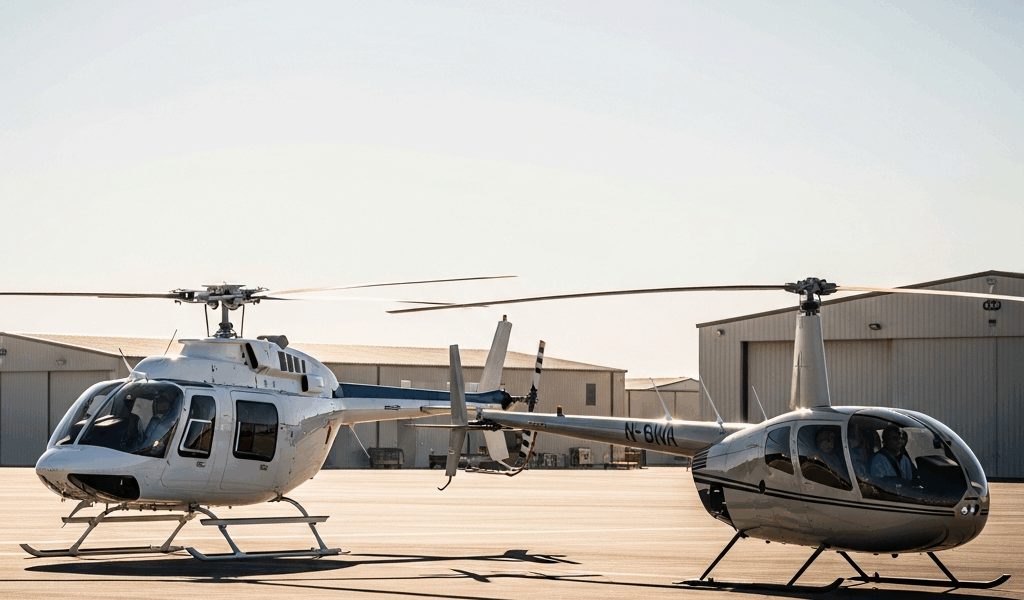
Two Very Different Helicopters Wearing the Same Turbine Badge
The Bell 407 vs Robinson R66 debate has gotten complicated with all the turbine upgrade noise flying around. Both run a single turboshaft engine. Both show up in training fleets, charter operations, and private hangars across the country. That’s roughly where the similarities end — and I mean that literally, not as a figure of speech.
The R66 is Robinson’s answer to the operator who wants turbine reliability without selling a kidney. The 407 is a professional-grade workhorse that costs about three times as much new and earns every dollar of that premium in useful load and operational muscle. Calling them direct competitors is a little like calling a Tacoma and an F-350 direct competitors. Same broad category. Completely different missions.
Specs That Actually Matter Side by Side
I’ll skip the FAA certification dates. Here’s what actually drives the buying conversation:
- Engine: R66 runs a Rolls-Royce RR300, rated at 300 shp. The 407 runs an Allison 250-C47B producing 813 shp. That’s not a rounding error — it’s a fundamentally different power class entirely.
- Max Gross Weight: R66 tops out at 2,700 lbs. The 407 sits at 6,000 lbs. Different league.
- Useful Load: R66 offers roughly 1,200 lbs depending on configuration. The 407 delivers around 2,500 lbs. This single difference defines who buys what.
- Seats: R66 seats five with the standard layout. The 407 seats six, in a wider cabin that actually feels like it seats six — not six sardines.
- Cruise Speed: Closer than you’d expect. R66 around 100–110 knots, 407 around 120–133 knots depending on conditions and loading.
- Range: R66 stretches to approximately 350 nautical miles on standard fuel. The 407 runs comparable range, but with far more payload flexibility across that distance.
- Service Ceiling: R66 at 14,000 feet. The 407 reaches 20,000 feet. High-altitude operations aren’t even a real conversation in the R66.
The useful load gap is the number to fixate on. Charter operators and utility crews aren’t buying extra load capacity to feel good about themselves — they’re buying revenue capacity. At full fuel, the R66 has you making payload trade-offs that a 407 operator genuinely never thinks about. That asymmetry shapes everything downstream.
What It Actually Costs to Own and Fly Each One
Probably should have opened with this section, honestly. For most people reading a comparison like this, the cost structure is the whole ballgame — everything else is secondary.
New purchase price: The Robinson R66 comes in around $1.07 million factory-new. The Bell 407 runs approximately $3.2 million new. That $2.1 million gap doesn’t close with clever financing. It defines the decision before you get to any other consideration.
Used market: Clean used R66s from the 2015–2019 vintage have been trading in the $600,000–$850,000 range depending on hours and configuration. Used 407s are harder to generalize — you’ll find everything from $1.4 million for an early-2000s airframe with serious hours to $2.5 million-plus for a low-time recent model. The 407 market is more fragmented, partly because the missions vary so dramatically from one operator to the next.
Hourly direct operating costs: The R66 gets quoted at $400–$600 per flight hour in direct costs — fuel, oil, and scheduled maintenance reserves included. The 407 runs meaningfully higher. Figure $700–$1,000 per hour as a working baseline for direct costs. Numbers shift with fuel prices and actual maintenance cycles, but the ratio holds fairly consistently.
Engine overhaul reserves: The RR300 on the R66 carries a 2,500-hour TBO and an overhaul cost in the neighborhood of $150,000–$200,000. Reserve roughly $60–$80 per hour against that. The Allison 250-C47B on the 407 has a 3,500-hour TBO — but the overhaul bill runs $350,000 or more. The per-hour reserve math isn’t dramatically different between the two machines, but the lump-sum exposure absolutely is. Don’t make my mistake and undermodel that number early in the planning process.
Insurance: Expect $25,000–$40,000 annually on an R66 with a commercial policy, depending on pilot experience and operation type. The 407 runs $45,000–$80,000 or higher for comparable coverage. Charter and utility ops add layers of complexity that push that figure around considerably.
One honest note on maintenance infrastructure — Bell’s service network is broader and more mature globally. Operating somewhere remote or internationally, finding a qualified 407 mechanic is meaningfully easier than tracking down someone current on R66-specific systems. Robinson has improved its support network in recent years, but Bell’s depth is a real operational advantage that never shows up on any spec sheet.
I’m apparently an optimistic utilization modeler, and projecting 600 hours annually to spread fixed costs works for my spreadsheets while reality never cooperates on schedule. Fixed costs don’t care about your projections. Model conservatively — then model even more conservatively than that.
Who Buys the R66 and Who Buys the 407
Surprised by how often these buyer profiles overlap in conversation but diverge completely in practice, I’ve started treating this as two genuinely separate markets wearing the same turbine label.
The R66 buyer usually falls into one of three buckets. First is the flight school that has maxed out its R44 fleet and wants to offer turbine time without a $3 million capital commitment per aircraft — the R66 makes that economics work, barely, but it works. Second is the private owner flying personal trips in the 150–300 mile range who wants turbine reliability and fuel efficiency without the operating complexity of a larger machine. The R66 burns roughly 25–30 gallons per hour versus an R44’s 16–18 gph, so it’s not cheap, but the reliability argument is genuinely real. Third is the budget-conscious commercial operator running tours or light utility work where payload limits aren’t a daily problem.
The 407 buyer looks different. Charter operators who need to put six adults and luggage in a helicopter and actually fly them somewhere useful — that’s a 407 mission. EMS operations run 407s. Utility and powerline patrol work runs 407s. Tour operators in Hawaii and at the Grand Canyon run 407s because load capacity and cycle durability matter at commercial utilization rates. The professional who looks at the 407’s acquisition cost and says “I need what this helicopter does, so I need to figure out the financing” — that’s your 407 buyer. They’re not buying performance as a luxury. They’re buying it as a job requirement. That’s what makes the 407 endearing to utility and charter operators who’ve tried to make smaller machines work.
So Which One Should You Actually Buy
Here’s the unhedged version.
Flight school operator, private turbine owner, or small commercial operation where payload limits won’t bite you regularly — the R66 is the right answer on economics. Full stop. Lower acquisition cost, lower hourly burn, and manageable overhaul reserves make turbine operations financially survivable at smaller scales. That’s not a small thing.
Running charter, utility, or tour operations where useful load and cycle durability are daily operational realities — the 407 justifies its price. The math works completely differently when empty seats and payload compromises cost you revenue on every single flight.
For most people reading this, the 407 is genuinely aspirational. The R66 is the realistic path into turbine operations that doesn’t require a fleet of investors or a large commercial contract just to stay solvent. No shame in that — the R66 is a legitimate turbine helicopter. Not a consolation prize. So, without further ado, go run the actual numbers for your specific operation before anyone sells you on either one.
Either way, both options beat explaining another magneto issue to your passengers at a fuel stop in the middle of nowhere — and that counts for more than people admit.


Stay in the loop
Get the latest aero weenie updates delivered to your inbox.