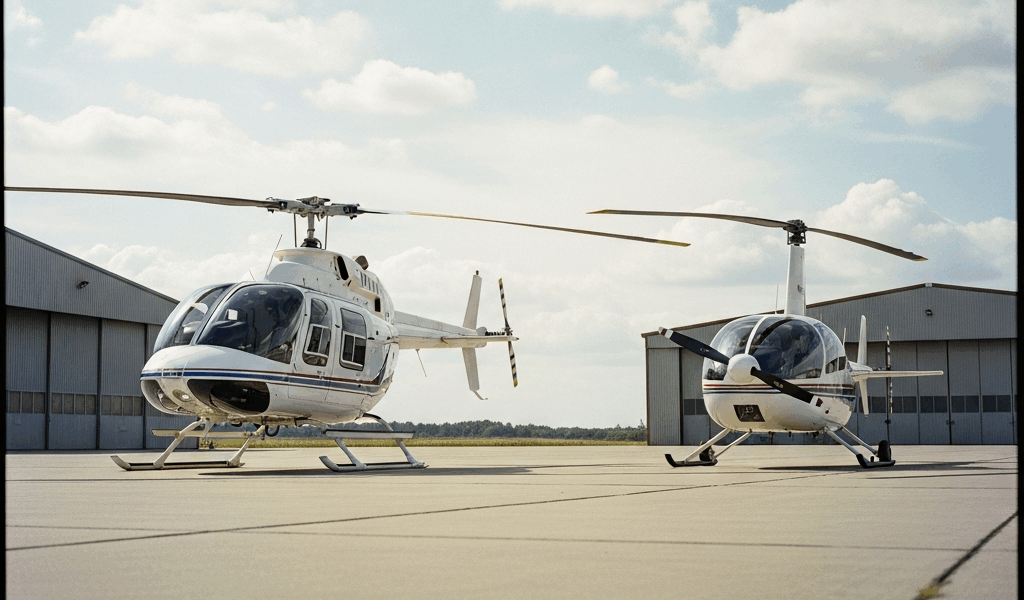
Why Are You Even Comparing These Two
The Robinson R44 vs Bell 505 debate has gotten complicated with all the spec-sheet noise flying around. First time someone put this question to me — standing in a hangar outside Centennial Airport, coffee going cold — I actually laughed. Then I spent the better part of a week thinking about it. These machines live in genuinely different categories. One is a piston four-seater that’s been the backbone of civilian rotary aviation for thirty-plus years. The other is an entry-level turbine Bell designed as a deliberate step up from exactly that world. So why do they keep landing on the same shortlist?
Budget reality, mostly. A buyer sitting somewhere between $700,000 and $1.2 million — with a real mission profile and enough hours to know what they actually need — will often look at both. A new R44 Raven II runs $380,000–$420,000 depending on configuration. A new Bell 505 Jet Ranger X is closer to $1.1–$1.2 million. But the used market is where things get interesting. A well-maintained 505 with reasonable hours and a recent overhaul starts appearing in the same neighborhood as a low-time, well-equipped R44. That’s where this comparison gets real.
As someone who has sat through this exact decision — and watched three other operators make it under pressure — I learned everything there is to know about where these two aircraft actually diverge. Today, I will share it all with you. Three types of people need this: the private owner-operator who wants honest cost math, the small flight school weighing a turbine addition, and the R22 or R44 pilot who’s turbine-curious and trying to figure out whether the 505 is a smart move or just an expensive one. I fell in love with a spec sheet once. Cost me months of recalibrating expectations. Don’t make my mistake.
Specs and Performance Where It Actually Matters
Filtered through real missions rather than manufacturer PDFs, here’s what separates these two.
| Specification | Robinson R44 Raven II | Bell 505 Jet Ranger X |
|---|---|---|
| Max Gross Weight | 2,500 lb (1,134 kg) | 3,600 lb (1,633 kg) |
| Useful Load (approx.) | ~850–900 lb | ~1,300–1,400 lb |
| Cruise Speed | ~109 ktas | ~125 ktas |
| Service Ceiling | 14,000 ft | 20,000 ft (certified) |
| Range | ~300 nm | ~350 nm |
| Engine | Lycoming IO-540, 245 hp | Arrius 2R turboshaft, 504 shp |
That useful load gap — roughly 450 to 500 pounds — is the number that rewrites actual mission planning. Put three adults with luggage in an R44 on a hot August afternoon at a mile-high airport and you’re doing weight calculations with genuine anxiety. The 505 just handles it. Hot-and-high margin isn’t marketing language on the Bell brochure. It’s the difference between a departure and a delay. Operating in Denver, Aspen, Telluride — anywhere with meaningful elevation — this becomes the deciding factor before you even crack the cost section.
Cruise speed matters less than most people think for sub-200nm legs. Sixteen knots separates these two aircraft. On a typical private flight, that’s maybe eight minutes. Not nothing. But not the argument it gets treated as at fly-ins.
True Ownership Costs — Annual and Per Hour
Probably should have opened with this section, honestly. Everything else is interesting. This is where decisions actually get made.
Fuel Burn
The R44 Raven II runs a Lycoming IO-540 burning roughly 15–16 gallons of 100LL per hour at cruise. At $6.50 per gallon — and it varies wildly by location, I’ve seen $5.80 in Texas and $8.40 in parts of New England — that’s around $100–$104 per hour in fuel. The Bell 505 burns approximately 30–32 gallons of Jet-A per hour. Jet-A typically runs cheaper per gallon, call it $5.50–$6.00, so you’re looking at $165–$192 per hour in fuel. The 505 burns more. The per-gallon gap softens it somewhat, but not entirely.
Engine Overhaul
The Lycoming IO-540 in the Raven II carries a TBO of 2,200 hours. Overhaul runs $30,000–$45,000 depending on condition and the shop doing the work. The Arrius 2R in the 505 has a TBO of 3,000 hours — but that overhaul is a different financial category entirely. Budget $150,000–$200,000 when that interval comes due. On a per-hour reserve basis: R44 engine sets aside roughly $16–$20 per hour, the 505 sets aside $50–$67 per hour. That gap compounds fast in any honest hourly cost model.
Insurance
Hull and liability for a private R44 owner with 500-plus hours typically runs $8,000–$14,000 annually — depends on use, location, and apparently which underwriter you catch on which day. I’m apparently a “favorable risk profile” and AVEMCO works for me while two other carriers never quoted me anything remotely competitive. The 505, with its higher hull value and turbine classification, tends to come in at $18,000–$30,000 for comparable coverage. Flight school operators should expect those numbers to climb considerably once student exposure enters the policy conversation.
Maintenance Network
Robinson’s service network is genuinely one of the best-distributed in civilian rotorcraft. Parts are available. Mechanics know the platform from Alaska to Australia. Robinson’s factory support out of Torrance, California is responsive — I’ve had parts questions answered same-day. The 505 is newer, smaller fleet, different picture. Finding a Bell-authorized turbine shop in a secondary market is a real logistics consideration. Not a dealbreaker. But something to verify before you buy, not after.
All-in: budget $200–$250 per hour total operating cost for a well-maintained R44. Budget $400–$500 per hour for the 505. Rough working numbers — verify them with your local operator or a CFI who has actual hours on both types before you build a business case around them.
Mission Fit — Who Should Buy Which One
Here’s the honest decision tree, without the diplomatic padding. So, without further ado, let’s dive in.
Buy the R44 if:
- Your operations run in flat, low-elevation terrain where the piston’s ceiling never becomes a real constraint
- You’re running a training program and need a platform with massive instructor availability, affordable parts, and handling characteristics that forgive student mistakes
- Your annual flight hours sit under 200 and lower total operating cost outweighs mission capability
- You’re in a market where Robinson service is strong and the nearest turbine shop is two states away
- Resale liquidity and predictable depreciation are genuine priorities — not just things you say they are
Buy the Bell 505 if:
- You regularly operate above 6,000 feet density altitude — non-negotiable, the 505 is simply a different aircraft in that environment
- You want turbine type time for career or credential reasons and want hours that translate forward to larger machines
- You have passengers or cargo requirements that stress the R44’s useful load on warm days — and “warm” in Denver means May through September
- Your budget supports the higher operating cost without squeezing safety reserves or maintenance intervals
- You’re building a premium charter or tour operation where the 505’s cabin quality and turbine credibility genuinely matter to the customers writing the checks
Stunned by how often buyers try to force the R44 into a high-altitude mission because the purchase price feels more comfortable. That’s the wrong call. The aircraft will technically fly. But every summer departure becomes a performance calculation that shouldn’t be anywhere near that close.
The Resale and Depreciation Reality
But what is R44 resale depth, really? In essence, it’s one of the most liquid positions you can hold in civilian rotorcraft. But it’s much more than that. Over 6,000 units delivered globally. Pricing is well-established, comps are easy to pull, and a well-maintained Raven II holds value in a reasonably predictable band. Buyers exist at every price point, in every market. Need to exit quickly because life changed — and life does change — the R44 is about as liquid as piston helicopters get. That’s what makes the R44 endearing to us private operators who value flexibility.
The Bell 505 tells a different story. Not a bad one. Different. The fleet is still young. Fewer comps, thinner used market, less pricing predictability — that cuts both ways. Buyers occasionally find deals because sellers can’t find comp support for their asking price. But your own exit may take longer or require more pricing flexibility than you’d expect coming from an R44 background. As the 505 fleet matures through its first and second major overhaul cycles, resale patterns will clarify. Right now you’re operating with less data than you’d want.
Check controller.com and rotor.trade for current asking prices on both models before making any assumptions based on sticker prices or what someone told you at a fly-in two years ago. Markets move. That number from 2022 is not this number.
The verdict isn’t complicated once you strip away the emotional attachment to either platform. Low-altitude operations, firm budget, strong local Robinson service, and a preference for simplicity with proven resale depth — the R44 is the right aircraft. Full stop, no shame in that. Regular altitude operations, turbine hours on your career radar, a payload requirement that stresses a piston on warm days, and a budget that supports the operating cost without cutting corners on maintenance — the 505 earns every dollar of its premium. The mistake isn’t picking one over the other. The mistake is picking the cheaper option for a mission it was never designed to handle well.



Stay in the loop
Get the latest aero weenie updates delivered to your inbox.