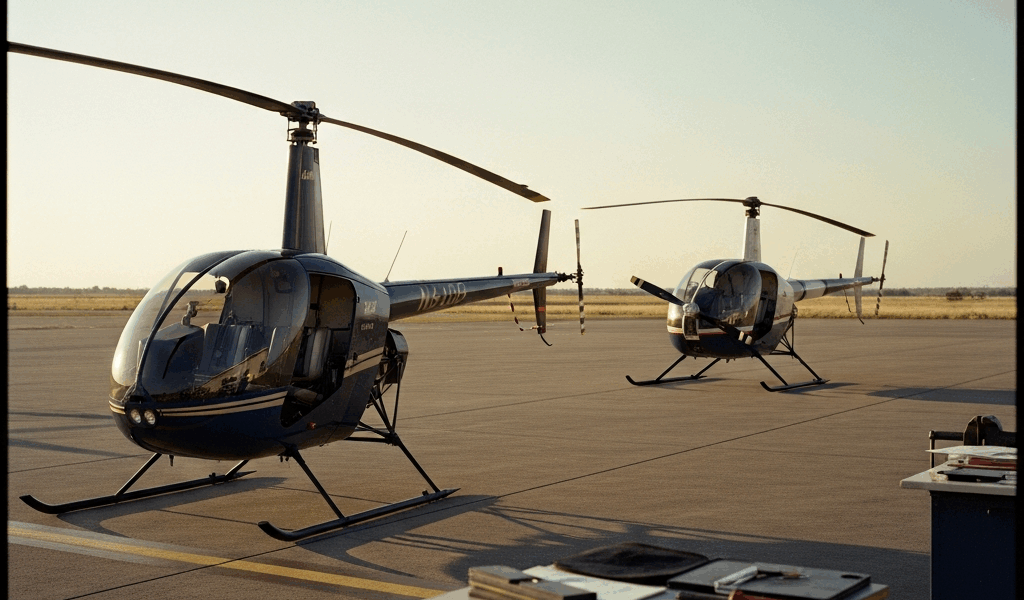
Robinson R22 vs Bell 47 — Which One Should You Train In
Why Anyone Is Still Asking This Question
The Robinson R22 vs Bell 47 debate has gotten complicated with all the nostalgia and strong opinions flying around. Which is genuinely strange, when you think about it — one of these aircraft first flew in 1945. The Bell 47 is old. Exposed rotor mechanics, a goldfish-bowl bubble canopy, skids that look like a welding project from someone’s backyard. And yet some Part 61 schools still run them. Some CFIIs swear by them. Students actively hunt them down. That tension between nostalgia and practicality deserves a real answer before you write a check for your first lesson.
The Robinson R22, introduced in 1979, became the dominant piston helicopter trainer for reasons that aren’t hard to see. Cheap to operate. Everywhere. Robinson built an entire ecosystem around keeping them airborne. But “dominant” doesn’t mean “universally beloved.” Talk to enough helicopter pilots and you’ll find a vocal contingent convinced that Bell 47 training produces better stick-and-rudder pilots. Whether that’s genuinely true or just nostalgia wearing a flight suit — that’s exactly what we’re going to settle here. So, without further ado, let’s dive in.
Real Costs Per Hour You Need to Know
Probably should have opened with this section, honestly. Cost is what actually drives most training decisions, regardless of what anyone says about philosophy or aircraft character.
Wet rental rates for a Robinson R22 Beta II at a typical Part 61 school run roughly $280 to $380 per hour — depending on your region and whether fuel is bundled in. Los Angeles, South Florida, you’re looking at the high end routinely. Dual instruction stacks another $60 to $90 per hour on top of that. The R22’s TBO sits at 2,200 hours. Factory overhauls from Robinson run $22,000 to $26,000, and the parts chain is genuinely solid. Robinson is still manufacturing R22s. You can get a starter, a tail rotor hub, a main rotor blade — shipped with reasonable lead times. That matters more than people realize when you’re mid-training.
Bell 47 economics are a different conversation entirely. Wet rental rates, where they even exist, tend to run $320 to $450 per hour. That surprises people who assume old equals cheap. It doesn’t. The Lycoming TVO-435 or VO-540 engines powering most flying Bell 47s carry TBOs between 1,200 and 1,400 hours — shorter than the R22, costlier to overhaul, and sourcing parts has become a genuine treasure hunt. Several components aren’t manufactured new anymore. Shops pull from old stock, cannibalize airframes, or fabricate with FAA DER approval. A Bell 47 sitting AOG for three weeks waiting on a tail rotor gearbox seal is not an unusual story. I’m apparently someone who asks too many maintenance questions at flight schools, and every Bell 47 operator I’ve spoken with had at least one version of that story.
- R22 Beta II wet rental — $280 to $380/hr typical
- Bell 47 wet rental — $320 to $450/hr where available
- R22 engine overhaul — $22,000 to $26,000 factory
- Bell 47 overhaul — higher cost, longer lead times, aging parts ecosystem
- R22 TBO — 2,200 hours
- Bell 47 TBO — 1,200 to 1,400 hours depending on engine variant
The school’s maintenance burden matters to you directly as a student — it affects availability. R22s fly more weekly hours at most schools. More availability means more scheduling flexibility and a faster path to your checkride. Don’t make my mistake of overlooking that detail until you’re waiting two weeks for a rescheduled lesson.
What Flying Each One Actually Feels Like
Humbled by my first hover attempt in a piston helicopter, I burned through nearly four hours just convincing the aircraft to stay within ten feet of where I wanted it. Both the R22 and Bell 47 will do that to you. Neither forgives inattention. But they do it differently — and that difference is worth understanding before you pick a school.
The Bell 47 has a reputation — earned, not mythologized — for extreme hover sensitivity. Two-blade semi-rigid rotor system, significant mechanical feedback through the cyclic, long exposed control runs with almost no damping between your hand and the rotor disk. Inputs feel immediate. Twitchy. Instructors who love training in the Bell 47 argue this forces students to develop genuinely light hands early on. One CFII put it plainly during a conversation at a fly-in: “If you can hover a 47, you can hover anything. If you can’t hover a 47, you’re going to know about it fast.” That’s what makes the Bell 47 endearing to us aviation history types — but it’s also a real training variable worth weighing.
The R22 is also twitchy — notoriously so — but in a more predictable way. Lighter than anything turbine, responsive, low-inertia rotor system that absolutely will not tolerate a wandering attention span in the hover. The difference is that the R22’s feedback loop is slightly more forgiving of the constant micro-corrections students make while learning. It punishes inattention. It doesn’t necessarily punish a student for simply being a student.
Autorotations feel different in each aircraft too. The Bell 47’s heavier rotor stores more inertia — some instructors genuinely prefer it for teaching power-off landings. The R22’s low-inertia rotor demands a faster entry. Miss the timing in an R22 auto and you’re behind the aircraft almost instantly. That’s a real training consideration, not a spec sheet footnote.
Safety Record and Training Suitability
But what is the R22’s actual safety story? In essence, it’s complicated — and it’s much more than the current snapshot suggests. The early record was genuinely bad. Through the 1980s and into the early 1990s, low-rotor-RPM accidents, mast bumping incidents, and pilot error crashes involving low-time pilots drew serious NTSB scrutiny. Robinson responded hard — mandatory safety courses, SFAR 73 requirements, Robinson Safety Course enrollment now baked into insurance requirements at most schools. The accident rate improved substantially. That’s 1987 versus now, and they are not the same picture.
The Bell 47’s training accident history is less documented in aggregate, partly because fewer are flying in formal training roles anymore. Accidents that did occur in training environments often involved wire strikes, low-altitude maneuvering, and hover sensitivity overwhelming students who got behind the aircraft and couldn’t recover. Neither machine is inherently dangerous when flown properly. Both will punish poor airmanship fast — with very little warning and no polite runway to sort things out on.
The honest answer is that the R22’s standardized training infrastructure — structured syllabi, SFAR 73, Robinson-approved school programs — makes it the more accountable training environment today. Frustrated by early accident trends, Robinson essentially built a training ecosystem from scratch around the R22 using mandatory courses, standardized checkride prep, and manufacturer oversight. This new approach took hold through the late 1990s and eventually evolved into the structured R22 training world instructors know and rely on today.
So Which One Should You Actually Train In
Here’s the direct answer most articles won’t give you. Train in the R22. For most students, in most locations, with most budgets — it’s the correct call. Parts are available. Schools are common. Instructors are standardized. Your rating transfers into a job market where R22 time is understood and respected. While you won’t need to obsess over every maintenance detail, you will need a school with reliable aircraft availability and a well-worn syllabus behind it.
The Bell 47 makes sense in exactly two scenarios. First — you’re a vintage enthusiast who genuinely values the experience of flying a classic machine and you have the budget for higher hourly costs and potential scheduling gaps. That’s a legitimate reason. Second — there’s an actual Part 61 school near you running Bell 47s with a solid maintenance program, an experienced CFII who knows the aircraft deeply, and you’ve personally verified the parts situation isn’t quietly a liability. That combination exists. It’s just rare.
What the Bell 47 is not is a budget option or a hidden gem other students are sleeping on. The mystique is real. The economics are not in your favor.
Train in the R22. Fly the Bell 47 later — at least if you want context for what helicopter pilots in 1962 were actually working with. You’ll appreciate both machines more that way. And you’ll already know how to fly.



Stay in the loop
Get the latest aero weenie updates delivered to your inbox.