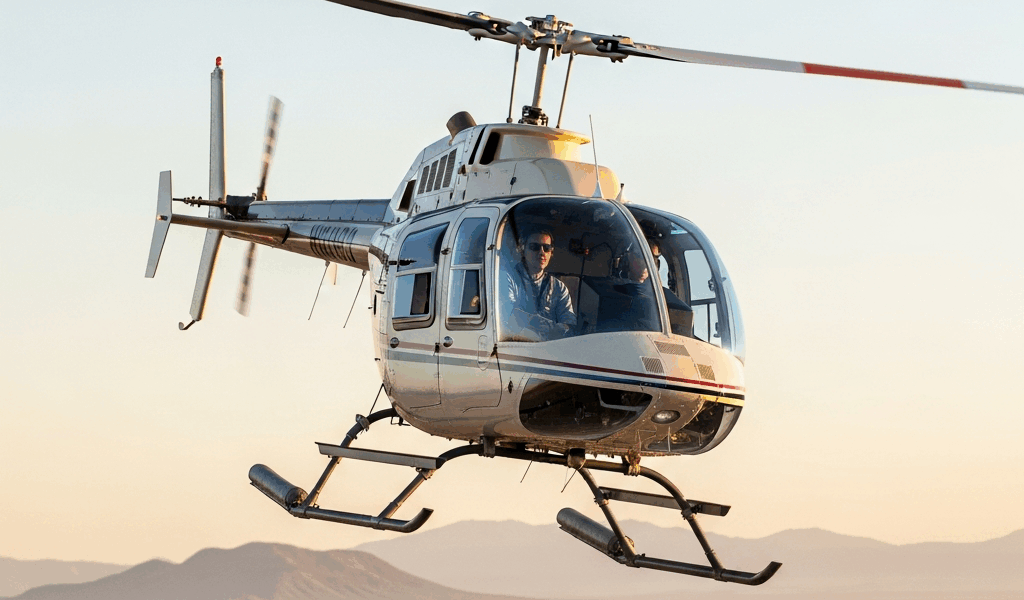
Why the 206 Engine Failure Catches Pilots Off Guard
Bell 206 JetRanger engine failure procedures have gotten complicated with all the generic emergency checklists flying around. Most of what you’ll find online applies to turbine helicopters broadly — not this airframe specifically. As someone who went through 206 transition training the hard way, I learned everything there is to know about what actually happens when an Allison 250-C20 decides it’s done working. Today, I will share it all with you.
But what is a 206 power loss, really? In essence, it’s a turbine spool-down event — not a sudden cutoff. But it’s much more than that. It’s a trap. The Allison 250-C20 doesn’t fail like a Lycoming O-360. Piston engines quit violently. Immediately. Your hands feel it before your brain registers it. Rotor RPM starts bleeding almost at once. A turbine failure in the 206 is something else entirely — the engine spools down over five to eight seconds, and if you’re not actively monitoring power, you’ll rationalize the early signs as an instrument glitch or a transient fault.
That spool-down lag kills people.
The 206 carries significant rotor inertia. When power drops, Nr doesn’t decay the same way a smaller piston bird’s would. This feels like a safety buffer. It isn’t. That inertia window fools pilots into believing they have more time than they do — sitting there thinking RPM at 95 percent means everything’s fine, when really the autorotation already started whether they admitted it or not.
Pilots coming from Robinson R22s, R44s, or piston Enstrom helicopters sometimes struggle most with this. In those ships, engine failure is unmistakable. Your hands and feet know in the first heartbeat. In the 206, the sensation is almost gentle. That gentleness is the real emergency. That’s what makes the 206 uniquely dangerous to pilots who think turbine experience alone prepares them for it.
The First Three Seconds Actually Matter
The moment the low rotor RPM horn fires — or you catch any power loss at all — everything changes. Those first three seconds decide whether this becomes a routine autorotation or a controlled crash.
Collective down. Immediately. Not tentatively. Not “let me confirm airspeed first.” Smooth but full — all the way down. Hesitation here bleeds rotor inertia faster than anything else you could do wrong. Without engine power, rotor inertia is your only remaining energy resource. Every second you delay lowering collective, you’re spending that energy trying to hold altitude — and you’ll lose the altitude anyway, just slower, arriving at your landing zone lower and faster with no good options left.
Lowering collective converts rotor speed and potential energy into forward airspeed. That’s the trade. The 206, being a relatively heavy single-engine turbine, needs that airspeed conversion — you can’t nose over and float down like a lighter ship would.
Rotor decay rate on a 206 runs roughly 15 to 20 RPM per second with collective held up. Get collective down promptly and you’ll hold between 80 and 95 percent Nr through most of your descent. That window — maybe 15 to 20 seconds of usable rotor speed — separates a landing from a wreck. Blow through it by hesitating on collective, and you’re fighting a dying rotor with no altitude to spare.
Cyclic comes next. Gentle forward pressure — nothing abrupt. The 206 rewards finesse more than most helicopters I’ve flown. Rough inputs destabilize the platform fast. Smooth pressure forward, establish a shallow descent, let airspeed build to roughly 60 knots — adjusted for loading and density altitude.
Tail rotor pedals stay neutral or slightly forward. This matters more in gusty conditions or with any sidewind component. A crosswind autorotation in a 206 requires active pedal work — anticipate heading changes as airspeed builds and relative wind angle shifts.
Autorotation Entry in the 206 Step by Step
Probably should have opened with this section, honestly — but the psychology piece matters as much as the mechanics.
Entry sequence starts with power confirmation. The moment you know power is actually gone — not “possibly gone,” but gone — you begin. The 206 gives you a second or two to rule out an instrument fault. Not much more.
Collective to the floor or close to it. Full down. Some pilots worry about rotor overspeed here. Don’t. The 206’s rotor governor manages Nr during autorotation. You cannot overspeed the system during a clean power-off descent.
Pitch attitude: 5 to 10 degrees nose-down depending on weight and loading. Too much pitch and you’re trading altitude for airspeed you don’t need. Too little and you’re not converting rotor energy efficiently. The altitude-airspeed energy relationship — the diagram concept every CFI draws on a whiteboard — becomes very real here. You have a finite energy budget. How you spend it determines where you land.
Airspeed target: 55 to 65 knots is ideal for most 206 configurations. Some pilots prefer running 70 to 75 knots for margin — I’m apparently more conservative than most, and the lower end works for me while the hotter numbers never felt right in this airframe. Don’t make my mistake of starting high and trying to bleed speed late. Higher airspeed demands a bigger flare to arrest descent before touchdown. Lower airspeed — 40 to 50 knots — stretches your glide but leaves you with less rotor RPM available for the flare. Pick your number and stay consistent.
Nose attitude gives you the visual reference. In a 206, you’re looking for a shallow 5 to 10 degrees below level flight. The cowling provides decent pitch cues once you know what you’re looking for. Too nose-high and airspeed won’t build. Too far down and you’re burning rotor energy you need at the landing zone.
Landing zone selection happens early — within your first 20 seconds. A field that looks marginal now will look terrible in 60 seconds. Prefer higher ground where possible — landing downslope wastes altitude. Clear of trees, power lines, obstacles. The 206 gives you roughly 3 to 4 nautical miles of glide from 2,000 feet AGL at moderate weight — but be honest about where that puts you before you commit.
What Goes Wrong and Where Pilots Mess Up
Late collective reduction tops every list. I’ve watched this on check rides and in recurrent training — pilot detects power loss, focuses on finding a landing zone, and subconsciously keeps collective raised because the instinct is “I need lift.” That’s backwards. Without power, collective raised creates drag and kills rotor speed. Lower collective aggressively the moment you accept the autorotation and everything becomes manageable. Keep it raised and nothing does.
Chasing airspeed is the second killer. You target 60 knots, winds shift or you’re on a slope, and suddenly you’re reading 70. Some pilots will raise collective or push nose further down to “correct” the number. Wrong move. Small deviations from target airspeed are fine — the energy cost of chasing a perfect number exceeds any benefit from holding it exact. Pick a target, aim loosely, accept minor variation.
Poor landing zone selection under pressure — I’ve done this myself. Rotor speed solid, Nr at 85 percent, and you’re thinking you’ve got time to reach that road another quarter mile out. You don’t. You’ve probably got 60 to 90 seconds total in autorotation and that time evaporates. Commit to a zone inside your first 20 seconds. Changes late in descent cost altitude and rotor energy you cannot recover.
Flare timing is where skill separates from luck. Too early — flaring at 100 feet — and you lose momentum without touching down, then drop hard from low altitude. Too late and you’re still descending when skids meet ground. The 206 flare window is maybe 30 to 50 feet. Transition to a shallow pitch-up, increase collective smoothly, coordinate pedals to hold heading. Zero vertical velocity at the moment your skids touch — that’s the goal.
One more thing. After power loss, the engine is not restarting mid-autorotation. Some pilots touch down and immediately start troubleshooting — if the Allison 250-C20 doesn’t spool within a few seconds, control deteriorates fast. Accept the autorotation early. Focus on the landing. Run your diagnostics after you’re on the ground.
Practicing This Before You Need It
The only good 206 engine failure is one you’ve already practiced. A lot.
While you won’t need a full aerobatic training program, you will need a handful of specific resources — starting with a 206-qualified CFI who knows this airframe specifically. Generic helicopter instructors don’t cut it here. You want someone who understands Allison 250-C20 characteristics, rotor inertia feel, and the landing zone geometry that’s specific to a JetRanger. Budget $300 to $450 per flight hour. That was closer to $275 when I started training in this type — those days are gone. It’s expensive. It’s also the cheapest insurance you’ll buy this year.
Power recovery autorotations should be in every training profile. Enter from 1,500 feet AGL, stabilize at 60 knots with solid rotor speed, recover to level flight with power. Do 10 of these and the actual emergency procedure starts feeling like muscle memory rather than memorized steps. First, you should run this drill in light loading conditions — at least if you want to establish baseline feel before adding weight and density altitude variables.
Practice entries from different configurations. External load, light and heavy, hot and high. Gusty conditions change the picture significantly. Knowing how your glide characteristics shift across those variables keeps you ahead of the emergency instead of reacting to it.
Currency matters more than most pilots admit. The FAA doesn’t require recurrent autorotation practice for Part 91 helicopter operations — which is honestly a gap in the regulations. Every 6 to 12 months, get back in the left seat with an instructor and run 5 to 10 power-off descents. Muscle memory fades faster than pilots expect. Judgment gets rusty quietly.
The 206 might be the best option for learning real autorotation discipline, as turbine transition training requires genuine respect for the airframe’s characteristics. That is because the spool-down failure mode punishes complacency in ways piston training simply doesn’t prepare you for. Respect the aircraft. Zero out the margin for error through preparation — and the engine failure becomes manageable. Skip the preparation, and the 206 will teach you the same lesson at a much higher cost.


Stay in the loop
Get the latest aero weenie updates delivered to your inbox.