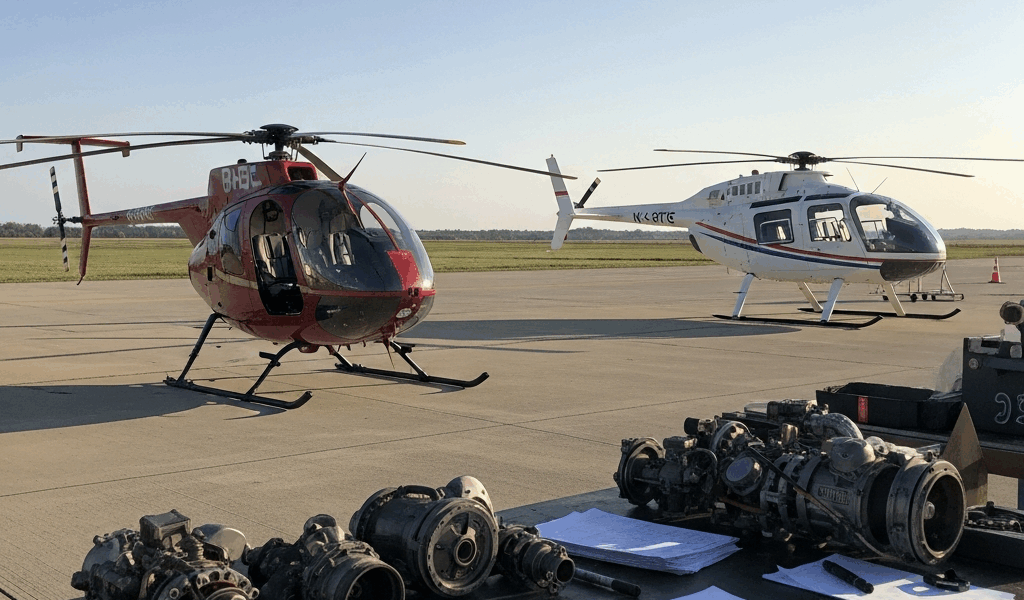
MD 500 vs Bell 206 JetRanger — Which One Wins
The Short Answer Nobody Wants to Hear
The MD 500 vs Bell 206 JetRanger debate has gotten complicated with all the forum noise and YouTube hot takes flying around. As someone who has spent years around both platforms — logging time in each and watching operators make expensive mistakes with both — I learned everything there is to know about what actually separates these two machines. Today, I will share it all with you.
There’s no trophy here. Genuinely. Both helicopters are excellent. Both are genuinely different. And both are the wrong choice for a surprising number of people who buy them for the wrong reasons. I’ve watched operators drop serious money on an MD 500 because it looks like a fighter jet’s little brother — then spend six months cursing parts lead times and wondering what went wrong. I’ve also watched Bell 206 guys haul it into mountain terrain it had absolutely no business being in, just because the seats were comfortable and the door looked impressive parked at the FBO. Don’t make my mistake. Figure out which buyer you actually are before you’re already committed.
So, without further ado, let’s dive in.
Performance and Handling — Feel vs Numbers
The MD 500E cruises around 140 knots true airspeed. The Bell 206B3 sits closer to 130. That ten-knot gap sounds modest on paper. It feels dramatic over mountain terrain when you’re fighting a headwind and watching your fuel gauge tick down.
Power-to-weight is where the MD 500 gets genuinely unfair. That little egg-shaped fuselage carries an Allison 250-C20B making roughly 420 shaft horsepower — and drags far less airframe around than the 206 does. Hover out of ground effect at density altitude is meaningfully better in the MD 500. Not a close call. I spent three summers watching MD 500s pick up loads at a remote construction site outside Glenwood Springs, Colorado — loads that would have required the Bell 206 to either dump fuel or leave a passenger standing at the bottom. The MD 500 just went and came back. Every time. That was worth something real, not theoretical.
The Bell 206B3 — also running the Allison 250-C20J in its variant — is smoother, quieter from the passenger seat, and handles more like a stable platform than an athletic one. IFR-capable 206 variants have a long documented record for a reason. It’s not exciting to fly. It’s confidence-inspiring to fly. That’s a different thing entirely, and honestly more valuable in commercial ops than exciting ever was.
The MD 500’s tail rotor deserves a straight mention here. NOTAR variants solve this completely, but most used 500s on the market run a conventional tail rotor — one with a well-known reputation for being snappy in certain crosswind and confined-area hover situations. It rewards pilots who stay ahead of it. It punishes pilots who treat it like a forgiving trainer. The 206 is more forgiving. Full stop.
Operating Costs — Where Your Wallet Actually Cries
Probably should have opened with this section, honestly. Performance debates are fun. Buying decisions are financial.
Direct operating costs on a Bell 206B3 typically land somewhere between $350 and $500 per flight hour — depending on your location, your maintenance shop, and how hard you’re running it. The Allison 250-C20J carries a TBO of around 3,500 hours on the engine, 3,000 hours on the compressor section depending on configuration. Overhaul runs roughly $80,000 to $110,000 at a reputable facility — Western Skyways, Turbine Engine Center, operators like that.
The MD 500E on the 250-C20B sits at a similar TBO range, and engine overhaul costs are comparable. Where things actually diverge is airframe parts, rotor system components, and global support infrastructure. Bell 206 parts exist everywhere. Jeppesen maintenance manuals are straightforward. A part you need at 10 PM in a remote location has a real chance of arriving from a regional distributor by morning. The MD 500 supply chain is noticeably thinner outside major markets. Sourcing a tail rotor component or a specific dynamic part can mean waiting — and AOG time is not an accounting line item anyone enjoys explaining to a client.
Fuel burn is close enough to be almost irrelevant as a deciding factor. Both helicopters burn roughly 25 to 30 gallons per hour at cruise, with the MD 500 slightly more efficient at lower gross weights. I’m apparently running tighter margins than most operators, and fuel cost still never cracked my top three concerns. If it’s yours, that conversation probably starts somewhere before turbine helicopters.
Mission Fit — What Are You Actually Doing With This Thing
This is where the decision gets made for people who think clearly about it.
But what is the MD 500, really? In essence, it’s a compact, high-performance utility platform. But it’s much more than that — it’s purpose-built for work that demands maneuverability, a small footprint, and aggressive power-to-weight numbers. Law enforcement agencies have run 500s for decades for exactly this reason. Tight urban environments, hard acceleration, spaces the 206 simply cannot touch. Agricultural and utility operators love the MD 500 for the same reasons. Confined-area landings are where this helicopter earns its cost premium in the right markets. Training operations that prioritize teaching actual rotor-craft coordination — rather than comfortable system automation — often choose the MD 500 precisely because it demands more from students. That’s a feature, not a bug, for the right school.
That’s what makes the MD 500 endearing to us utility operators.
The Bell 206 dominates tour operations, EMS support roles, executive transport, and offshore utility work. The payload difference is real — the 206B3 carries around 1,600 pounds useful load against the MD 500E’s roughly 1,400 pounds. But the more meaningful difference in tour and charter work is the cabin. Four adults fit in a 206 with luggage without anyone requiring a motivational speech. The doors are proper doors. The windows are large. A passenger spending $400 on a Grand Canyon tour does not want to feel like they climbed into a sports car helmet. They want to feel like they’re in a helicopter — and to them, the Bell 206 looks like a helicopter. That perception gap has a real dollar value in charter markets. I’ve seen operators lose repeat bookings over it.
So Which One Should You Buy
While you won’t need to have flown both platforms extensively to make this call, you will need a handful of honest answers about your actual mission, your maintenance infrastructure, and your client base. Here’s the breakdown without hedging:
- Buy the MD 500 if you’re operating in high-density altitude environments, running utility or agricultural contracts, need genuine confined-area capability, or are building a training program that prioritizes handling precision over passenger comfort. Also buy it if your maintenance base is already established and your parts relationships are solid — at least if you want to avoid the AOG surprises I didn’t see coming.
- Buy the Bell 206 if you’re running tours, charter, EMS, or offshore work. Buy it if you operate internationally or anywhere your nearest turbine shop is not a short drive. Buy it if your clients are paying passengers who quietly associate the aircraft’s appearance with their own safety. Buy it if you want your A&P to source a part at 11 PM without calling in a personal favor.
- Buy the MD 500 with NOTAR if you have the budget and the confined-area mission — the noise profile and torque behavior change the mission envelope in ways that matter operationally, not just on spec sheets.
- Buy a used 206L LongRanger if you’ve been reading this whole article thinking “I just need more seats.” That’s a different article. But the answer is probably waiting for you there.
Frustrated by a hasty decision on my first turbine transition — where I underestimated parts logistics by roughly 100%, using nothing but optimism and a spreadsheet I now cringe at — I learned that acquisition cost is about 20% of the real conversation. The other 80% is what the aircraft costs you when it’s sitting on the ground waiting for a part, and what it costs you when the mission doesn’t match the machine.
Both helicopters are icons. Both earned their reputations through decades of hard use in serious conditions. The MD 500 is faster, more athletic, and more demanding. The Bell 206 is more comfortable, better supported, and more forgiving. Neither choice is wrong. Both choices still require explaining to your accountant why you absolutely needed a turbine helicopter — and for that particular conversation, no amount of performance data is going to help you.



Stay in the loop
Get the latest aero weenie updates delivered to your inbox.