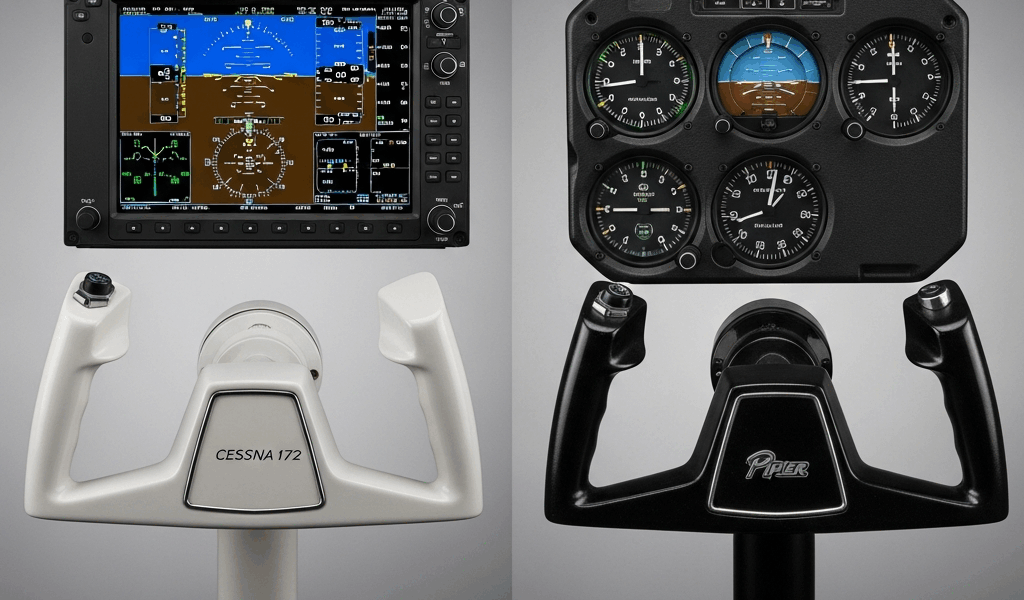
Cessna 172 vs Piper Cherokee — Which Trainer Is Actually Better?
The Cessna 172 vs Piper Cherokee debate has gotten complicated with all the hot takes and forum arguments flying around. I’ve been in the middle of it for years — roughly 3,000 dual instruction hours split between both aircraft — and my opinion probably isn’t what you’re expecting. It took me four years at a Part 141 school running a mixed fleet to form it. Six 172SPs on one side of the ramp, four Cherokee 140s on the other, and me grabbing whichever keys were hanging on the board that morning. That accidental arrangement turned out to be one of the better educations I got as a CFI.
The answer depends almost entirely on where you are in training. And what kind of pilot you actually want to become.
High Wing vs Low Wing — More Than Visibility
Most comparisons lead with visibility, drop a few bullet points, and call it done. That undersells how much wing position shapes those early hours in ways students don’t even realize are happening.
The 172’s high wing gives you a clean, unobstructed look at the ground directly below — which sounds minor until you’re teaching someone to track a road, identify a landmark, or figure out where the runway threshold is developing on a pattern entry at an unfamiliar field. I’ve watched low-wing students miss the turn to final because they genuinely couldn’t see what was beneath them. The high wing also shades the cockpit. That’s not a creature comfort — a student in Texas in July who isn’t squinting through afternoon glare is actually scanning instruments instead of fighting the sun. Small thing. Adds up.
The Cherokee flips that advantage in specific moments. In a left-hand traffic pattern, the low wing drops away from the runway during base-to-final — instead of obscuring the threshold, it gets out of your way. More importantly, the Cherokee sits lower. Wider effective stance, lower center of gravity — on a gusty day, students tend to hold centerline better through rollout. Not because they’re more skilled. Because the airplane is more forgiving of small side-load errors at touchdown.
Preflight is where the high wing wins cleanly. Fuel check on a 172 — stand on the ground, open the cap, use a $4 plastic tester. Done in 30 seconds. The Cherokee’s tanks sit lower in the wings, sure, but confirming fuel levels correctly takes more practice than it looks. The geometry is less intuitive. First solo preflight in a Cherokee, I had more than one student walk away without checking the left wing entirely. Don’t make my mistake — if you’re instructing in Cherokees, brief that specific step twice.
- 172 high wing — better ground visibility, natural cockpit shading, simpler fuel preflight
- Cherokee low wing — better visibility in banked turns, steadier crosswind handling, lower center of gravity feel on rollout
- Neither is categorically safer — they’re just differently demanding
Fuel Systems — The Difference Students Notice First
Probably should have opened with this section, honestly. Of everything separating these two airplanes in a training environment, the fuel system gap is the most practically significant — and most written comparisons skim right past why it matters.
The 172 runs gravity-fed. Selector has three positions: LEFT, RIGHT, BOTH. Set it to BOTH before engine start. Leave it alone. It is genuinely one of the last things you think about in the cockpit during a lesson.
The Cherokee requires manual tank switching — take off on one tank, fly roughly 30 minutes, switch, fly another 30, switch back. The checklist item is real. The timer discipline is real. And forgetting it has consequences that aren’t immediately obvious. Fuel starvation — not exhaustion — is a documented accident cause in PA-28-series aircraft. There’s fuel on board. It’s just sitting in the tank you forgot to switch to while the engine flames out. That distinction matters more than most students realize when they first read about it.
I had a student — 1970 PA-28-140, tail number Six-Four November, second lesson at a Class D airport — get deep into a radio call and miss the tank switch by 12 minutes. Engine kept running. We caught it. But that moment illustrated exactly why adding a 30-minute timer to a student who’s already juggling airspeed, altitude, heading, traffic scan, and a nervous CFI is a bigger ask than it appears in a ground briefing.
The counterargument is legitimate — Cherokee pilots who build the tank-switching habit early are ahead of the curve in complex aircraft. King Airs have fuel management procedures. Piper Seminoles have them. That’s true. But for a student in their first 20 hours trying to survive a stage check, it’s one more failure mode during a phase when failure modes should be minimized.
172 wins this round for beginners. Cherokee wins long-term if you’re thinking about where training leads.
Landing Characteristics
This is where it gets interesting. I came up in 172s and initially thought the Cherokee just felt different on landing. After about 400 hours of dual given in Cherokees, I think it’s actually harder to land well — in a way that’s genuinely useful.
The 172 floats. Every pilot uses that word, and it’s accurate. In ground effect, on speed at around 65 knots, a properly configured 172 will want to stay airborne longer than you expect — especially in warm conditions with a light headwind. For students, that’s forgiving. Crossed the threshold a little fast? The airplane gives you time to catch up. The flare is gradual, the sink rate is gentle, and a passable landing is achievable even with speed errors that would bite you elsewhere.
The Cherokee sits down more decisively — shorter fuselage, different wing loading, different energy behavior. Arrive 5 knots fast over the threshold and you feel it. Arrive 5 knots slow and it drops sooner than you planned. The margin is tighter, and the airplane communicates that clearly. Sometimes loudly.
What I noticed across both fleets: my 172 students could solo earlier in terms of landing consistency. My Cherokee students landed more precisely once they figured it out. The Cherokee essentially demanded good technique. The 172 allowed survival technique. Students who trained exclusively in 172s and then transitioned to retractable-gear aircraft sometimes struggled more than their logbook hours suggested — the Cherokee-trained pilots had already internalized arriving on speed, on glidepath, every time, because the airplane punished them when they didn’t.
The Cherokee builds better pilots in the long run. The 172’s forgiveness keeps students from quitting during the most fragile phase of training. Both things are true simultaneously — that’s what makes this debate endearing to us instructors who’ve watched it play out across hundreds of first solos.
The Verdict — Which to Train In
Clear answer, with conditions.
If you have access to both aircraft, the best sequence I’ve ever seen produce good pilots is this: start in the 172 for the first 10 to 15 hours, then transition to the Cherokee for the remainder of your private training. Use the 172’s forgiving ground effect to build basic landing confidence before the self-doubt sets in. Use the simple fuel system to keep your mental load manageable while you’re learning to hold altitude and work the radio at the same time. Then move to the Cherokee before your habits calcify. Let the more demanding airplane tighten your energy management, your tank discipline, and your approach precision.
That sequence produced the best pilots I’ve seen come out of primary training — not a common school structure, but if you’re comparing two schools and one offers both aircraft in sequence, that’s a real differentiator worth asking about.
If you’re stuck with one airplane, here’s how to think about it:
- Pure beginner, no prior aviation experience, first 40 hours: Train in the 172. The lower barrier to an acceptable landing, the simpler fuel system, and the forgiving handling reduce early frustration. Frustration is the number one reason student pilots quit before soloing — the 172 removes obstacles instead of creating them.
- Motivated student who wants to be better than average: Train in the Cherokee. Accept that landings will feel inconsistent longer than they would in a 172. The airplane is teaching you something every time it punishes a speed error — and that lesson doesn’t need to be relearned when you step up to something faster and heavier.
- Student planning a professional flying career: Get Cherokee hours whenever possible. The fuel management habit, the precision approach discipline, the experience transitioning between wing configurations — all of it pays dividends. Airline training departments don’t care much which airplane you started in, but your checkride performance in complex aircraft will reflect how precisely you flew your trainer.
One last honest note: the airplane matters less than the instructor, and less than how often you fly. A student flying twice a week in a 172 will outpace a student flying once a month in a Cherokee — every single time, no contest. This debate is worth having. I just spent 1,500 words on it. But showing up consistently and flying with someone who can actually teach is the variable that determines how this ends for you.
Both airplanes have made excellent pilots for over 60 years. The 172 is easier. The Cherokee makes you work. Pick based on where you are in training — not based on which one looks better sitting on the ramp.
The Cessna and Cherokee are not the only training choices. Our Diamond DA40 guide explains the NG/XLT distinction, glass-cockpit training, visibility and ownership tradeoffs.


Stay in the loop
Get the latest aero weenie updates delivered to your inbox.