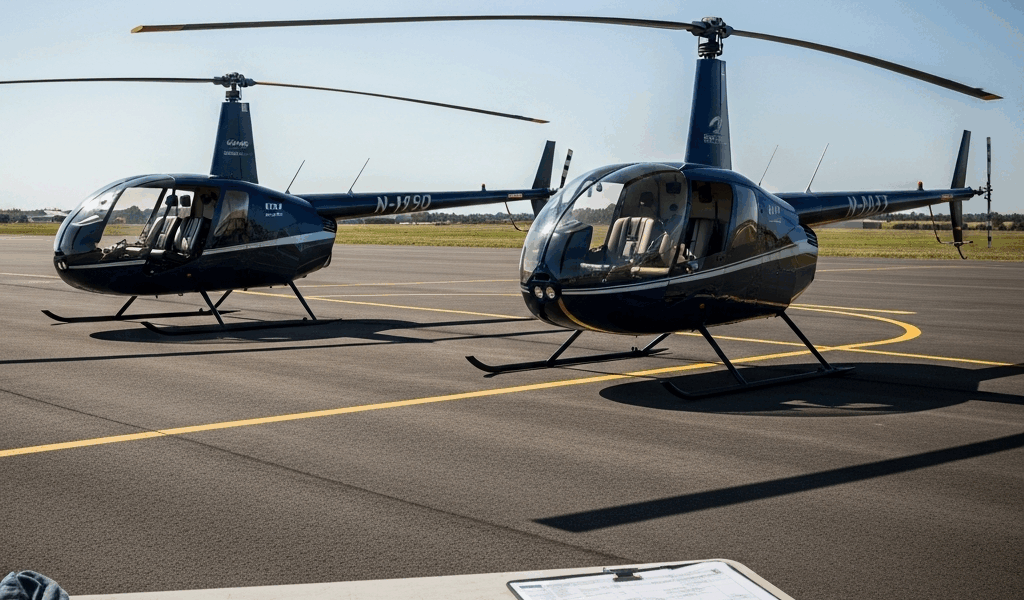
Robinson R44 vs Schweizer 300 — Which One Is Worth It
What You Are Actually Choosing Between
The Robinson R44 vs Schweizer 300 debate has gotten complicated with all the forum noise and manufacturer cheerleading flying around. As someone who has logged hours in both machines and watched pilots agonize over this exact decision at fly-ins across the country, I learned everything there is to know about what these helicopters actually cost and what they actually teach you. Today, I will share it all with you.
The R44 is the dominant piston helicopter in private ownership and flight school fleets — full stop. The Schweizer 300C and 300CBi are the scrappy holdovers with a cult following among CFIs who believe suffering builds character. Both are piston. Both are trainer-capable. Both will eat your wallet in ways you genuinely did not anticipate when you signed the paperwork.
The typical buyer here is one of three people: a student trying to pick a school, a private buyer shopping their first helicopter, or a small operator running fleet numbers. No cheerleading. No forum wars. Just what the machines cost and what they teach.
Performance and Flying Feel — Side by Side
The performance gap is real. It matters. But what each helicopter actually feels like to fly — that’s where things get interesting.
| Spec | Robinson R44 Raven II | Schweizer 300CBi |
|---|---|---|
| Cruise Speed | ~110 knots | ~85 knots |
| Useful Load | ~1,100 lbs | ~600 lbs |
| Hover Ceiling (IGE) | ~9,000 ft (Raven II) | ~6,400 ft |
| Fuel Capacity | 29.5 gallons usable | 22 gallons usable |
| Engine | Lycoming IO-540, 245 HP | Lycoming HIO-360, 190 HP |
The R44 is faster, carries more, and goes higher. On a cross-country you feel that 25-knot cruise advantage somewhere around hour two. Three adults and luggage? The R44 handles it without drama. The 300CBi is a two-seat machine in any honest real-world configuration — that third seat exists mostly on paper once you load full fuel and a human instructor with a flight bag.
But what is the Schweizer 300 really offering, then? In essence, it’s a precision-demanding machine that forces competence rather than rewarding passable inputs. But it’s much more than that. The tail rotor authority feels immediate in a way that surprises people. Autorotations in the 300 are genuinely different — lower inertia, faster energy bleed, tighter timing windows. Some CFIs swear it builds better fundamentals precisely because it doesn’t forgive sloppiness. The R44 is more stable, more forgiving, easier to look competent in on day three. Whether that’s a feature or a bug depends entirely on your goals.
In the pattern, the R44 feels like a proper aircraft. The 300 feels like a very serious toy. Both descriptions are meant as compliments. That’s what makes each of them endearing to us rotorhead types.
Real Operating Costs Per Hour
Probably should have opened with this section, honestly. This is what actually determines which machine you can afford to keep flying six months after the purchase high wears off. So, without further ado, let’s dive in.
Fuel Burn
The R44 Raven II burns around 14–16 gallons per hour at cruise. Avgas at $6.50/gallon — pretty standard across most U.S. markets right now — puts you at roughly $91–$104/hour in fuel alone. The 300CBi burns 10–12 GPH. Call it $65–$78/hour. That delta compounds fast over a full year of flying. We’re talking $1,500–$2,000 in annual fuel savings at moderate utilization, just from picking the smaller airframe.
Engine and TBO Reserve
This is where people get surprised — genuinely caught off guard, even buyers who did their homework. The Lycoming IO-540 in the R44 has a 2,200-hour TBO. Factory overhaul runs $35,000–$45,000. Spread across TBO life, that’s $16–$20/hour you should be setting aside. Every. Single. Hour. The HIO-360 in the 300CBi has a 2,000-hour TBO with overhaul costs typically in the $22,000–$30,000 range — roughly $11–$15/hour in reserve. The 300 wins on engine reserve math, and it’s not particularly close.
Airframe and Rotor System Maintenance
I’m apparently someone who learned about blade inspection intervals the hard way — a $4,200 lesson I did not need — and sticking to the schedule works for me while ignoring it never does. Don’t make my mistake. The R44’s rotor blade replacement cost runs $15,000–$25,000 per set depending on condition and timing. The Robinson support network is massive. Parts are available, DER repairs are well understood, and any competent helicopter A&P has opened an R44 cowling before.
That’s not universally true for the Schweizer. The 300 has cheaper individual components in some categories — certain hardware runs 30–40% less than comparable Robinson parts — but the supply chain is thinner. Labor hours climb at shops that aren’t familiar with the airframe. Budget an additional 10–15% on labor if you’re not near a Schweizer-specialist shop, and finding one outside the Southeast and Texas is genuinely harder than it used to be.
Insurance
Insurance on an R44 for a low-time private pilot typically runs $4,000–$8,000 annually for hull plus liability on a $250,000 hull value. Schweizer 300s insure cheaper in absolute dollar terms — hull values are lower and premiums often land in the $2,500–$5,000 range. As a percentage of hull value, the rates are similar. The R44’s higher insured value just means the check you write is bigger.
Total Wet Cost Estimate
- R44 Raven II: All-in wet cost including reserves — roughly $250–$300/hour
- Schweizer 300CBi: All-in wet cost including reserves — roughly $180–$220/hour
These are honest ballpark estimates, not guarantees. Your numbers shift by location, maintenance history, and how conscientious you are about squawks. But the order of magnitude is right, and the gap between the two machines is real.
Training Value and Resale Reality
There is a genuine religious war between Schweizer loyalists and R44 owners. I’ve been standing in the middle of that argument at more than one fly-in — usually around the second beer. Here’s the honest take.
The Schweizer 300 is genuinely excellent for building fundamentals. Lower rotor inertia means autorotations teach you timing in a way the R44 simply doesn’t demand. Hovering a 300 in a 12-knot crosswind with any real precision feels like an accomplishment — because it is one. Students who train exclusively on R44s sometimes struggle when they transition to turbines with snappier pedal response. Instructors who trained on 300s tend to have better feet. That’s not mythology. That’s consistently reported by type rating instructors who see both populations come through their doors.
The R44 wins on resale. Full stop. A well-maintained Raven II holds value in a way the 300 doesn’t. The used market is liquid — buyers exist, financing is available, and transition training into R44 from other types is everywhere. A Schweizer 300 in good shape is a fine aircraft, but you’re selling into a smaller pool every year as the fleet ages. Flight schools prefer R44s for solo endorsements and rental programs because the FAA’s low RPM rollover training requirement was specifically designed around the Robinson system.
The 300 makes you a better pilot. The R44 makes you a more employable one — and sells for more when you’re done with it. That’s what makes this decision endearing to us aviation types who like to pretend it’s not really about the money.
Which One Should You Actually Buy
For most private buyers and small flight schools — buy the R44. The operating costs are higher, but the resale liquidity, instructor availability, parts support, and practical cross-country utility aren’t close. If you’re building a training fleet or buying your first helicopter with any real intention of selling it someday, the R44 is the rational choice by a wide margin.
The Schweizer 300CBi might be the best option for training-focused operators, as helicopter instruction requires genuine fundamentals development. That is because lower rotor inertia and demanding pedal work create pilots who actually understand the aircraft rather than managing it. Three specific scenarios make the 300 genuinely worth considering: you’re running a program that specifically prioritizes autorotation excellence over throughput, you’ve found a deal on a low-time airframe — something under 600 hours with fresh annual — that pencils out on the numbers, or you happen to have a Schweizer-specialist mechanic in your hangar row. Otherwise, the thin support network and softer resale complicate the math in ways that are hard to argue around.
Frustrated by watching good pilots buy the wrong machine and regret it inside of 18 months, I put this comparison together using actual cost data and real flight time in both airframes rather than spec-sheet arithmetic. Both are good helicopters flown by serious people who will defend their choice loudly and often. One of them is just considerably easier to sell when you’re done arguing about it.


Stay in the loop
Get the latest aero weenie updates delivered to your inbox.