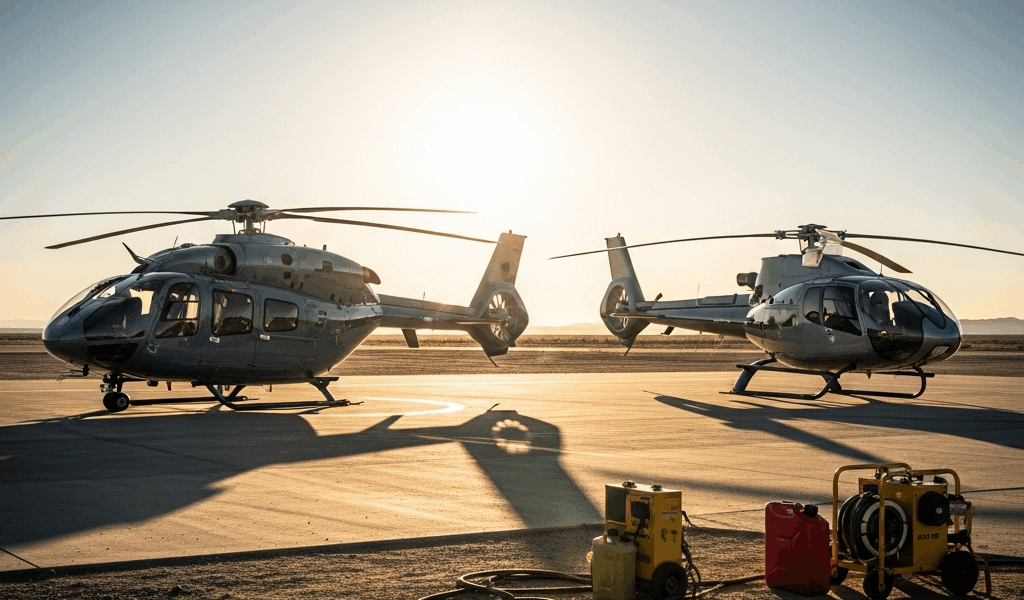
Two Serious Turbines, One Difficult Choice
The H125 vs Bell 407 debate has gotten complicated with all the spec-sheet noise flying around. As someone who has spent years watching operators agonize over this exact decision — and made a few expensive calls myself — I learned everything there is to know about what actually separates these two machines in daily use. Today, I will share it all with you.
Neither helicopter is a compromise. That’s what makes the choice genuinely hard. The H125 summited Everest — not as a marketing stunt, but because the Arriel 2D engine actually performs at altitude where other turbines start gasping. The Bell 407 is the cabin-forward, parts-everywhere machine that remote operators seek out specifically because a mechanic three states away will have the component you need on a Tuesday morning. This breakdown covers acquisition cost, payload tradeoffs, real operating costs, and maintenance realities. Not a spec recitation. The stuff that shapes your ownership experience after the paperwork clears.
Acquisition Cost and What You Actually Pay
Let’s start here. New, you’re looking at roughly $3.1M to $3.4M for an H125 — the AS350 B3e lineage, fully rebranded under Airbus Helicopters now. The Bell 407GXi lands in a comparable bracket, typically $3.2M to $3.6M depending on configuration, avionics package, and whatever the sales rep decided to call “standard fit” that week. Both numbers hurt. I once calculated what a 15-year note looks like on $3.3M and then needed a moment completely alone.
The used market is where this gets interesting. Bell’s installed base is enormous — over 1,500 407s delivered globally — which means real supply on the used side. You’ll find 2012–2016 407GXPs with reasonable airframe times in the $1.4M to $1.9M range with some regularity. Used H125s, particularly B3e variants post-2015, hold value tighter. Expect $1.6M to $2.2M for similar vintage and similar hours. The spread isn’t dramatic, but it’s real money.
What actually moves the transaction price: avionics fit — Garmin G1000H NXi versus older glass or steam gauge — interior condition, remaining airframe TBO, and paint. A fresh paint job on a turbine helicopter runs $40,000 to $80,000. If you’re comparing two aircraft and one looks tired, factor that in before congratulating yourself on finding a deal. Insurance class matters too. Some underwriters price the H125 differently based on operational category, particularly for external load and mountain ops. Get an insurance quote before you’re emotionally attached to a specific tail number.
Payload and Performance Where It Actually Matters
Probably should have opened with this section, honestly — payload drives mission fit more than almost anything else. So, without further ado, let’s dive in.
The H125 carries a max gross weight of 4,961 lbs with useful load typically landing around 1,540 to 1,600 lbs depending on configuration. Sounds fine until you start loading EMS equipment, a crew of two, and enough fuel for meaningful range. Then the margins get real fast. But what is the H125’s actual advantage? In essence, it’s altitude performance. But it’s much more than that — the Arriel 2D is specifically optimized for high-density-altitude conditions in a way that operators doing backcountry utility work or mountain tours notice on day one. Colorado summer tours at 9,000 feet density altitude. That’s where the H125 argument becomes almost impossible to argue against.
The Bell 407 runs a slightly higher gross weight at 5,250 lbs with a cabin that’s meaningfully wider. Seating six passengers in a 407 feels less like a negotiation than in the H125. For EMS operators, that extra cabin width can mean the difference between fitting a specific stretcher configuration or not — and that’s not an abstract problem, that’s a mission-ending one. The CG envelope is also more forgiving when loading asymmetrically, which happens constantly in real utility ops.
Frame it this way: regular operations above 8,000 feet density altitude push you hard toward the H125. Operations at lower elevations where cabin comfort and load flexibility matter more push you toward the 407. That’s what makes mission profile so endearing to us operators — it simplifies what looks like a complicated decision.
Operating Costs and Maintenance Reality
This is the section most comparison articles skip or bury in vague language. Here are rough numbers — with the honest caveat that your actual costs vary based on operational profile, geography, and whether your mechanic charges shop rates or extracts something closer to a soul payment.
Direct operating costs for the H125 run approximately $650 to $850 per flight hour in real-world single-pilot utility operations. That factors fuel burn — around 42 to 46 gallons per hour on the Arriel 2D — plus maintenance reserves and consumables. The Bell 407 with its Rolls-Royce 250-C47B comes in similarly, call it $700 to $900 per hour with the same caveats. Neither machine is cheap. But that’s turbines.
TBO intervals matter more than people expect. The Arriel 2D is rated at 3,000 hours TBO — overhaul costs run roughly $350,000 to $450,000 depending on what the inspection finds. The Rolls-Royce 250-C47 series has a comparable TBO structure. The 250-series engine lives in countless platforms globally — that installed base keeps the support ecosystem wide and parts pricing competitive. I’m apparently a 250-series loyalist at this point, and the global parts availability works for me while sourcing some Airbus components has never quite worked the same way in remote locations.
Here’s the honest operator feedback collected over years: Bell’s parts network wins on availability in remote areas. Period. Operating in the Mountain West, Alaska, parts of Canada, or anywhere far from a major MRO hub — the ability to find a 407 part locally or overnight from a Bell-authorized shop matters more than any spec comparison. Airbus Helicopters support has improved significantly since around 2019, and their HCare program is legitimate. But operators in genuinely remote locations still flag occasional parts delays on H125 components that wouldn’t happen with equivalent Bell hardware. Don’t make my mistake of assuming support infrastructure is equal across geographies before you’ve actually tested it.
While you won’t need to hire a full-time parts coordinator, you will need a handful of reliable MRO contacts within reasonable distance of your base. First, you should map your nearest Bell and Airbus authorized service centers before signing anything — at least if you operate more than 150 miles from a major aviation hub. Parts geography might be the best deciding factor, as turbine operations require consistent support access. That is because a grounded helicopter generates exactly zero revenue while you wait for a backordered component.
So Which One Should You Actually Buy
Here’s the actual framework — no cop-out hedge, no “it depends” non-answer.
Buy the H125 if:
- Your operations regularly exceed 6,000 feet density altitude — tours in Colorado, Utah, the Pacific Northwest, or anything near real mountains
- You’re weight-margin sensitive and need every performance point the Arriel 2D can deliver at altitude
- You want current-generation Airbus avionics architecture and the updated cockpit ergonomics that come with it
- External load work is core to your mission — the H125’s load hook setup and pilot visibility are purpose-built for it
Buy the Bell 407 if:
- You need six comfortable adult passengers regularly and cabin geometry matters for your customer experience or equipment fit
- You operate where parts availability and a massive independent maintenance base make your life meaningfully easier on a monthly basis
- Your mechanics already know the Rolls-Royce 250-series and you have zero interest in retraining anyone
- EMS configuration is anywhere in your future — the 407’s cabin has become a segment standard for genuinely good reasons
These are both excellent problems to have. Genuinely. The pilot wrestling between an H125 and a 407 sits in a better position than 90% of the rotorcraft market. Both helicopters are well-supported, carry deep used market liquidity, and perform reliably when maintained correctly. The difference is operational fit — not quality. This new generation of purpose-built turbines took off several years ago and eventually evolved into the remarkably capable platforms enthusiasts know and trust today.
If you found this useful, the H125 vs R66 and Bell 407 vs R66 comparisons on this site cover the adjacent tradeoffs — particularly worth reading if you’re still weighing whether to step up from a light turbine at all. Worth the read before you make any final calls.


Stay in the loop
Get the latest aero weenie updates delivered to your inbox.