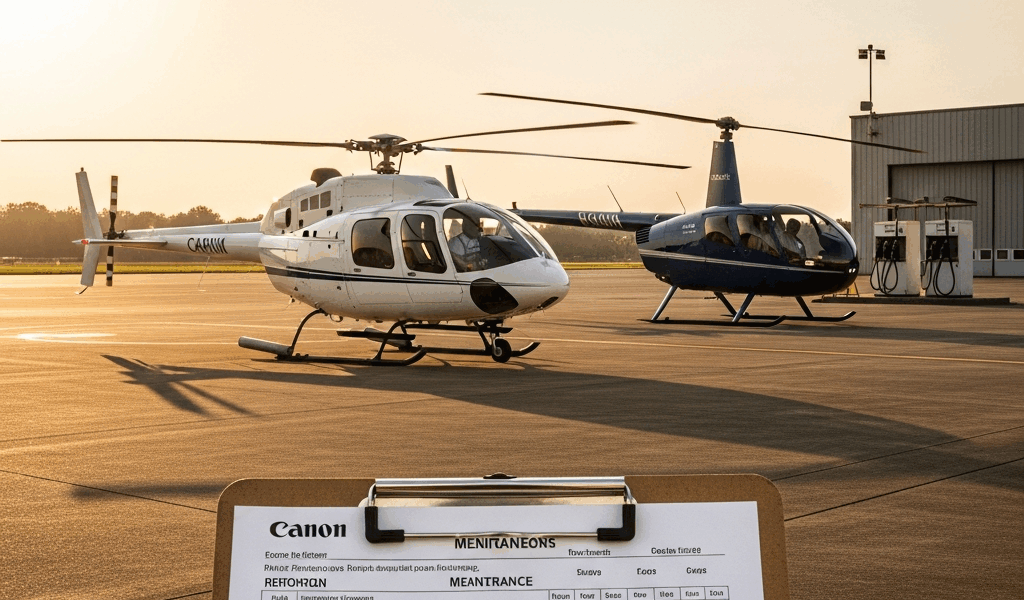
Bell 505 vs Robinson R66 — Which One Wins
What You’re Actually Choosing Between
The Bell 505 vs Robinson R66 debate has gotten complicated with all the brand loyalty and forum noise flying around. As someone who has spent real time in both cockpits — logged hours, talked shop with owners at fly-ins, and sat through genuinely uncomfortable conversations with insurance brokers — I learned everything there is to know about what separates these two machines. Today, I will share it all with you.
These are not the same aircraft wearing different paint. They come from two completely different philosophies about what a light turbine single should be — and that gap matters more than the spec sheets suggest. Bell’s 505 Jet Ranger X is a clean-sheet design, certified in 2016, built around a Garmin G1000H glass panel from the factory, FADEC engine management, and engineering decisions that lean hard into capability and redundancy. Robinson’s R66 is Robinson doing exactly what Robinson has always done: take the Rolls-Royce RR300 turbine, wrap it in familiar R44 DNA, and price it so that actual people can buy and operate one without needing a hedge fund. Neither philosophy is wrong. But they produce aircraft that will serve you very differently over the decade you actually own one.
Purchase Price and the Pain That Follows
New Bell 505 — figure $1.4 million to $1.6 million, depending on your option list. Add the Garmin autopilot, cargo hook provisions, or an EMS interior and that number climbs fast. New R66 sits at roughly $950,000 to $1.1 million. That’s a $400,000 to $600,000 gap. Stare at it for a moment before you rationalize it away.
But what is the used market reality? In essence, it’s a story where the R66 wins on availability. But it’s much more than that. The R66 has been in production since 2010 — there are legitimate used examples with clean maintenance histories floating around in the $650,000 to $800,000 range. The 505 is newer, the global fleet has fewer total hours, and finding a well-documented used example under $1.1 million takes patience and some luck. Supply is just thinner right now.
Insurance deserves a real mention here — at least if you want to avoid a nasty surprise after the purchase agreement is signed. The R66, because of the sheer volume of Robinson’s training and ownership ecosystem, tends to attract lower hull rates for pilots entering with appropriate turbine transition training. A broker I spoke with last spring quoted roughly 1.8–2.2% hull on a new 505 versus 1.4–1.7% on a comparable R66. Over five years, that compounds into genuinely serious money. The 505 commands higher premiums partly due to aircraft value and partly because underwriters are still building actuarial history on a relatively new type. Don’t make my mistake of treating insurance as a line item afterthought.
Flying Them Back to Back — What Actually Feels Different
Probably should have opened with this section, honestly. The cockpit experience is what makes people fall in love before they ever open a cost spreadsheet.
The Bell 505’s FADEC is the thing. Coming from a piston background — or even from an older turbine without full authority digital engine control — the first few hours in the 505 feel almost suspiciously easy. You set a power lever position and FADEC manages fuel flow, turbine temperature, and rotor RPM within a tight band. Less raw cockpit workload. That’s not a knock on the pilot; it’s a genuine safety architecture decision. Transitioning from an R44 or a piston twin, that FADEC envelope gives you real cognitive bandwidth to actually fly the aircraft instead of managing the engine.
The R66 uses the Rolls-Royce RR300 — a 300-shaft-horsepower turbine that is deliberately straightforward. No FADEC. You have more direct engine management, which experienced turbine pilots find perfectly comfortable but which adds workload for someone fresh out of piston training. Once you’re current in it, the R66 is an honest, predictable machine. Respect it and it will not surprise you.
Cruise speed — the Bell edges it. Roughly 125 knots indicated versus the R66’s 115 knots in real-world cruise. Not dramatic, but it’s there. Useful load is closer than people expect: both aircraft carry around 1,100–1,300 pounds depending on fuel load and configuration. Where the difference gets visceral is cabin volume on a hot day with four adults and luggage. The 505 is wider. It feels more like a small utility machine than a touring aircraft. Load four 200-pound passengers into either helicopter on a 95-degree afternoon at a 4,500-foot density altitude field — suddenly the Bell’s hot-and-high performance margin becomes a real argument, not a brochure talking point. That’s what makes the 505 endearing to us operationally-focused buyers.
Operating Costs — Where the R66 Fights Back Hard
This is where the conversation shifts, and I’m not going to waffle: the R66 wins the operating cost argument for most private owners. It isn’t particularly close.
The RR300 on the R66 carries a 2,200-hour TBO. Overhaul costs have been documented extensively through the Robinson dealer network — figure roughly $80,000 to $110,000 at TBO depending on hot section condition. The global Robinson service infrastructure is enormous. Certified Robinson Service Centers exist in every major market in the country. Parts availability is not a phone call you dread making at 7 a.m. on a Monday.
The Arrius 2R engine on the Bell 505 carries a 3,000-hour TBO — attractive on paper. Overhaul costs are less settled. The fleet simply hasn’t been operating long enough to produce the volume of documented shop visits the R66 ecosystem has. Bell’s dealer and maintenance network is still maturing. That’s not speculation; it’s the arithmetic of a newer type. Bell is building it out actively, and it will improve. But right now, if your aircraft goes AOG in a mid-sized market, your options are narrower with the 505 than with the R66.
Hourly fuel burn is comparable — around 25–28 gallons per hour for both, with the 505 burning slightly more at higher power settings. I’m apparently sensitive to these numbers and tracking them obsessively works for me while rough estimates never do. Roll in maintenance reserves and the R66 typically lands at $300–$400 per flight hour in realistic private operation. The 505 runs $450–$600 per hour once you account for higher parts costs and premium labor rates at the fewer shops qualified to work on it. Over 200 hours a year, that’s a $30,000 to $40,000 annual gap. Over a ten-year ownership period, that difference funds a hangar, insurance, and still has money left over.
Which One Should You Actually Buy
Real decision tree. No hedging. So, without further ado, let’s dive in.
Buy the Bell 505 if you operate commercially or plan to — if you fly regularly into conditions where the glass panel, optional autopilot, and FADEC workload reduction make a genuine safety case. Buy it if brand positioning matters for charter or utility work, or if you’re flying enough hours annually that the 3,000-hour TBO meaningfully defers your overhaul cycle. Specifically, the 505 makes sense if:
- You fly 300+ hours annually in demanding operational environments
- You need the commercial capability margin and avionics suite to justify the acquisition cost
- You are transitioning into Part 135 operations where the newer type rating carries real value
- IMC-adjacent flying is a regular part of your mission profile
Buy the R66 if you are a private owner putting on 150 to 200 hours a year, if you want a proven support network that won’t strand you in a smaller market, if resale predictability matters, or if keeping operating costs contained is the difference between the aircraft being sustainable and it sitting in the hangar. Specifically, the R66 makes sense if:
- Your annual utilization sits under 250 hours
- You want a turbine machine with a documented, affordable maintenance pathway
- Strong resale and a liquid used market matter to your exit strategy
- You want lower insurance premiums and an easier transition training pathway
Frustrated by the gap between what he wanted and what the numbers actually supported, a friend of mine spent six months convincing himself the 505 was obviously the right call — using forum posts, brochure specs, and some creative mental accounting. Then a very patient accountant walked him through a ten-year cost projection using real maintenance data, real insurance quotes, and realistic utilization numbers. That was a $380,000 reality check. The Bell 505 is the better aircraft. The R66 is the smarter purchase for the overwhelming majority of people reading this. This new kind of cost clarity took hold several years into the 505’s production life and eventually evolved into the consensus serious buyers know and trust today.



Stay in the loop
Get the latest aero weenie updates delivered to your inbox.