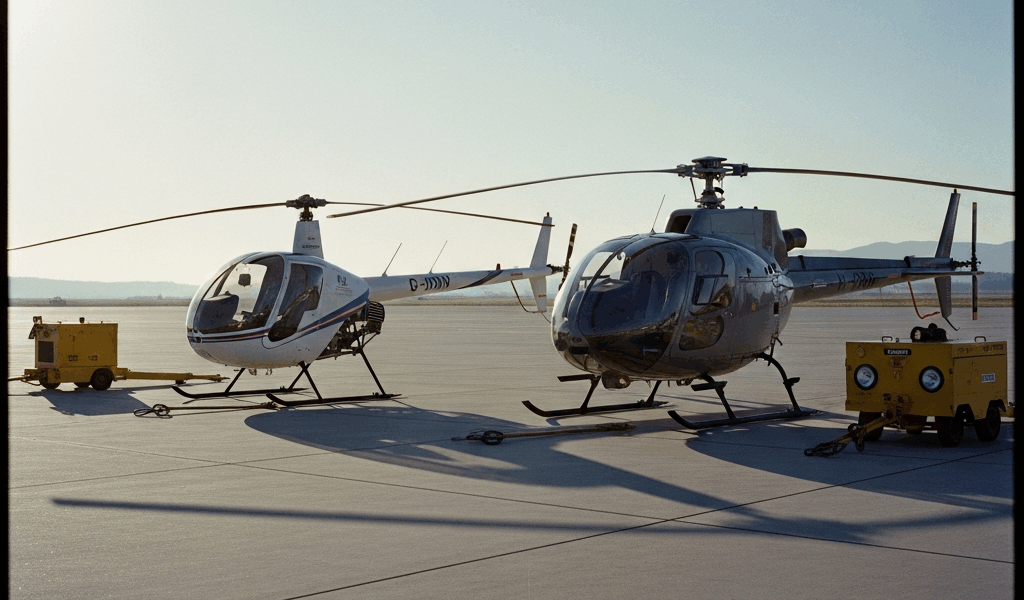
Robinson R44 vs MD 500 — Which One Is Right for You
Helicopter ownership has gotten complicated with all the forum noise and spec-sheet wars flying around. As someone who’s sat in both left seats, talked to dozens of owners, and watched more than a few people burn serious money chasing the wrong aircraft, I learned everything there is to know about this particular decision. Today, I will share it all with you.
This isn’t a brochure comparison. The R44 and the MD 500 occupy genuinely different worlds — and they keep landing on the same shortlist anyway. So let’s figure out which one actually belongs on yours.
What You Actually Get for the Money
A mid-time Robinson R44 Raven II — somewhere between 1,200 and 1,800 hours on the airframe, with a fresh or mid-time Lycoming IO-540 — runs $180,000 to $280,000. Paint, avionics, and the seller’s optimism move that number around. But the market is liquid. Dozens available at any moment. Pricing is predictable. Pre-purchase inspection networks exist and aren’t hard to find.
But what is the MD 500 market? In essence, it’s a wide-open range running from $150,000 for a tired 500D with deferred maintenance stacked up like cordwood, all the way to $600,000 or more for a clean, low-time 500E with a recent Rolls-Royce 250 overhaul. But it’s much more than just a price spread — it’s a minefield. Plenty of 500s sitting at $180,000 look like deals until someone pulls the maintenance records and discovers the Allison — now Rolls-Royce — 250-C20B hasn’t seen the inside of a shop in 1,400 hours. The cheap ones are cheap for a reason. Budget accordingly, or budget for a very thorough pre-buy from someone who actually knows turbine powerplants.
On paper, comparable acquisition cost between the two is possible. In practice, an equivalent-condition MD 500E costs more than an equivalent R44 Raven II. Just accept that upfront and move on.
Operating Costs Side by Side
Probably should have opened with this section, honestly. This is where buying decisions should actually live.
The R44 Raven II burns around 13 to 15 gallons of 100LL per hour. At $6.50 per gallon — a reasonable national average right now — that’s roughly $85 to $100 in fuel per Hobbs hour. The Lycoming IO-540 carries a 2,200-hour TBO. A factory remanufactured engine from Lycoming runs $32,000 to $38,000. Parts are common. A Robinson service center is almost certainly within driving distance of wherever you’re reading this.
The MD 500’s Rolls-Royce 250 series burns Jet-A — roughly 22 to 28 gallons per hour depending on conditions and how hard you’re pushing it. Jet-A runs cheaper per gallon than 100LL in most places, so the gap narrows. But you’re still looking at $110 to $140 per hour in fuel alone. The 250-C20B carries a 3,500-hour TBO on a new engine — but turbine overhaul costs are not piston overhaul costs. Not even close. A hot section inspection runs $15,000 to $25,000. A full overhaul on a 250-C20B through a reputable shop like Western Skyways or Covington Aircraft? $60,000 to $90,000. That’s not a typo.
Bottom line on operating costs:
- R44 Raven II — roughly $150 to $200 per hour all-in with honest reserves
- MD 500D/E — realistic all-in hourly sits at $300 to $400 when you stop kidding yourself about reserves
The turbine doesn’t win on economics. It just doesn’t. Anyone telling you otherwise is selling something — probably an MD 500.
Flying Feel and Mission Fit
Strapped into an MD 500E for the first time, most pilots describe something close to culture shock. The teardrop fuselage. The stripped-down cockpit. The way it responds to collective like it has strong personal opinions. Designed originally by Hughes for performance and agility, that heritage shows in every single flight hour. Doors off, low and slow over terrain — it’s one of the most tactile machines in general aviation. That’s what makes the 500 endearing to us enthusiasts. Tour operators in Hawaii and at the Grand Canyon run them for exactly this reason.
High-altitude performance is genuinely better in the MD 500 than the R44. Operating regularly above 6,000 feet density altitude — ranching in Colorado, flying the Mountain West — the turbine’s power margin is not a trivial advantage. The R44 at high DA starts giving you homework. The 500E does not.
The R44 Raven II carries four people with reasonable baggage at sea level, cruises around 110 to 115 knots, and covers ground efficiently. It’s comfortable for cross-country work in a way the 500 really isn’t — that 500 cabin is cozy at best for two adults on a two-hour leg. The R44 has more practical utility for the owner who actually wants to go somewhere regularly, bring a passenger, and land at a normal FBO without a production.
Flight schools love the R44 because it’s forgiving, well-documented, and the FAA training pipeline is essentially built around it. Ranchers and agricultural operators in the West often gravitate toward the 500 for its maneuverability and turbine reliability in harsh environments. That’s the split, broadly speaking.
Maintenance and Support Reality
Robinson has built one of the most accessible support networks in piston helicopter history. The factory in Torrance, California is responsive — I’ve personally watched an R44 owner get someone on the phone at Robinson’s parts desk on a random Tuesday afternoon. Parts ship fast. Annual inspections are predictable. That kind of accessibility isn’t an accident. It’s a deliberate business model, and it shows.
MD Helicopters support is spottier. The company has weathered ownership changes and financial turbulence over the years — both of which have affected parts availability and factory support continuity at various points. Third-party support exists, and some of it is genuinely excellent. Military and law enforcement operators have kept the 500 fleet flying for decades, and that MRO ecosystem is real. But it’s less plug-and-play than the Robinson network. It rewards owners who already have relationships with good turbine shops. Don’t make my mistake of assuming you can build those relationships after something goes wrong.
The age of the MD 500 fleet matters here too. Most 500Ds were built in the 1970s and early 1980s. Airframe corrosion, fatigue on older components, logbook gaps — genuine concerns on the cheaper end of the market. The R44 carries its own well-documented criticism around tail rotor blade sensitivity and the history of tail rotor incidents in training environments. That’s real. It’s also largely mitigated by following Robinson’s training requirements, which are not optional and not suggestions.
So Which One Should You Buy
Here’s the actual answer, broken down by who you are. So, without further ado, let’s dive in.
Buy the R44 Raven II if you’re building toward a commercial certificate or instrument rating, want predictable ownership costs, plan to fly 100 to 200 hours a year recreationally, or need a machine your local A&P can actually work on without a turbine rating and a specialty parts account already in place.
Buy the MD 500 if you have a specific operational mission that rewards its strengths — high-altitude work, doors-off utility, or the kind of sporting flying that makes the R44 feel sedate by comparison. And if — this is the part people skip — you have the maintenance budget to do it right. Not the acquisition budget. The maintenance budget. That’s the distinction most buyers miss, usually right around the time the first hot section comes due.
I’m apparently wired to appreciate the MD 500’s electricity — sitting in one has a charge to it that the R44, for all its practicality, genuinely doesn’t match. Cool machine. But cool doesn’t pay for turbine overhauls. More than a few buyers have purchased into the MD 500’s reputation and sold at a loss eighteen months later with a maintenance-deferred airframe and a hard lesson about turbine economics. The R44 won’t generate the same hangar stories. It will, however, still be flying and paid for when the 500 next comes due for a hot section.
Buy the helicopter that matches your actual budget and your actual mission. Everything else is just noise.


Stay in the loop
Get the latest aero weenie updates delivered to your inbox.