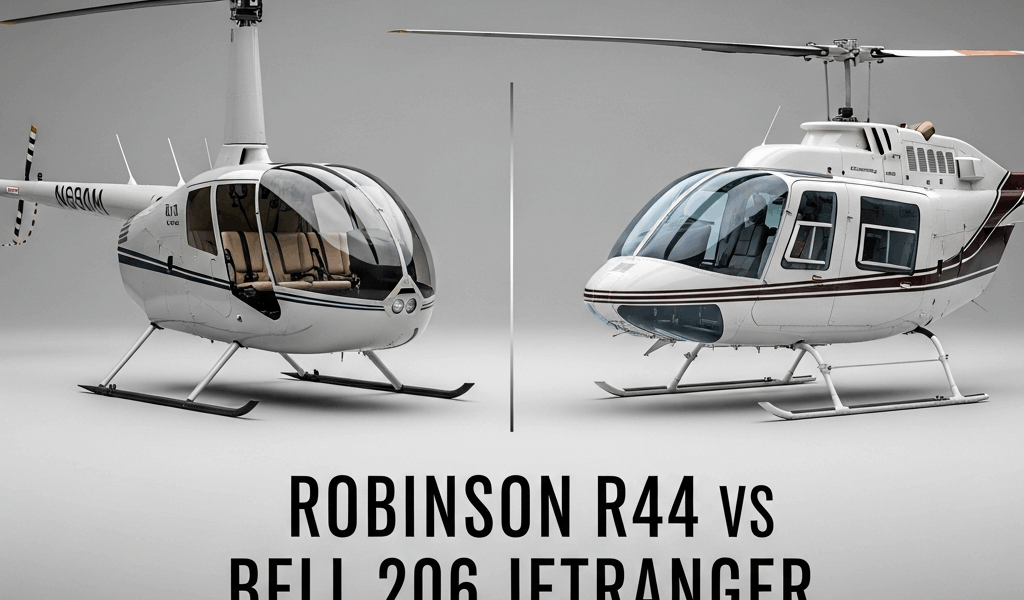
Robinson R44 vs Bell 206 JetRanger — Piston vs Turbine Showdown
The Robinson R44 vs Bell 206 JetRanger debate has gotten complicated with all the spec-sheet noise flying around. Thirty years of forum threads, and most of them never land anywhere useful. As someone who owned an R44 Raven II for four years and flew Bell 206B-3s extensively during a tour operation contract across the Southwest, I learned everything there is to know about what actually separates these two machines — and it’s not cruise speed or door width. It comes down to one question nobody online seems to frame clearly: do you actually need a turbine engine? Answer that honestly, and everything else falls into place.
The Real Question — Do You Need Turbine?
The Robinson R44 runs a Lycoming IO-540 six-cylinder piston engine. The Bell 206 JetRanger runs an Allison 250-C20 series turboshaft. But what is that difference, really? In essence, it’s a drivetrain distinction. But it’s much more than that — it’s a philosophical commitment to what kind of machine you want to operate and what kind of life you want living inside your maintenance schedule.
Turbine engines are smoother. Not marginally smoother. The vibration profile in a JetRanger cruising at 100 knots is genuinely different from what you feel in an R44. The Lycoming thumps — you feel it in your feet, your seat, your hands on the cyclic. Over a two-hour cross-country it stacks up into real fatigue. I didn’t fully appreciate this until I flew a 206 the week after a long R44 trip and felt like I’d swapped cabins on an international flight. The difference was that obvious.
Reliability at altitude is the other turbine argument worth taking seriously. The Allison 250 makes power up high and in heat where the Lycoming starts gasping. Density altitude crushes piston engines in ways that turbines genuinely shrug off. Fly in Colorado. Fly in August in Arizona. Fly out of a 6,000-foot strip in the Rockies — the 206 doesn’t care. The R44 absolutely does.
What turbine enthusiasts gloss over, though: the Lycoming IO-540 is one of the most proven piston aircraft engines on the planet. Operators worldwide run these things tens of thousands of hours with disciplined maintenance. It’s not fragile. It’s not unreliable. It’s just a piston engine — lower cost, lower ceiling, lower performance at the extremes. If your operating environment never pushes those extremes, you’re paying a turbine premium for turbine capability you’ll never actually use.
Probably should have opened with this section, honestly. Because everything below — the costs, the performance numbers, the mission profiles — only makes sense once you’ve decided where you stand on the engine question.
Operating Costs — The Numbers That Matter
This is where the comparison gets uncomfortable for 206 advocates. I say that as someone who genuinely loves the JetRanger.
R44 All-In Hourly Cost
Running an R44 Raven II, my all-in hourly cost settled somewhere between $265 and $310 depending on the year and fuel prices. Here’s roughly how that breaks down:
- Avgas (8.5 GPH at $6.50/gallon) — roughly $55/hr in fuel
- Engine reserve to TBO at 2,200 hours — approximately $50/hr
- Blade and rotor head reserve — roughly $40/hr
- Scheduled maintenance labor — around $35/hr amortized
- Insurance (owner-flown, Part 91, 500+ hours TT) — approximately $25/hr
- Miscellaneous consumables, avionics upkeep — $20/hr
Add it up and you’re somewhere between $225 and $310 an hour depending on how conservative your reserves are. Call it $275 as a working number.
Bell 206 All-In Hourly Cost
The 206 is a different world entirely. Jet-A runs cheaper per gallon than avgas — but the Allison 250-C20B burns around 23 to 26 gallons per hour at cruise. Fuel alone lands at $130 to $160 per hour at current prices. That’s before you touch engine reserves.
The Allison 250 carries a TBO around 3,500 hours, but an overhaul runs $80,000 to $120,000 depending on condition and what you find inside. That’s $23 to $34 per hour in engine reserve alone. Hot section inspections — required every 1,750 hours at roughly $15,000 to $25,000 a visit — push that turbine reserve number up fast.
- Jet-A fuel (24 GPH at $5.80/gallon) — roughly $140/hr
- Turbine engine and hot section reserve — approximately $55/hr
- Transmission and rotor system reserve — around $60/hr
- Scheduled maintenance labor — roughly $80/hr amortized
- Insurance (commercial-capable airframe) — approximately $60/hr
- Miscellaneous, avionics, parts lead times — $30/hr
Total: $850 to $1,100 per hour all-in for a well-maintained Bell 206. Some operators run leaner. Some run more conservatively. The spread between these two machines is real — the 206 costs roughly three times what the R44 costs to operate per hour.
That’s what makes the R44 endearing to us private owners who actually do the math. The question was never whether the 206 is better. The question is whether it’s three times better for your specific mission. For most private owners flying 100 to 150 hours a year on weekend trips, that arithmetic doesn’t pencil. For a tour company flying eight hours a day with five paying passengers, it pencils immediately.
Don’t make my mistake — I underestimated the blade reserve early in my R44 ownership. Skimped on that number in my mental model, then got surprised when blade erosion came up at an inspection. Budget every life-limited component as if you’ll hit TBO, not as if you’ll sell the aircraft before then.
Payload, Range, and Performance
Seats and Useful Load
The Bell 206B-3 seats five — pilot plus four passengers. The Robinson R44 seats four — pilot plus three. One seat sounds modest. In normal operations it often is. But for commercial tours, for family flying with kids, for any operation where you’re consistently moving four passengers plus a pilot, the 206 wins cleanly. There’s no workaround for that.
Useful load tells a more nuanced story. The R44 Raven II maxes out at 2,500 lbs gross — empty weight around 1,560 lbs — giving roughly 940 lbs of useful load. The Bell 206B-3 grosses at 3,200 lbs with an empty weight around 1,900 lbs, for a useful load near 1,300 lbs. The 206 carries more, but not as dramatically more as the empty weight difference suggests. Fill either aircraft with four adults and two hours of fuel and you’re watching weight carefully regardless — the 206 just has more margin to work with.
Speed and Range
Here’s the number that surprises people: the R44 is faster. The Raven II cruises at 109 to 113 knots depending on conditions. The Bell 206B-3 cruises around 100 to 104 knots. Not a dramatic gap, but it’s real — and it goes in the Robinson’s favor. For a piston machine everyone assumes is the economy option, it moves.
Range is roughly comparable, actually. The R44 carries 28.5 usable gallons — at 8.5 GPH that’s about three hours and change with reserves, around 280 to 300 nautical miles in practical terms. The 206 carries 76 gallons usable, but at 24 GPH that’s just over three hours — roughly 290 to 320 nautical miles. Similar legs. Very different fuel quantities filling those legs.
Hot and High Performance
This is where the 206 earns its premium for operators who genuinely need it. Take either aircraft to 8,000 feet density altitude on a hot summer afternoon — the R44 is working hard. You’re managing power carefully, watching climb rates drop, sometimes leaving a passenger or bags behind on the ramp. The JetRanger at those same conditions still has meaningful power reserve remaining. The Allison 250 doesn’t care about heat and altitude the way piston engines do.
Frustrated by watching R44 operators manage weight carefully on every single departure out of Sedona, Arizona — field elevation around 4,800 feet, summer temps regularly pushing 100°F — I started paying close attention to how 206 operators handled those same conditions using the same runup checklists and the same departure corridors. They didn’t have that conversation. Turbine performance in those conditions isn’t a marketing claim. It’s operationally real.
External Load Capability
The Bell 206 is certified and routinely used for external load operations — sling loads, construction, utility work. The R44 has a cargo hook option but is genuinely limited in practical utility application by its power margin relative to the 206. For any serious external load mission, the 206 wins without argument.
The Verdict — Which One to Buy
Burned by vague comparisons that never committed to a real recommendation, I want to be specific here. The right helicopter depends almost entirely on what you’re actually doing with it.
Buy the Robinson R44 If —
You’re a private owner flying recreationally, building hours, doing weekend cross-countries, or running a small training operation. The R44 Raven II — bought used in the $180,000 to $260,000 range — is one of the best values in personal aviation, honestly. It’s responsive, honest in its handling, and forgiving enough to be a real trainer while interesting enough to be a real flying machine. All-in operating costs around $275 an hour are manageable for the serious private flyer.
Training schools specifically should be looking at the R44 over the 206 for ab initio and early commercial work. The piston engine teaches students engine management in ways turbines simply don’t. Students who learn on the R44 and transition to turbines later tend to come out as more complete pilots — that’s not a theory, it’s apparently the consensus among every CFI I’ve spoken with who’s trained on both.
First, you should assess your home base elevation — at least if you’re seriously comparing these two airframes. If you’re operating at sea level or low elevation, not flying in extreme heat regularly, and not trying to carry four passengers plus yourself commercially — the R44 is not a compromise. It’s the right answer.
Buy the Bell 206 JetRanger If —
You need five seats for commercial operations. Full stop. Tour operators, air taxi, charter — the Bell 206’s fifth seat directly affects revenue per flight. One extra fare at $150 to $300 per seat pays a meaningful portion of that operating cost premium over time. The math is simple once you run it.
The 206 might be the best option for high-altitude or high-temperature bases, as turbine performance requires real power margin. That is because the Allison 250 simply doesn’t suffer the density altitude penalties that ground piston-powered operators on hot afternoons. Utility operators, pipeline patrol, external load work — these missions belong in the 206 almost automatically.
Buy it if your passengers are paying clients who notice ride quality. The turbine smoothness is a real product attribute — passengers who’ve been in both aircraft remember the difference, and in the premium tour and charter market that memory matters.
A used Bell 206B-3 in airworthy condition runs $250,000 to $450,000 depending on total time, engine time remaining, avionics, and configuration. Engine time remaining is the critical number. Buying a 206 close to hot section or TBO is buying a maintenance event immediately after the purchase wire clears.
The Honest Summary
Most private buyers who look at both aircraft and genuinely agonize over the decision end up in R44s — and most of them are right to. The 206 is a magnificent machine, smoother and more capable at the edges. But those edges are expensive to own. The R44 covers 80% of what private helicopter owners actually do, at roughly a third of the operating cost.
That’s what makes this comparison endearing to us — there’s no objectively wrong answer, just wrong answers for specific missions. The Bell 206 JetRanger belongs in commercial operations where the fifth seat, the turbine performance, and the ride quality translate directly into capability and revenue. For a private owner flying 100 hours a year recreationally out of a coastal airport, the R44 is the better helicopter. Not because it outperforms the 206 — it doesn’t, not across the board — but because it fits the mission and the budget without apology.
Decide first whether you need turbine. Then let everything else follow from that answer.



Stay in the loop
Get the latest aero weenie updates delivered to your inbox.