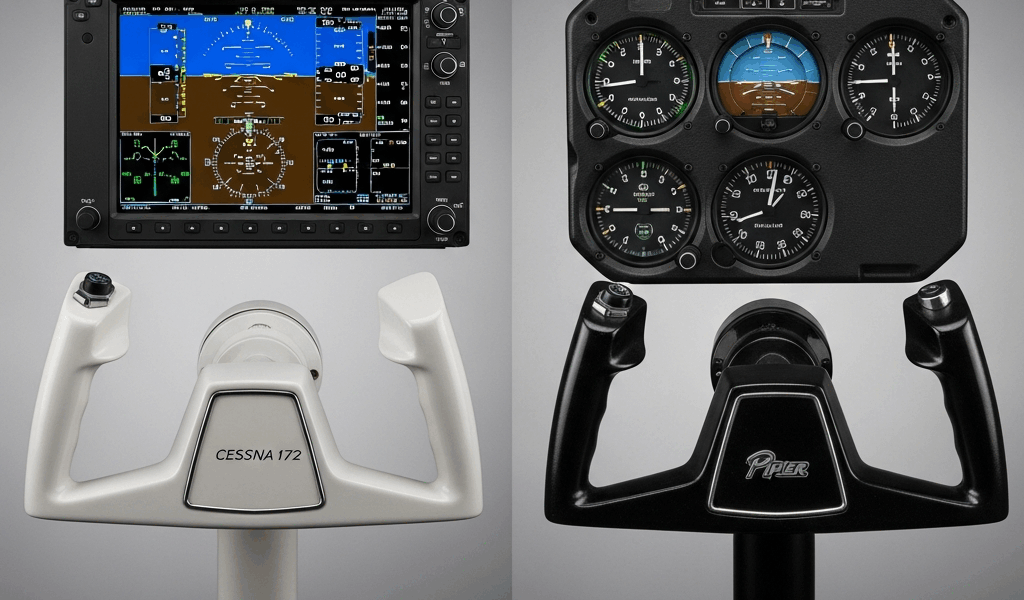
Cessna 172 vs Piper Cherokee — Which Trainer Is Actually Better?
The Cessna 172 vs Piper Cherokee debate has been running in pilot lounges since roughly 1960, and I have a specific opinion about it — one that took me about 3,000 dual instruction hours to form. I’ve taught primary students in both aircraft, signed off private pilots in both, and watched students struggle and succeed in both. The answer isn’t what most people expect, and it depends almost entirely on what stage of training you’re in and what kind of pilot you want to become.
Quick background so you know where I’m coming from: I got my CFI in a Cessna 172S, then spent four years at a Part 141 school that ran a mixed fleet — a block of six 172SPs and four Piper Cherokee 140s. I taught in whichever airplane was available on a given day. That accidental cross-training turned out to be one of the better educations I received as an instructor.
High Wing vs Low Wing — More Than Visibility
Most articles about this lead with visibility comparisons, list a few bullet points, and move on. That undersells how much the wing position actually shapes the learning experience in those early hours.
The 172’s high wing gives you a clear, unobstructed view of the ground directly below — which sounds trivial until you’re teaching a student to identify landmarks, track roads, or set up a pattern entry at an unfamiliar field. I’ve watched students in low-wing airplanes miss a turn-to-final because they couldn’t see the runway threshold developing beneath them. The high wing also shades the cockpit in summer. That might sound like a creature comfort, but a student who isn’t squinting through afternoon glare in Texas in July is a student who is actually scanning instruments instead of fighting the sun.
The Cherokee flips the advantage in certain phases. In a left-hand traffic pattern, the low wing actually gets out of your way during the turn from base to final — the wing drops away from the runway instead of obscuring it. More importantly, the low wing configuration makes the Cherokee noticeably more stable in a crosswind. Lower center of gravity, wider effective stance. On a gusty day, students in Cherokees tend to hold centerline better during rollout, not because they’re more skilled, but because the airplane is more forgiving of small side-load errors on touchdown.
For preflight, the high wing wins cleanly. Fuel checks on a 172 involve standing flat on the ground, opening the fuel cap, and using a $4 plastic fuel tester. On the Cherokee, you’re still at ground level — the tanks are in the wings, which sit lower — but the geometry of checking and visually confirming fuel levels takes more practice to do correctly. Sumping the Cherokee’s tanks the first time feels less intuitive, and I’ve had more than one student forget to check the left wing entirely during their first solo preflight.
- 172 high wing — better ground visibility, natural cockpit shading, simpler fuel preflight
- Cherokee low wing — better visibility in banked turns, steadier crosswind handling, lower center of gravity feel on rollout
- Neither is categorically safer — they’re differently demanding
Fuel Systems — The Difference Students Notice First
Probably should have opened with this section, honestly. Of everything that separates these two airplanes for student pilots, the fuel system difference is the most practically significant — and almost no written comparison explains why it actually matters in a training environment.
The Cessna 172 runs on a gravity-fed system. The selector has three positions: LEFT, RIGHT, and BOTH. For virtually all normal flight, you set it to BOTH and leave it alone. Fuel flows from both tanks simultaneously. You do not touch it again until shutdown, other than a quick check during runup. It is genuinely one of the last things you’ll think about in the cockpit.
The Piper Cherokee uses a manual tank-switching system. You take off on one tank, fly for approximately 30 minutes, switch to the other tank, fly 30 minutes, switch back. The checklist item is real, the timer discipline is real, and forgetting it has consequences. Fuel starvation — not fuel exhaustion, but starvation, meaning there’s fuel aboard but it’s not reaching the engine — is a documented accident cause in Cherokee-type aircraft. Pilots who forget to switch tanks don’t run out of fuel. They flame out an engine while sitting on a full tank they never used.
For a student who is already managing airspeed, altitude, heading, radio calls, traffic scan, and a nervous flight instructor, adding a 30-minute timer to the cognitive load is significant. In my first year instructing, I had a student in a Cherokee PA-28-140 (the 1970 model we called “Six-Four November”) get so focused on a radio call at a Class D airport that she missed the tank switch by 12 minutes. Engine kept running — we caught it — but the moment illustrated exactly why this is a bigger deal than it looks on paper.
The counterargument, and it’s legitimate, is that Cherokee pilots who internalize tank-switching early build a habit that serves them well in more complex aircraft. King Airs have fuel management procedures. Piper Seminoles have them. If you learn to manage tanks as a reflex in a Cherokee, you’re ahead of the curve when you step up. That’s true. But for a student in their first 20 hours trying to pass a stage check, it’s one more failure mode during a phase when failure modes should be minimized.
The 172 wins this round for beginners. The Cherokee wins long-term if you’re thinking about aircraft complexity progression.
Landing Characteristics
This is where it gets interesting. Trained by instructors who came up in 172s, I initially thought the Cherokee’s landing behavior was just different. After about 400 hours of dual given in Cherokees, I think it’s actually harder to land well — in a useful way.
The 172 floats. That’s the word every pilot uses, and it’s accurate. In ground effect, a properly configured 172 on speed at around 65 knots will want to stay airborne longer than you expect, especially in warm conditions with a light headwind. For students, this is forgiving. You crossed the threshold a little fast? You’ve got runway ahead and the airplane will let you catch up. The flare is gentle, the sink rate is gradual, and a passable landing is achievable even with minor speed errors.
The Cherokee has a shorter, lower-slung fuselage and a different wing loading (around 13.5 lbs/sq ft on a PA-28-140 vs approximately 14.0 on a 172N, but the subjective behavior differs more than the numbers suggest). It sits down more decisively. Arrive over the threshold 5 knots fast in a Cherokee and you’ll feel it — the airplane bounces or floats past where you planned. Arrive 5 knots slow and it drops sooner than expected. The energy management window is tighter.
Here’s what I noticed teaching in both: my 172 students could solo earlier in terms of landing consistency, but my Cherokee students landed more precisely once they got it. The Cherokee essentially required good technique. The 172 allowed survival technique. Students who trained exclusively in 172s and then transitioned to retractable gear aircraft sometimes struggled more than their hours suggested they should — the Cherokee-trained pilots had already internalized the concept of arriving on speed, on glidepath, every single time.
So which landing character builds better pilots? The Cherokee does, in the long run. But the 172’s forgiveness keeps students from getting discouraged during the most fragile phase of training. Both things are simultaneously true.
The Verdict — Which to Train In
Clear answer, with conditions.
If you have a choice between the two aircraft and your flight school operates both, the best possible sequence is: start in the 172 for your first 10 to 15 hours, then transition to the Cherokee for the remainder of your private pilot training. Use the 172’s forgiving ground effect to build basic landing confidence without getting demoralized. Use the 172’s simple fuel system to keep your cognitive load manageable while you’re learning to hold altitude and talk on the radio simultaneously. Then move to the Cherokee before your skills calcify. Let the more demanding airplane tighten your energy management, your tank-switching discipline, and your precision on approach.
That sequence produces the best pilots I’ve seen come out of primary training. It’s not a common school structure, but if you’re choosing between two schools and one offers both aircraft in sequence, that’s a meaningful differentiator.
If you’re stuck with one airplane, here’s how to think about it:
- Pure beginner, no prior aviation experience, first 40 hours: Train in the 172. The lower barrier to an acceptable landing, the simpler fuel system, and the forgiving handling reduce early frustration. Frustration is the number one reason student pilots quit before soloing. The 172 removes obstacles.
- Motivated student who wants to become a better-than-average pilot: Train in the Cherokee. Accept that it will be harder. Accept that the landings will feel inconsistent longer than they would in a 172. The airplane is teaching you something valuable every time it punishes a speed error — and that lesson doesn’t have to be relearned when you move up.
- Student planning to fly professionally: Get Cherokee hours whenever possible. The fuel management habit, the precision approach discipline, and the experience transitioning between wing configurations will all pay dividends later. Airline training departments don’t care which you started in, but your checkride performance in complex aircraft will reflect how precisely you flew your trainer.
One last honest note: the airplane matters less than the instructor and less than your own flying frequency. A student flying twice a week in a 172 will outpace a student flying once a month in a Cherokee every single time. The debate between these two airplanes is worth having — I just did, for 1500 words — but the most important variable is showing up consistently and flying with someone who can teach.
Both airplanes have produced excellent pilots for over 60 years. The 172 is easier. The Cherokee makes you work. Pick based on where you are in training, not based on which one looks better on the ramp.



Stay in the loop
Get the latest aero weenie updates delivered to your inbox.