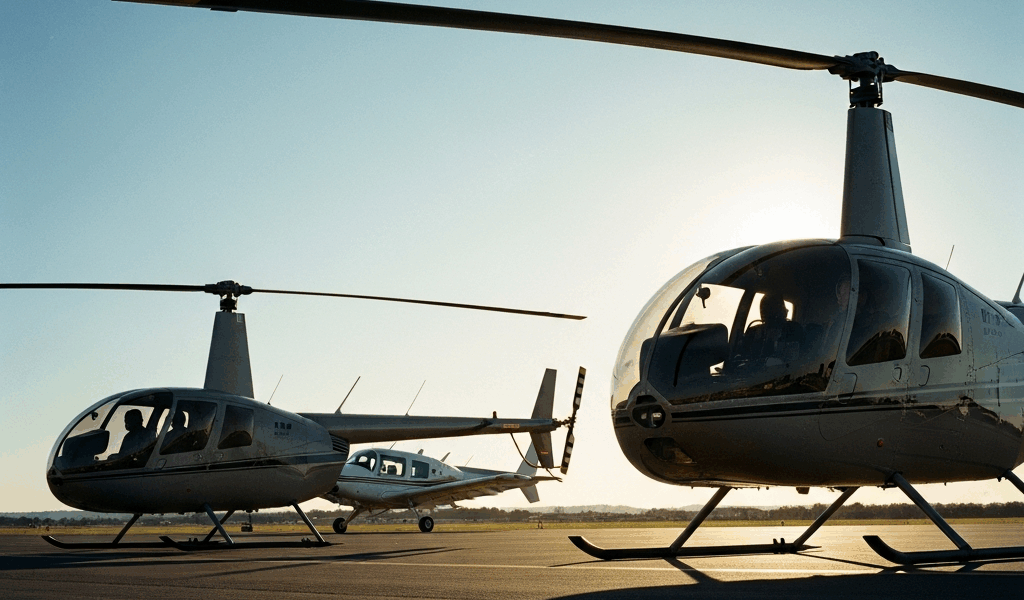
Bell 206 vs Robinson R66 — Which One Wins
Two Very Different Takes on a Turbine Single
The Bell 206 vs Robinson R66 debate has gotten complicated with all the forum noise and spec-sheet wars flying around. As someone who ferried a 206B3 across the Rocky Mountain west and logged real hours in an R66 during a turbine transition course in Bend, Oregon, I learned everything there is to know about how these two machines actually behave outside of a brochure. Today, I will share it all with you.
But what is this comparison, really? In essence, it’s two turbine singles fighting for the same buyer’s attention. But it’s much more than that — it’s a choice between a legacy platform with decades of real-world infrastructure behind it and a modern machine built by a company that genuinely understands cost control. These helicopters are not aimed at identical buyers, even if they keep ending up on the same shortlist.
Here’s something worth knowing upfront. Bell stopped delivering new 206 JetRangers commercially — the 505 Jet Ranger X is their current light turbine offering. That means any 206 purchase today is a used aircraft purchase. Could be a 1978 206B with 8,000 airframe hours. Could be a 2008 206B3 with fresh logs and a recent overhaul. The R66, meanwhile, rolls out of Robinson’s Torrance, California facility right now, new, for roughly $1.1 million depending on how you configure it. That single fact reframes this entire conversation.
Who’s actually cross-shopping these? Owner-pilots buying their first turbine. Small charter operators trying to climb out of piston without torching their operating budget. Flight schools that want turbine training without the overhead of a 407. That’s the audience. If you’re managing a petroleum utility contract, you’ve already made this call. So, without further ado, let’s dive in.
Performance and Payload — Where It Gets Interesting
The R66 is lighter than most people expect walking up to it. Robinson rates max gross at around 2,700 pounds, with useful load typically landing near 1,050 pounds depending on installed equipment. Genuinely impressive for a five-seat turbine. The 206B3 carries more — useful load closer to 1,500 pounds — more cabin, more machine, more of everything.
Translating that into actual missions: four adults with reasonable bags at sea level works in both. Push to 8,000 feet density altitude — a mountain tour out of Aspen, say, or a hunting camp drop somewhere in central Idaho — and the 206 starts feeling its weight while the R66’s lighter airframe handles thinner air with noticeably more composure. The Rolls-Royce RR300 in the R66 produces 300 shaft horsepower, flat-rated from its actual 317. The Allison 250-C20J in the 206B3 makes 420 shaft horsepower. But the 206 airframe is heavier, and the power-to-weight math doesn’t always deliver the advantage you’d assume at elevation.
Cruise speed is close enough that it genuinely doesn’t matter on most real routes — call it 110 to 120 knots for both. Range on standard tanks runs roughly 350 nautical miles either way. Where the 206 wins outright is interior volume. Four adults are actually comfortable in that cabin. The R66 is fine — but it’s cozy in a way that clients notice on anything over an hour. That’s what makes the 206 endearing to us utility-minded operators who are moving actual humans, not just logging hours.
Operating Costs and the TBO Reality Check
Probably should have opened with this section, honestly. Because acquisition price is just the cover charge — operating economics are where the decision actually lives.
The RR300 in the R66 carries a 2,200-hour TBO. Overhaul costs have been running $85,000 to $100,000 depending on the shop and what they find once they’re inside. Robinson has worked hard to make the R66 cheap to operate by turbine standards, and they’ve largely pulled it off. Parts flow through the Robinson dealer network, and because the aircraft is still in production, you’re not hunting discontinued components at a premium.
The Allison 250 — now badged as the Rolls-Royce 250 — is a genuinely different situation. That engine family has been in production in various forms since the early 1960s. Overhaul shops exist on multiple continents. Mechanics who have worked on it are not rare. If you put a 206 down at a remote FBO in northern Montana or somewhere in the Canadian interior, your chances of finding someone who has touched an Allison 250 are dramatically better than finding an RR300 specialist. That infrastructure matters when it’s 4 p.m. on a Friday and you need to fly out Sunday morning.
Here’s the honest part. Buying a used 206 means inheriting someone else’s maintenance decisions. I’ve seen 206B3s with clean logs and reasonable airframe time sitting at $400,000 to $600,000 that were legitimately good deals. I’ve also seen ones that looked clean until a pre-buy inspection surfaced deferred airframe work and a suspiciously quiet engine trend monitoring history. Budget $15,000 to $20,000 for a serious pre-buy. Don’t make my mistake of assuming a tidy logbook means a tidy aircraft.
The R66’s advantage is transparency — buy new, know exactly what you’re getting, factory warranty in place, current avionics from day one. All-in hourly operating costs run $400 to $600 for either platform depending on how aggressively you’re reserving for overhaul. The R66 edges ahead slightly on direct costs. The 206’s parts ecosystem keeps it competitive.
Training, Insurance, and the Paperwork Nobody Talks About
Frustrated by a rate quote that looked like a typo, I called three aviation underwriters in a single afternoon trying to understand why insurance on a clean used 206 was coming in $8,000 higher annually than a new R66 — same pilot, 1,200 hours total time, 200 turbine hours. The answer is less obvious than you’d think.
Underwriters know the 206 deeply. Thirty-plus years of loss data, standardized sim courses through FlightSafety International in Lakeland and Fort Worth, and a global fleet mean actuarial comfort. But that comfort comes attached to requirements — minimum turbine hours, sometimes mandatory Level D simulator time, and close scrutiny of the specific airframe you’re insuring.
The R66 benefits from something different: Robinson’s existing safety ecosystem. If you’ve flown R22s or R44s, you’ve likely already sat through a Robinson Safety Course. Insurers writing Robinson policies have years of R44 data shaping their R66 pricing, and pilots transitioning from the piston Robinson line are familiar to underwriters in a way that reduces friction. I’m apparently a textbook Robinson-pipeline pilot, and that insurer comfort worked for me in ways that cold-calling 206 underwriters never quite did.
Type rating isn’t required for either aircraft under Part 91 in the U.S. But insurers set their own minimums regardless, and for a low-time turbine pilot, the R66 route to insurability is typically smoother and cheaper in year one. The 206 becomes more competitive as your logbook fills in. First, you should build turbine time in whatever gets you flying — at least if you want the 206 insurance math to eventually work in your favor.
So Which One Should You Actually Buy
Fine. Here’s the actual answer, broken into real scenarios.
- You’re a high-time Robinson pilot buying your first turbine on a personal budget — Buy the R66. The systems transition is logical, insurance is cleaner, Robinson support picks up the phone, and a new R66 at $1.1 million is a known quantity. You’ll sleep better.
- You’re running a small commercial operation that needs to put a helicopter down anywhere and get parts by Tuesday — The 206 ecosystem wins. The Allison 250 support network is unmatched for a light turbine, training infrastructure is standardized, and a clean 206B3 at $500,000 to $650,000 leaves real capital for reserves and a proper maintenance contract.
- You’re a flight school building a turbine curriculum — The R66 is probably the smarter build given the Robinson transition pipeline, but if you already have 206-qualified instructors and a solid local MX relationship, don’t overthink it.
- You care about resale in five years — This one is genuinely close. The R66 market is still maturing. The 206 market is liquid and predictable. I’d give the edge to the 206 on resale certainty, though a well-maintained R66 with low hours will always find a buyer.
The mistake I made early in this comparison was treating it like a car purchase where newer automatically beats older. In helicopter ownership, the support ecosystem behind a platform matters as much as the platform itself. A brilliant aircraft with orphaned parts is a hangar queen — and a hangar queen is just an expensive way to feel bad about a decision you can’t easily reverse.
Neither of these machines is wrong. The R66 is something Robinson should genuinely be proud of — bringing cost-control discipline into turbine territory without gutting capability is hard, and they pulled it off. The 206 is still the helicopter that trained a generation of military pilots and built the offshore oil industry’s rotary-wing backbone. Arguing about which one is better over bad coffee at a fixed-base operator, pretending you’ve definitely flown both more than you actually have — that’s honestly half the fun of caring about this stuff. Buy the one that fits your mission. Then spend the next five years completely certain you were right.




Stay in the loop
Get the latest aero weenie updates delivered to your inbox.