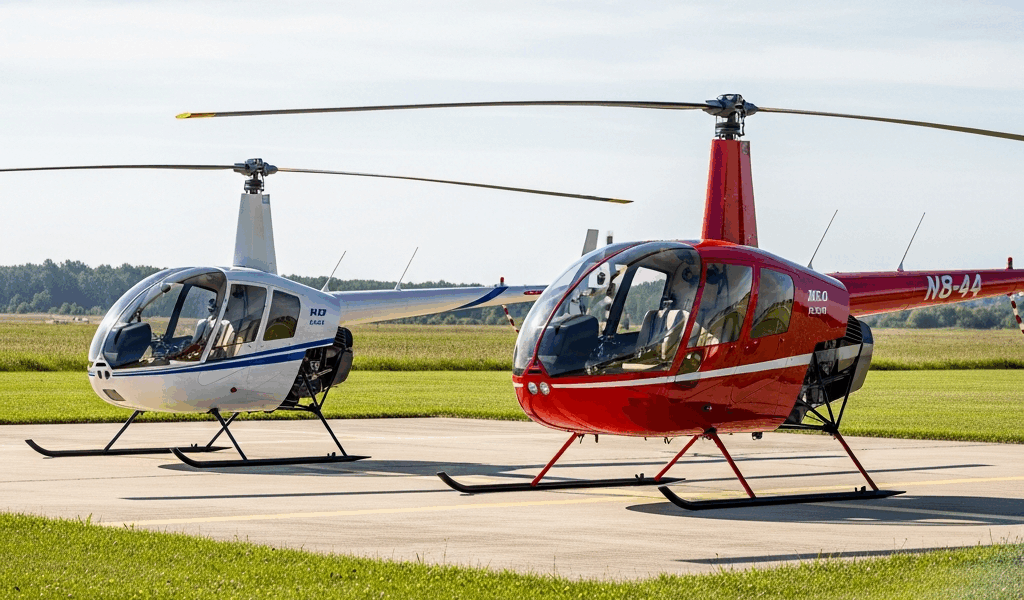
You earned your private helicopter license in an R22, loved every sweaty, concentration-draining minute of it, and now you want your own Robinson. The question every Robinson buyer eventually wrestles with: stick with the R22 you already know, or step up to the R44?
The short answer — if you are flying solo or with one passenger on short hops, the R22 does the job for roughly half the hourly cost. If you want to carry family, fly cross-country, or build time toward a commercial certificate with real useful load, the R44 is the helicopter to buy. Here is exactly why.
R22 vs R44 at a Glance
Before we get into the weeds, a side-by-side snapshot of the two Robinsons tells you most of what you need to know.
| Spec | Robinson R22 Beta II | Robinson R44 Raven II |
|---|---|---|
| Seats | 2 (pilot + 1) | 4 (pilot + 3) |
| Engine | Lycoming O-360, 180 hp | Lycoming IO-540, 260 hp |
| Max Gross Weight | 1,370 lb | 2,500 lb |
| Useful Load | ~400 lb | ~900 lb |
| Cruise Speed | 96 kts | 110 kts |
| Range | ~190 nm | ~300 nm |
| Fuel Burn | ~8 gph | ~15 gph |
| New Price (2026) | ~$420,000 | ~$650,000 |
| Used Price Range | $180,000–$320,000 | $300,000–$520,000 |
The R44 is not just a stretched R22 — it is a fundamentally different helicopter in terms of useful load, rotor inertia, and what missions you can realistically fly. That table makes it look like a straightforward scale-up, but the flying experience diverges in ways the numbers alone do not capture.
Operating Costs Per Hour
This is where most purchase decisions actually get made. The sticker price matters, sure, but the hourly burn rate is what you live with for the next 2,200-hour overhaul cycle. I have talked to owners who bought the cheaper helicopter and spent more in five years because they flew it twice as often — so run the numbers for your actual planned hours, not some theoretical annual budget.
| Cost Component | R22 (per hour) | R44 (per hour) |
|---|---|---|
| Fuel (avgas at $6.50/gal) | $52 | $98 |
| Engine Reserve | $30 | $45 |
| Airframe Reserve | $25 | $40 |
| Insurance (annual / 200 hrs) | $35 | $55 |
| Annual Inspection (prorated) | $15 | $20 |
| Miscellaneous (oil, filters) | $8 | $12 |
| Total per Hour | ~$165 | ~$270 |
Owner-operated numbers vary depending on your airport, your mechanic, and frankly your luck, but budget roughly $165 per hour for the R22 and $270 per hour for the R44 once you fold in reserves, insurance, and routine maintenance. The R44 costs about 60 percent more per hour — not double, which surprises a lot of people who only look at fuel burn.
Insurance is the variable that swings the most. A 500-hour pilot with an instrument rating might pay $12,000 annually on an R44. A 200-hour private-only pilot could see $18,000 or more. The R22 insurance market is tighter than you would expect because the accident history keeps premiums stubbornly high relative to the aircraft value. Get quotes before you commit to either one — the insurance number alone has killed more than a few purchase plans.
How They Handle
Flying an R22 requires your full, undivided attention. The two-blade, semi-rigid rotor system has low inertia, which means the blades slow down fast if you get behind on collective inputs. In an engine failure, you have roughly 1.6 seconds to enter autorotation before the rotor RPM decays past the recovery point. That is not a typo — one-point-six seconds. Every R22 pilot learns to live with that number hovering in the back of their mind, especially on hot days when the engine is already working hard.
The R44 shares the same semi-rigid, two-blade design philosophy, but the heavier blades carry meaningfully more inertia. You get a more comfortable margin in autorotation entries, and the helicopter feels more planted in gusty conditions. Where the R22 gets shoved around in 15-knot crosswinds, the R44 just sits there and takes it. The extra weight and rotor inertia buy you stability that translates directly into lower pilot workload on a bumpy day.
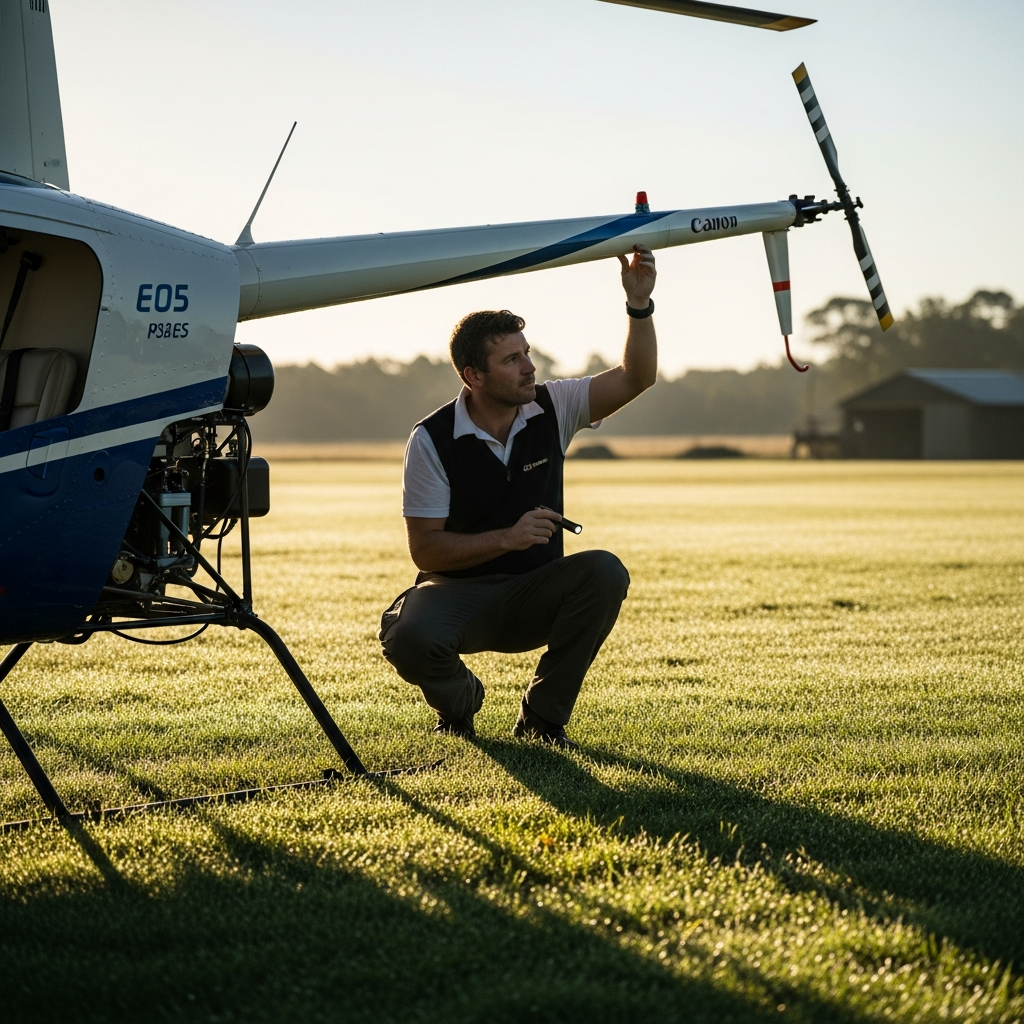
Hover work tells the same story. The R22 in a hover is a constant micro-correction exercise — pedals, cyclic, collective all need small, continuous inputs. Your hands never stop moving. The R44 holds a hover with noticeably less effort, partly because of the higher gross weight and partly because the flight controls are hydraulically boosted. After a long afternoon of pattern work in an R22, your legs are genuinely tired. The R44 is just less physically demanding, period.
Training vs Personal Use
If you are still building hours toward a commercial certificate, the R22 makes financial sense and it is not close. At $165 per hour versus $270, those 150 hours of required flight time cost roughly $24,750 in the R22 versus $40,500 in the R44. That $15,750 difference buys a lot of additional flight time — or pays for most of your instrument rating.
Most flight schools in the United States still train primarily in R22s for exactly this reason. The R22 also teaches you to be a precise, attentive pilot because it punishes sloppy inputs immediately. Instructors like to say that a pilot who learned in an R22 transitions up more smoothly than someone who learned in a forgiving machine and picked up lazy habits they now have to break.
For personal use, the math changes fast. The R22 has a two-seat limit and a maximum occupant weight of about 400 pounds combined. If you weigh 200 pounds and your passenger weighs 180, you are right at the edge with basically no fuel margin. Full tanks and a heavy passenger? You might be reducing baggage to literally zero.
The R44 seats four and carries roughly 900 pounds of useful load. You can take your spouse and two kids on a scenic flight without spending twenty minutes agonizing over the weight-and-balance sheet. Cross-country trips become practical with a 300-nautical-mile range. Want to fly from your home base to a weekend getaway three hours away? The R44 does it with one fuel stop. The R22 needs two, minimum.
The most common path Robinson owners follow: train in the R22, build hours inexpensively, then buy an R44 when personal or commercial missions demand the payload. The type transition is straightforward since both Robinsons share the same design DNA — semi-rigid rotor, T-bar cyclic, governor-managed throttle. A few hours of dual instruction with a good CFI and you are comfortable in the larger ship.
The Verdict
Buy the R22 if you are training, building hours, or flying solo on short local flights where payload is not a factor. It costs less to purchase, less to operate per hour, and it will make you a sharper, more attentive pilot. There is real value in that.
Buy the R44 if you want a personal helicopter that carries family or friends, handles cross-country missions, and does not beat you up on a gusty Tuesday afternoon. The higher hourly cost is simply the price of a helicopter that actually fits the missions most private owners end up flying.
If you are genuinely on the fence and can swing the R44 financially, buy the R44. Most R22 owners who fly for personal use eventually upgrade anyway, and selling an R22 to buy an R44 means paying transaction costs and downtime twice. The R22 is the better trainer. The R44 is the better helicopter for everything else.




Stay in the loop
Get the latest aero weenie updates delivered to your inbox.