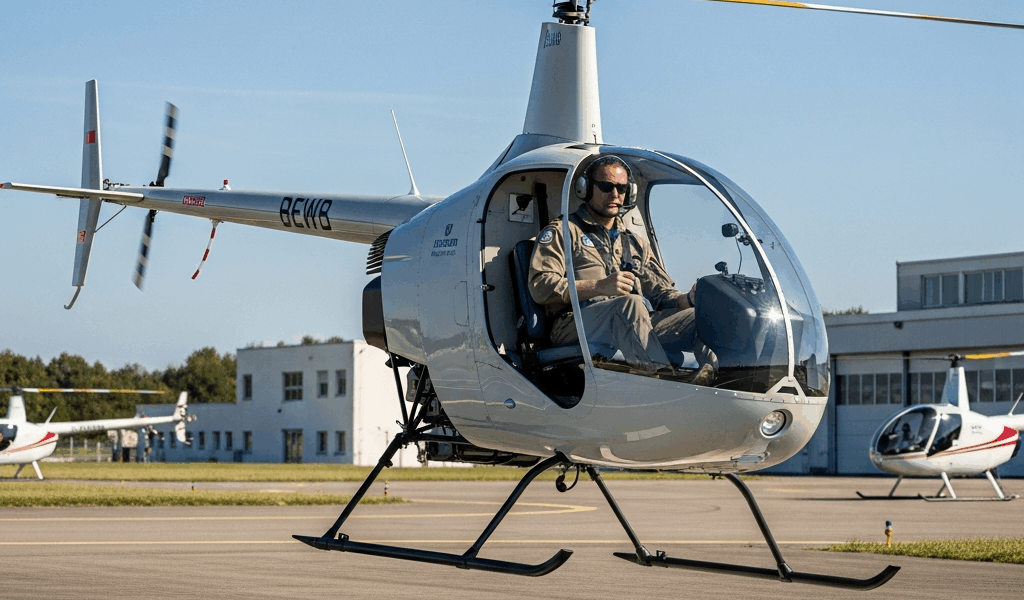
You are shopping for a training helicopter or your first personal ship, and the two names that keep surfacing in every forum thread and hangar conversation are the Robinson R22 and the Guimbal Cabri G2. Every flight school that operates one will tell you theirs is the superior choice — which makes those comparisons almost useless unless you hear from someone who is not trying to fill their own schedule.
Here is an honest look at both. The Cabri G2 is the better-engineered helicopter with meaningful safety advantages that are not just marketing copy. The Robinson R22 is more available, cheaper to rent in most markets, and still the default training platform across the majority of US flight schools. Which one you should fly depends on where you train, what you weigh, and what you plan to do once you have that plastic card in your wallet.
R22 vs Cabri G2 Quick Specs
The spec sheet tells part of the story, but the biggest difference between these two helicopters is not hiding in the numbers — it is the rotor system architecture. The R22 uses a two-blade teetering rotor. The Cabri runs a three-blade fully articulated rotor. That single design decision drives most of the handling, safety, and maintenance differences you will actually feel when you fly them.
| Spec | Robinson R22 Beta II | Guimbal Cabri G2 |
|---|---|---|
| Seats | 2 | 2 |
| Engine | Lycoming O-360, 180 hp | Lycoming O-360, 180 hp |
| Main Rotor | 2-blade, semi-rigid (teetering) | 3-blade, fully articulated |
| Tail Rotor | Exposed 2-blade | Shrouded (fenestron) |
| Max Gross Weight | 1,370 lb | 1,543 lb |
| Useful Load | ~400 lb | ~496 lb |
| Cruise Speed | 96 kts | 100 kts |
| Range | ~190 nm | ~350 nm |
| Fuel Burn | ~8 gph | ~9 gph |
| New Price (2026) | ~$420,000 | ~$480,000 |
Same engine, similar size, overlapping mission profile. But notice the useful load — the Cabri carries nearly 100 pounds more, which matters enormously when your occupants happen to be normal-sized adults. More on that in the cost section.
Safety Differences
This is where the Cabri G2 makes its strongest argument, and the advantage is not subtle.
The R22 has a well-documented autorotation challenge that every student learns about in ground school. Its low-inertia, two-blade rotor system gives you approximately 1.6 seconds to lower the collective and enter autorotation after an engine failure. Miss that window and the rotor RPM decays below the recoverable threshold. That narrow margin has contributed to the R22’s accident statistics over four decades of service, and it remains the single most frequently cited criticism of the aircraft in training environments.
The Cabri G2’s three-blade articulated rotor carries significantly more inertia. In an engine-out scenario, you have a wider time window to react, and the rotor RPM decays more gradually. For a student pilot still building muscle memory and reaction patterns, that extra margin is not just psychological comfort — it is measurable safety during the phase of flight training where you are most likely to make a mistake.
Then there is the tail rotor situation. The R22 has a conventional exposed two-blade tail rotor spinning at high speed near the rear of the fuselage. Ground crew, bystanders, and even experienced pilots have been injured or killed by walking into an R22 tail rotor — the blades are nearly invisible when spinning and sit at roughly head height on a crouching person. The Cabri uses a shrouded fenestron tail rotor fully enclosed in the vertical fin. You physically cannot contact the blades. For flight schools with students constantly moving around helicopters on a busy ramp, the fenestron eliminates an entire category of ground-handling risk.
The Cabri also incorporates a crash-resistant fuel system and energy-absorbing seats designed to reduce injury severity in a hard landing or low-altitude impact. The R22 was originally certified in 1979 and has been incrementally improved, but the fundamental airframe reflects an earlier generation of crash protection engineering.
What Each Costs to Train In
For years, the R22 held such a commanding cost advantage that this section would have been a single sentence. That gap has been narrowing steadily, and it surprises people who have not priced helicopter training recently.
Typical R22 wet rental rates at US flight schools run $280 to $350 per hour with an instructor. Cabri G2 rates, where the aircraft is available, run $300 to $380 per hour. The actual difference is maybe $20 to $40 per hour depending on the school and the market. Over 50 hours of training to a private pilot certificate, that works out to $1,000 to $2,000 in total additional cost for the Cabri. Real money, yes, but not the dramatic gulf the R22’s decades-old reputation for being cheap would suggest.
Maintenance economics are converging too. Robinson requires a 2,200-hour or 12-year overhaul, whichever comes first, and those overhauls are expensive. The Cabri uses on-condition maintenance for many components rather than hard calendar limits, which can reduce total cost of ownership for operators flying high hours. Flight school fleet managers increasingly favor the Cabri for this reason — less downtime, fewer mandatory replacements on a fixed schedule.
There is a hidden cost factor that rarely makes it into comparison articles: pilot weight. The R22 has a combined occupant weight limit of roughly 400 pounds. If you weigh 210 and your instructor is 200, you are over the limit. Full stop — you cannot legally fly that R22 together. The Cabri’s higher useful load pushes that threshold closer to 496 pounds, accommodating larger pilots and instructors without issue. If the R22 literally cannot carry you, your realistic choices are the Cabri G2 or jumping to an R44 at significantly higher hourly rates. For heavier students, the Cabri is actually the most affordable path to a helicopter license.
How They Fly
The R22 is a demanding machine to fly and makes no apologies for it. The low-inertia rotor and light airframe mean the controls are sensitive and the helicopter responds to inputs quickly — sometimes a bit faster than a student expects. In a hover, you are making constant small corrections on all three axes simultaneously. The pedals require steady, precise input to hold heading. Let your attention drift for two seconds and the R22 will remind you it does not tolerate daydreaming. Instructors who train in R22s will tell you that is a feature, not a bug — it builds excellent habits because there is simply no room for sloppy flying.
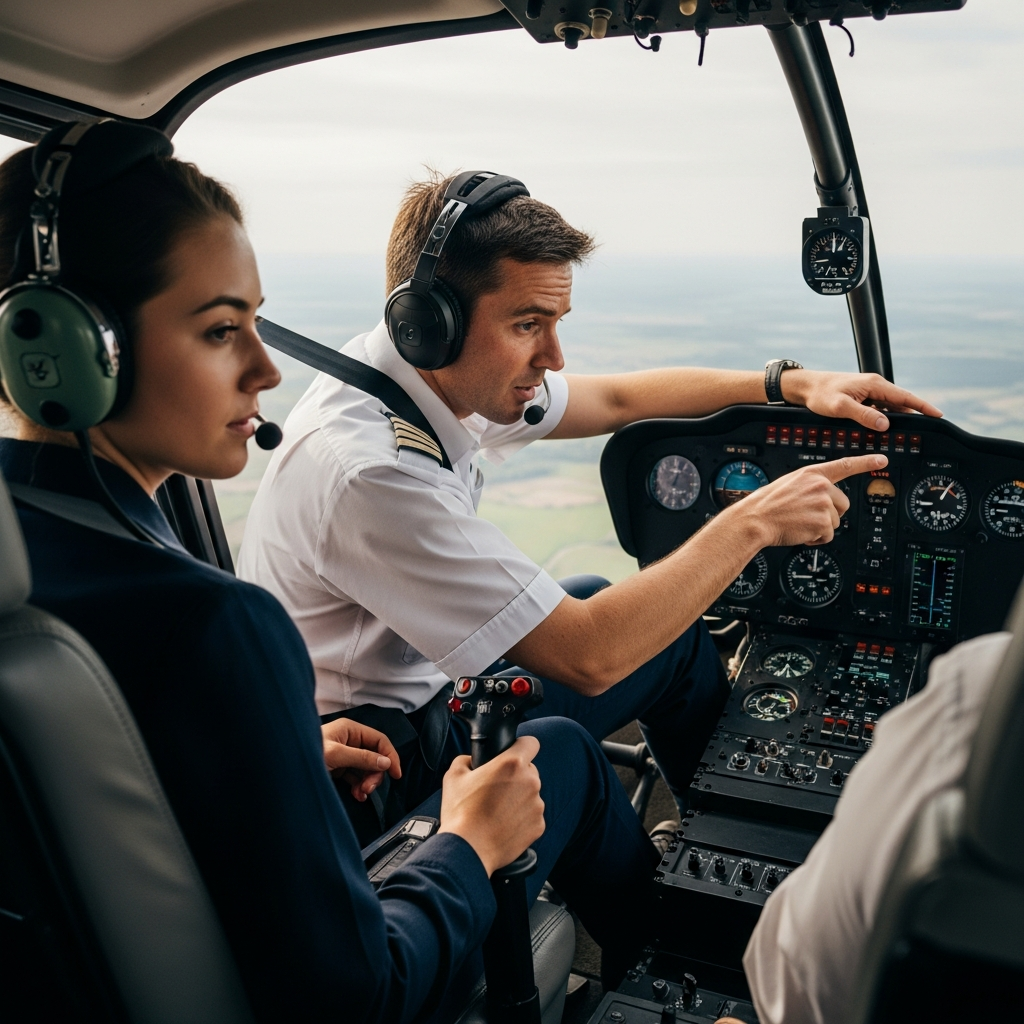
The Cabri is a different experience from the first hover. The three-blade rotor system delivers smoother, more predictable responses to control inputs. It feels more planted — not because it flies itself, but because the feedback is more linear and less twitchy. Students tend to solo faster in the Cabri because they spend less time wrestling the helicopter and more time actually learning maneuvers. The wider flight envelope means you are less likely to bump against a limitation during normal training exercises on a windy afternoon.
For transitioning to turbine helicopters later in your career, both platforms give you useful foundational skills through different paths. The R22 teaches precision and vigilance. The Cabri gives you a more representative feel for how modern articulated-rotor helicopters actually behave in flight. If your long-term goal is a turbine type rating — an Airbus H125, a Bell 407, something along those lines — the Cabri’s articulated rotor system is mechanically closer to what you will encounter in those machines. But the discipline the R22 drills into you has its own lasting value. Neither training path is wrong.
The Verdict
If you are training in the United States and your local school operates R22s, the R22 is the practical choice. Availability drives this decision more than anything else — there are roughly 4,500 R22s in service worldwide compared to around 300 Cabri G2s. Finding a Cabri-equipped school near you may require driving an hour or relocating for training, and limited aircraft means scheduling can be frustratingly tight.
If you have access to a Cabri G2 program within reasonable distance and the slightly higher cost fits your budget, choose the Cabri. It is the objectively better-designed training helicopter — safer rotor system, safer tail rotor, superior crash protection, higher weight capacity, smoother handling. These are not marketing talking points. They are engineering differences that directly affect your safety during the riskiest phase of your flying career.
If you weigh over 200 pounds and your instructor is not exactly petite, check the R22 weight limits before you write a deposit check. The Cabri may be your only realistic two-seat option short of the considerably more expensive R44.
The Cabri G2 is the better helicopter. The R22 is the more available one. Across most of the United States, availability still wins — but if you are anywhere within driving distance of a Cabri program, it deserves a serious look before you default to the Robinson.



Stay in the loop
Get the latest aero weenie updates delivered to your inbox.