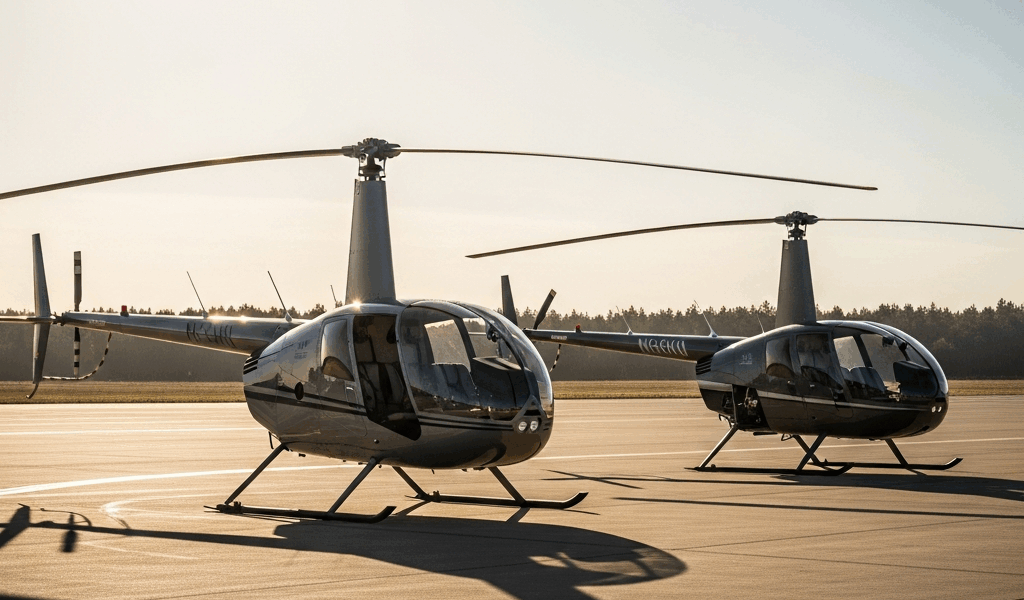
Bell 505 vs Robinson R66 — Which One Should You Buy
Why These Two Helicopters Keep Getting Compared
The Bell 505 vs Robinson R66 debate has gotten complicated with all the forum noise flying around. I’ve watched the same thread get resurrected on HeliFreaks at least a dozen times — different usernames, same argument, nobody walking away satisfied. Both machines occupy the light turbine single category. Both target the owner-pilot and small operator market. Both sit close enough in price that real buyers genuinely cross-shop them — we’re talking a ballpark acquisition range of roughly $1.1M to $1.5M new, depending on configuration. That overlap is exactly what makes this comparison legitimate and the forum arguments eternal.
These are not distant cousins. They’re competing for the same hangar space, the same loan amount, and often the same pilot. One is built by a company with decades of turbine pedigree and a global MRO footprint. The other democratized turbine flight for the owner-pilot segment more aggressively than anyone else in the market. Neither is wrong. But one of them is probably more right for you — and that’s what we’re actually here to figure out. So, without further ado, let’s dive in.
Performance and Handling Back to Back
As someone who has spent real time in both aircraft, I learned everything there is to know about what separates them on paper versus what separates them in the seat. Today, I will share it all with you.
The Robinson R66 carries a useful load that regularly impresses pilots coming up from piston — typically around 1,100 to 1,200 lbs depending on configuration. Its Rolls-Royce RR300 turbine punches well above its price class in reliability. The Bell 505 runs a Safran Arrius 2R, posts a higher service ceiling (around 18,045 feet pressure altitude versus the R66’s roughly 14,000 feet), and cruises faster — approximately 125 knots against the R66’s 110 knots. At sea level on a standard day, those differences feel almost academic. At 9,000 feet density altitude in Colorado or New Mexico in July? Not academic at all.
The handling difference is real. The R66 flies with that familiar Robinson touch — light, responsive, with a control feel that anyone who’s logged hours in the R22 or R44 will recognize immediately. It rewards pilots who already speak Robinson’s language. The 505 has a heavier, more deliberate feel — something many describe as more “transport category” in character. Pilots stepping up from Robinson piston ships often feel immediately at home in the R66. Pilots arriving from larger turbines or fixed-wing glass cockpits often prefer the 505’s more formal demeanor. That’s what makes each aircraft endearing to its respective crowd.
But what is the avionics gap, really? In essence, it’s the difference between a modern integrated flight deck and a more traditional cockpit layout. But it’s much more than that. The Bell 505 ships with the Garmin G1000H NXi suite as standard — dual ADAHRS, synthetic vision, integrated autopilot compatibility, and a flight deck that genuinely supports IFR operations in ways the R66 simply doesn’t match out of the box. If your mission involves actual IFR flight, or if you came up through fixed-wing and think in terms of glass panel workflow, the 505’s cockpit is a real differentiator. Not a marketing bullet point.
Ownership Costs — Where the Real Decision Happens
Probably should have opened with this section, honestly. Because performance specs matter less than the number your accountant reads off to you eighteen months after purchase.
Acquisition cost first. New R66 Turbine pricing has historically landed around $1.1M depending on options. The Bell 505 new comes in closer to $1.35M to $1.5M fully equipped. That delta matters less than people think when you’re financing over ten years — but it matters a lot when you’re deciding between new and a young used example. The R66 used market is deeper and more mature. Robinson has been delivering them since 2010, which means there’s real supply of 2,000-to-3,000-hour examples with known maintenance histories available in the $600K to $850K range. Used 505s exist, but the fleet is younger and inventory is thinner.
Hourly operating costs are where people get into forum fights using numbers they found on a different forum. A conservatively operated R66 running around 200 hours per year will likely run $300 to $450 per flight hour in direct operating costs — fuel, oil, routine maintenance, reserves for overhaul. The 505 in similar operation tends to run $450 to $600 per hour. These are not precise figures. Get actual quotes from operators flying similar missions in your geographic area. Forum math is not your pre-buy inspection.
The R66’s 2,200-hour TBO on the RR300 is well-regarded, and Robinson’s parts network in North America is genuinely mature — turnaround on parts is fast. Bell’s global support infrastructure is broader internationally. Operating in Europe, Southeast Asia, or Latin America? Bell’s MRO footprint is a real operational advantage the R66 cannot match. Insurance is another variable entirely. Premiums shift substantially based on pilot hours, turbine time, and geographic area. I’m apparently a data point insurers find uncomfortable — low total time, mountain operations — and shopping around made a significant difference in what I was quoted. Don’t make my mistake of calling only one underwriter. Seriously.
Who Actually Buys Each One and Why
The R66 buyer profile is pretty consistent. Owner-pilots stepping up from piston — often R44 or Schweizer 300 backgrounds — who want turbine reliability and turbine smoothness without the full operational overhead of a turbine program. They fly personal transport, maybe some aerial photography, and they want to own the aircraft outright and manage it themselves. The R66 fits that model cleanly. It’s not trying to be a corporate aircraft. It’s a serious owner-pilot machine with a forgiving learning curve and a parts ecosystem that won’t strand you outside Flagstaff at 10 p.m. on a Saturday.
The 505 buyer tends to look different. Tour operators needing higher ceilings for mountain operations — think the Rockies or the Alps. Small charter outfits that need the Garmin G1000H for actual IFR compliance. International operators who need Bell’s global dealer network. Flight training operations wanting students in a glass cockpit environment from day one. Aerial survey outfits needing service ceiling and avionics integration for sensor payloads. Different animal entirely.
Frustrated by early research that treated both aircraft as interchangeable spec columns, I eventually stopped comparing numbers side by side and started talking to actual operators. That changed everything. These machines serve overlapping but distinct profiles — and the right question isn’t which aircraft is better. It’s which aircraft is better for your specific combination of mission, geography, budget, and maintenance infrastructure.
So Which One Should You Actually Buy
Here’s the actual recommendation framework — not the cop-out version.
The R66 might be the best option if your operations stay below 8,000 feet density altitude, as owner-pilot flying requires exactly the kind of mature support network Robinson has built in North America. That is because parts availability is strong, cost per flight hour is lower, and the learning curve won’t punish pilots arriving from Robinson piston backgrounds. At that operating envelope and budget, the R66 is hard to beat. That’s not a consolation prize — that’s a clear win for a specific operator profile.
While you won’t need Bell’s full global MRO network flying day trips out of a sea-level home base, you will need a handful of things the 505 delivers that the R66 simply doesn’t — specifically if you operate above 8,000 feet regularly, need genuine IFR capability, or run missions internationally. First, you should honestly audit your actual mission profile — at least if you want to avoid paying a $1.5M premium for capabilities you’ll never use. The 505 earns its price in the right conditions. It’s not overpriced for what it delivers — it’s priced appropriately for a more capable and more globally supported aircraft.
Both helicopters are genuinely excellent. Both represent serious engineering from companies that know exactly what they’re doing. The real problem — and any honest pilot will tell you this — isn’t choosing between them. That was never really the hard part. It’s affording either one in the first place.


Stay in the loop
Get the latest aero weenie updates delivered to your inbox.