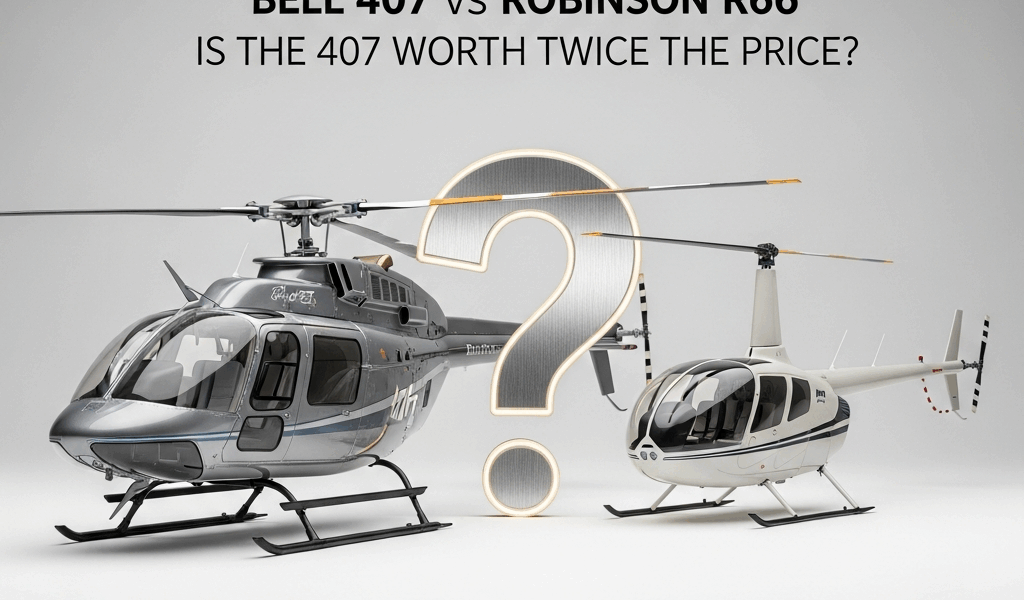
Bell 407 vs Robinson R66 — Is the 407 Worth Twice the Price?
The Bell 407 vs Robinson R66 debate comes up constantly in owner forums, flight schools, and charter company boardrooms — and almost every time, someone throws out a number without doing the real math. I spent three years working flight operations for a Part 135 charter company that ran both turbine singles, and the pricing conversation never got old. The 407 lists around $4 million new. The R66 comes in just under $1 million. That’s not twice the price. That’s four times the price. And the difference matters enormously depending on what you’re actually trying to accomplish.
I’ll give you the honest version here — the one that accounts for fuel bills, hangar conversations, maintenance surprises, and the specific moment I realized our R66 was the smarter aircraft for about 70% of the missions we were flying.
407 vs R66 — What Three Million Extra Buys You
Let’s put the numbers on the table right away because everything downstream flows from them.
| Specification | Bell 407 | Robinson R66 |
|---|---|---|
| New Price (approx.) | $4,000,000+ | $950,000–$1,050,000 |
| Engine | Rolls-Royce 250-C47B (813 shp) | Rolls-Royce 300-C20W (300 shp) |
| Seating | 7 (1 pilot + 6 passengers) | 5 (1 pilot + 4 passengers) |
| Max Gross Weight | 5,250 lbs | 2,700 lbs |
| Cruise Speed | 140 knots | 110 knots |
| Range | ~330 nm | ~350 nm |
| Fuel Burn | 45–50 gph | 22–25 gph |
| Useful Load | ~1,500 lbs | ~900 lbs |
| IFR Certified | Yes (with avionics package) | No (VFR only) |
| Part 135 Common Use | Yes — widely used | Limited — some operators |
Here’s what that $3 million gap actually buys: a heavier airframe, more than double the engine horsepower, two additional seats, IFR capability, a significantly higher useful load, and a Bell type certificate that opens doors — literally — at FBOs, corporate flight departments, and government contracts that will not touch a Robinson regardless of the pilot’s credentials.
That last point gets skipped in almost every spec comparison I’ve read. Perception is part of the purchase. A county sheriff’s department or an offshore oil company doesn’t just evaluate performance numbers. They evaluate brand credibility, parts availability, and what happens when an aircraft goes AOG in the field. Bell has been building the 407 since 1996. The global support network is massive. Robinson’s turbine support network is improving but it’s nowhere near the same level of maturity.
Motivated by budget reality but needing a capable turbine, many first-time helicopter owners end up choosing the R66 and then discovering its limitations only after signing the paperwork. I’ve watched it happen more than once. The aircraft is excellent. It just isn’t a 407, and pretending otherwise costs people money.
Cabin and Mission Flexibility
Walk up to both aircraft on a ramp and the size difference is immediately obvious. The 407 has a cabin interior roughly 58 inches wide and 50 inches high. The R66’s cabin measures about 42 inches wide. That sounds like a minor variance until you’re trying to load a Ferno 35 patient litter into an EMS configuration, or you’re fitting a law enforcement observer with a full tactical vest and a FLIR operator sitting alongside them.
The 407 seats seven total — one pilot plus six passengers in two rows of three. The R66 seats five — one pilot plus four passengers in a side-by-side front row and a rear bench. On paper, two seats sounds minor. In charter revenue math, it’s enormous. Running a 135 operation, the difference between a five-seat and seven-seat helicopter determines whether you can take certain group bookings at all. A family of five needs a pilot. In an R66, that’s full. In a 407, you still have a seat available for bags or a sixth traveler.
Mission Categories Where the 407 Wins Outright
- EMS and medevac — The 407 accommodates a stretcher, medical personnel, and equipment without creative loading compromises. The R66 physically cannot do this job.
- Law enforcement — Police aviation units want the 407’s cabin volume for observer seating, sensor mounts, and tactical gear. The Bell 407GXi is a common platform for air units across North America.
- Offshore utility — Weight, range on hot-and-high days, and payload margin matter in oil and gas transport. The 407’s useful load advantage is real and operational.
- IFR charter — This one matters more than people admit. If your operation is flying business travelers who need reliability across weather systems, VFR-only certification is a hard stop. The 407 with a Garmin G1000H or equivalent NMS package is a legitimate IFR platform.
- Corporate shuttles — Companies flying executives between city-center helipads and regional airports want the cabin width, the Bell nameplate, and the seat count.
Mission Categories Where the R66 Holds Its Own
- Private owner transport — Most private owners fly with one or two passengers. The R66’s cabin is perfectly comfortable for that use case.
- Tour operations — Four-passenger tours work fine. Many Grand Canyon tour operators run R66s successfully.
- Training — Turbine transition training, instrument currency work, and building turbine time is far more economical in an R66.
- Agricultural survey — Light observation, pipeline patrol, and survey work where payload is secondary to hours flown per dollar.
- Personal travel in VMC environments — In good weather, the R66 at cruise is comfortable, fast enough for most practical routes, and genuinely enjoyable to fly.
The honest cabin comparison comes down to this: if your mission ever includes a stretcher, a FLIR pod, more than four passengers, or IFR weather penetration, the R66 isn’t underpowered — it’s incompatible. No amount of creative loading fixes those structural constraints.
Operating Cost Reality Check
Probably should have opened with this section, honestly, because the acquisition price difference fades quickly when you look at what these aircraft cost to actually operate over a ten-year ownership cycle.
The 407’s Rolls-Royce 250-C47B burns 45 to 50 gallons per hour at cruise. Jet-A right now averages around $6.50 per gallon at most FBOs — call it $6.00 if you have a fuel agreement. That’s $270 to $300 per flight hour just in fuel. The R66’s Rolls-Royce 300-C20W burns 22 to 25 gallons per hour. Same fuel price, you’re looking at $132 to $162 per hour.
Over 400 flight hours per year — a reasonable number for a working charter aircraft — the fuel cost difference alone runs between $43,000 and $55,000 annually. Over ten years, you’re looking at $430,000 to $550,000 in fuel savings alone by flying the R66 instead of the 407 at equivalent hours.
Insurance
Insurance premiums track hull value. A $4 million 407 carries hull insurance typically running 0.8% to 1.2% annually for operators with clean records and experienced pilots — that’s $32,000 to $48,000 per year just for hull coverage, before liability. The R66 at $950,000 hull value runs $7,600 to $11,400 per year on comparable terms. The spread is $20,000 to $36,000 annually. Not trivial.
Maintenance Intervals and Labor
Both aircraft use Rolls-Royce engines, which helps on parts availability. But the 407 is a significantly more complex airframe. The Bell 407 has a 300-hour inspection interval for many major components, and the rotor system maintenance is labor-intensive. Expect annual maintenance costs in the range of $80,000 to $120,000 for a Part 135 407 flying moderate hours. Overhaul reserves on the Rolls-Royce 250-C47B run around $250 per hour.
The R66’s 300-C20W overhaul reserve is approximately $150 to $175 per hour. The airframe inspections are simpler. Robinson has worked hard to build an affordable turbine, and it shows in the service manual complexity relative to the Bell product. A well-run R66 in moderate charter service can hold total maintenance costs around $40,000 to $60,000 annually.
The Full Ten-Year Cost Picture
Running rough numbers for a private owner flying 200 hours per year:
- Bell 407 — Acquisition $4,000,000 + fuel ($60,000/yr) + insurance ($40,000/yr) + maintenance ($100,000/yr) = approximately $2,000,000 in operating costs over ten years, plus the acquisition. Total exposure: $6,000,000.
- Robinson R66 — Acquisition $975,000 + fuel ($29,000/yr) + insurance ($9,500/yr) + maintenance ($50,000/yr) = approximately $885,000 in operating costs over ten years, plus acquisition. Total exposure: $1,860,000.
That’s a $4.14 million difference over a decade of ownership at modest utilization. The numbers get worse for the 407 at higher hours because fuel and maintenance scale linearly while the acquisition cost is fixed. The more you fly, the harder the 407 is to justify on economics alone.
I made the mistake early in my career of looking at hourly costs in isolation rather than total ownership costs. A charter company director I worked under pulled out a spreadsheet one afternoon and walked me through ten years of projections on both aircraft. The 407 column made my eyes water. His point wasn’t that the 407 was a bad aircraft — it’s a genuinely excellent one — but that you had better be generating revenue that justifies those costs, or you’re burning wealth at altitude.
Residual Value
One place the 407 partially redeems itself financially is residual value. Well-maintained 407s hold value reasonably well — a 2015 Bell 407GXP with avionics and low hours can still fetch $2.8 to $3.2 million on the used market. Robinson R66 residual value is harder to predict because the turbine variant has a shorter market history, but used examples from 2013 to 2016 typically sell in the $550,000 to $750,000 range depending on hours and configuration. Neither depreciates gently. Helicopters never do.
The Right Helicopter for Your Budget and Mission
Here’s the direct answer after everything above.
Buy the Bell 407 if:
- Your operation includes IFR charter, EMS, law enforcement, or offshore work where the 407 is operationally necessary and not just preferred.
- You’re running a Part 135 certificate and your market can support seven-seat charter pricing — corporate groups, government contracts, high-net-worth clients who expect a Bell on the ramp.
- You’re flying in hot-and-high environments — mountain operations, high-density-altitude LZs, or utility lift missions where that 813 shp engine and 1,500-pound useful load are genuinely required.
- You have the infrastructure to support it — trained maintenance personnel familiar with the airframe, a fuel agreement that softens the burn cost, and revenue projections that pencil out against $6,000 in daily operating costs when the aircraft is flying.
Buy the Robinson R66 if:
- You




Stay in the loop
Get the latest aero weenie updates delivered to your inbox.