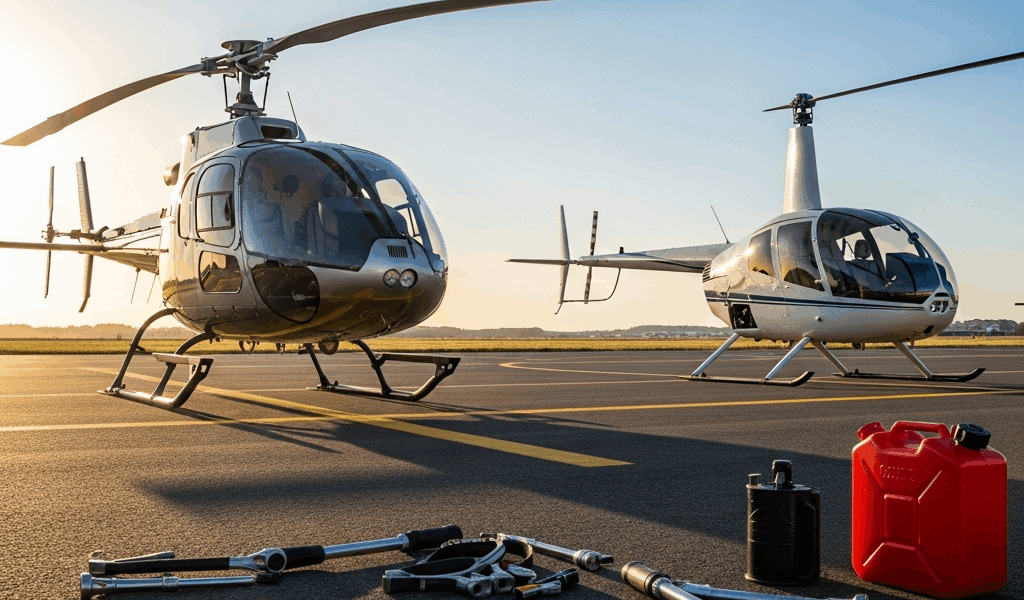
What These Two Helicopters Are Actually Competing For
The Airbus H125 vs Robinson R66 debate has gotten complicated with all the spec-sheet noise flying around. I’ve watched this conversation play out at operator meetups, flight school open houses, and over genuinely terrible coffee at HAI Heli-Expo — someone walks in with between $900K and $3M burning a hole in their acquisition budget, they want a turbine single, and suddenly these two wildly different machines end up on the same whiteboard. That’s the actual competitive set. Not H125 vs Bell 407. Not R66 vs Cabri. These two.
Both are turbine singles. Both pull in tour operators, charter outfits, and serious owner-pilots who’ve graduated from pistons and want something that won’t scare them at altitude. The price gap is enormous — a new H125 runs roughly $2.8M to $3.2M depending on how you configure it, while a new R66 lands between $900K and $1.1M. Used markets compress that gap somewhat, though not enough to make the comparison pointless. But what is the real question here? In essence, it’s which helicopter fits the mission and the financial reality of whoever is signing the check. But it’s much more than that — and most of the content floating around online refuses to treat those as separate problems.
So, without further ado, let’s dive in.
Performance Numbers That Actually Matter
Published specs are a starting point. Not a verdict.
Airbus H125
The H125 — powered by the Safran Arriel 2D, producing around 952 shaft horsepower — was essentially engineered for the Alps. Frustrated by the altitude limitations of earlier light turbines, Airbus designed this one using real-world data from high-mountain operators running missions where failure wasn’t an option. EASA certified it at a maximum takeoff weight of 2,722 kg, roughly 6,000 lbs. Useful load in a standard configuration runs close to 1,400 lbs, and with full fuel — 143 gallons — you’re still moving real payload. Cruise sits around 130 knots. Density altitude capability is legitimately impressive. Operators in the Himalayas and Andes run these routinely above 15,000 feet MSL. The manufacturer claims a service ceiling north of 23,000 feet, and real operator experience out of places like Lukla, Nepal, backs that up. This helicopter was not compromised for high altitude. It was designed for it.
Robinson R66
The R66 runs a Rolls-Royce RR300 turbine — derated to around 270 shaft horsepower at sea level — with a max gross weight of 2,700 lbs. Useful load hovers around 1,150 lbs, and payload with full fuel (73.8 gallons) drops to somewhere in the 600–700 lb range in real-world operator experience. Cruise is published at 110 knots, which lines up with what pilots actually report. The R66 handles altitude better than the R44 it replaced — no question there. But it is not an H125. Operators in Colorado and Montana report meaningful performance degradation in summer at density altitudes above 9,000–10,000 feet. That requires real payload discipline. That’s not a fatal flaw, honestly. That’s a planning constraint.
The honest takeaway: if payload-with-full-fuel is your decision driver — and for commercial operators it absolutely should be — the H125 wins by a margin that matters operationally, not just on paper.
Ownership Costs Nobody Puts in the Brochure
Probably should have opened with this section, honestly. Performance sells helicopters. Economics determines whether operators survive owning them.
Acquisition
New H125: $2.8M–$3.2M. Used H125 — 2015–2018 vintage, mid-time engine — runs $1.4M–$1.9M depending on avionics stack and configuration. New R66: $900K–$1.1M. Used R66 from the same era, low-time, comes in around $650K–$800K. The used market has tightened on both. The H125 used market is thinner, though — fewer units in private hands means fewer distressed sales showing up when you need them.
Engine Overhaul Economics
The Arriel 2D has a TBO of 3,000 hours. An overhaul runs approximately $350,000–$450,000 depending on the shop. The RR300 carries a TBO of 2,200 hours, with overhaul costs in the $80,000–$120,000 range. On a per-hour basis, the H125 carries roughly $130–$150 in engine reserve. The R66 runs somewhere in the $40–$55 range. Those numbers matter a lot when you’re logging 300–400 hours per year as a charter operator. Do the math before you fall in love with the airframe.
Maintenance Infrastructure
The R66 is Robinson simple. 100-hour inspections are straightforward, parts move quickly, and Robinson’s support network is global. The H125 requires more — Airbus Helicopters service centers, specialized tooling, technicians who actually know the Arriel platform. Not impossible. Just more expensive and more logistically demanding. For an owner-pilot operating out of a smaller FBO, that infrastructure gap is real and it will find you eventually.
Insurance and Hangar
H125 hull insurance on a $2M aircraft runs $40,000–$60,000 annually for a commercial operator with clean history. R66 at $900K runs $12,000–$20,000. Hangar footprint is similar — the H125 is larger but not dramatically so. Budget the hangar as a wash between the two.
Rough Cost Per Hour
- H125 (owner-operated, 300 hours/year): $800–$1,100/hour all-in
- R66 (owner-operated, 300 hours/year): $350–$500/hour all-in
The H125 does not pencil out for most private operators without a revenue stream attached. A flight school or active charter program isn’t optional — it’s load-bearing for the entire financial model.
Mission Fit — Where Each One Wins and Loses
I’m apparently someone who learns things the hard way, and defaulting to capability without understanding the mission works for nobody while costing everyone real money. Don’t make my mistake. Stumped once by a client asking me to recommend one without disclosing his operation, I went with the H125 because it’s objectively more capable. The operator was running Gulf Coast aerial photography at 500–1,500 feet AGL, averaging 200 hours per year — no external load work, no altitude, no heavy lift. The R66 would have served him better and cut his fixed overhead roughly in half. Capability you don’t use is overhead you can’t recover.
Where the H125 Wins
- High-altitude operations — Rocky Mountain lodge access, helicopter skiing, anything above 8,000 feet DA on a warm summer day
- External load and utility work — The H125 is a legitimate workhorse. Longline, construction support, power line patrol
- High-volume commercial tours — Grand Canyon, Glacier, any operation moving multi-passenger loads repeatedly where payload margin is a daily operational concern
- Demanding charter environments — Offshore, mountain rescue support, anything where you need margin and actual power reserves
Where the R66 Wins
- Cost-conscious owner-pilot operations — Flying 150–250 hours per year personally, the R66’s economics are hard to argue with
- Smaller tour and charter operations — Low-altitude, lower-density markets where the H125’s capability premium doesn’t generate a corresponding revenue premium
- Turbine-level flight training — The R66 is increasingly used for turbine transition and advanced training. Straightforward systems, lower operating cost, honest handling
- First turbine for an owner-pilot stepping up — Simpler, more forgiving operationally, and the consequences of a rough financial year are survivable
Concrete example: a Montana ranch operator flying guests into a private strip at 8,200 feet MSL in August — two passengers, bags, warm day — needs the H125. Not because the R66 can’t get there. It might. But the margin disappears and mission reliability suffers in ways that become very apparent very fast. Contrast that with a Florida operator running 30-minute coastal tours at 500 feet with two passengers at sea level. The R66 handles that mission comfortably, costs less to operate, and doesn’t drag along infrastructure demands that were never relevant to the mission anyway. That’s what makes each machine endearing to us operators — they’re both honest about what they are, once you’re honest about what you actually need.
So Which One Should You Actually Buy
Here’s the framework. No waffling.
Buy the R66 if: your operation stays below 7,000 feet DA, your annual utilization runs under 400 hours, you’re an owner-pilot without a dedicated maintenance team on the payroll, or you’re entering the turbine market and need the financial exposure to remain survivable if things go sideways. Also buy it if you’re running a training operation — the economics work and the aircraft is honest about its limits.
Buy the H125 if: your mission profile includes regular high-altitude ops, external loads, or commercial multi-passenger tours where payload margin is a daily operational variable. The H125 might be the best option for revenue-generating commercial work, as demanding terrain requires genuine performance reserves — that is because the cost premium only earns its keep when the mission is actually pushing the envelope. While you won’t need a full Airbus service center in your backyard, you will need a handful of qualified MRO relationships and the budget discipline to support 400+ hours per year with paying flights.
The used market creates a middle path worth considering seriously. A well-maintained 2016 H125 at $1.6M is a different conversation than a new one at $3M — same mission capability, economics that move meaningfully closer together. First, you should have a pre-purchase inspection done by a shop that knows the Arriel platform specifically — at least if you want to avoid inheriting someone else’s deferred maintenance headaches. Do not sleep on that option if you’re cross-shopping seriously.
One last honest thing. Both of these helicopters will expose the gap between the pilot you think you are and the pilot you actually are. The H125 at altitude with a full load is not the place to discover you’ve been sloppy about performance planning. The R66 in a hot-and-high scenario with overconfident loading is the same problem — just at a lower price point. The helicopter that fits you is the one whose limitations you’ve already made peace with before you sign the paperwork.

Stay in the loop
Get the latest aero weenie updates delivered to your inbox.