What Kind of Pilot Is Even Asking This Question
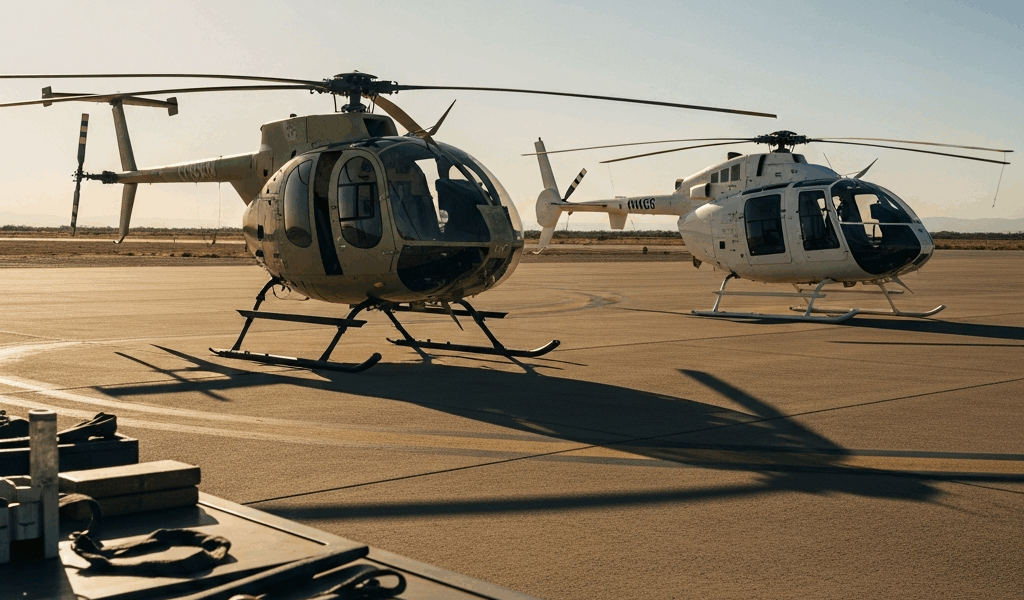
The MD 500 vs Bell 407 debate has gotten complicated with all the spec-sheet noise flying around. So let me cut through it. This question isn’t coming from a student pilot watching YouTube at midnight — it’s coming from someone who already has turbine time. Maybe a few hundred hours in a Robinson R66 or an Airbus H120. Maybe more. Either way, you’re staring at a real purchase decision with real money attached, and the difference between getting this right and getting it wrong is significant.
You’re looking at tour operations, utility contracts, high-altitude mountain work, or you’ve simply decided life is short and you want a machine that doesn’t apologize for itself. Fair enough. The price gap between these two airframes is honest and wide. A well-maintained used MD 500E runs somewhere in the $800,000 to $1.2 million range — depending on hours and avionics stack. A used Bell 407GXi will set you back $1.8 million to $2.8 million without blinking. That delta buys a lot of jet fuel. Or it doesn’t. Depends entirely on what you’re actually asking the helicopter to do.
Today, I’ll share everything I’ve learned about both platforms. So, without further ado, let’s dive in.
Performance Numbers That Actually Matter on a Real Mission
Spec sheets are written by marketing departments. Here’s what the numbers look like once a real mission is attached to them.
MD 500E — Small Airframe, Surprisingly Honest Numbers
- Cruise speed: 130–135 knots true at altitude
- Useful load: Approximately 1,100 lbs depending on configuration
- Range: Around 230–250 nm with standard fuel, no reserve games
- Hot-and-high: The Allison 250-C20B — or C20R in later variants — is a genuine performer at density altitude. Think 8,000 feet DA with meaningful payload still available
- Seats: Five total, but four adults with bags is where the arithmetic starts getting uncomfortable
The 500 punches above its weight at altitude. Ask anyone who’s flown tours out of Sedona or done utility work in the Rockies — the little NOTAR or T-tail ship climbs when heavier turbines are already sweating. That’s not a myth or a marketing line. It’s physics. A power-to-weight ratio that genuinely favors the smaller airframe when the air gets thin. That’s what makes the 500E endearing to us mountain operators.
Bell 407GXi — Where the Premium Actually Shows Up
- Cruise speed: 133–140 knots true, marginally faster in most conditions
- Useful load: Approximately 1,650–1,700 lbs — a full 500+ lbs more than the 500E
- Range: 330+ nm with auxiliary tanks; standard tanks give you around 270 nm comfortably
- Hot-and-high: The Rolls-Royce 250-C47B delivers more flat-rated power with better reserve on hot days — the 407 carries more people further at altitude without as much compromise
- Seats: Six passengers plus pilot, with actual adult-sized legroom
The 407’s useful load advantage is the number that wins arguments. If you’re running paying passengers, cargo, or EMS-adjacent missions, 500 additional pounds of useful load isn’t a spec sheet footnote. It’s the difference between a profitable flight and a repositioning flight. That’s a real operational distinction — one that compounds across hundreds of flight hours.
Operating Costs and Parts Availability in the Real World
Probably should have opened with this section, honestly. For most buyers evaluating these two airframes, the purchase price is just the opening bid.
MD 500 — Great Helicopter, Occasionally Annoying to Support
Wet hourly operating costs for the MD 500E typically land in the $600–$850 range — based on community-sourced estimates from operator forums and HAI conference conversations, not official manufacturer figures, which tend toward optimism. The Allison 250 series is a known quantity with a solid overhaul network. TBO on the C20B sits at 3,500 hours, which is respectable. Engine support is genuinely not the problem.
The airframe parts situation is where you earn your ownership experience. MD Helicopters has gone through enough corporate restructuring over the years that parts lead times can run long — and prices can surprise you. Rotor system components, tail boom parts, certain structural items. I’ve spoken with operators who described waiting weeks. Occasionally months. Frustrated by unexpected AOG situations, successful 500 operators typically build a meaningful parts inventory on the shelf before the need arises, using everything from Bell surplus dealers to niche MD-specific brokers. That’s not a dealbreaker. It’s a planning requirement. Talk to an MD-experienced A&P before you sign anything. Budget for consignment parts as part of your acquisition cost. Don’t make my mistake of treating parts availability as an afterthought.
Insurance runs notably lower on the 500 than the 407 — the lower hull value drives that math directly. Ballpark figures from brokers put annual premiums for a private operator with 500+ turbine hours somewhere in the $12,000–$18,000 range for the 500E. The 407 runs $22,000–$35,000. Your specific numbers will vary based on mission, base location, and pilot history.
Bell 407 — Premium Cost, Premium Support Network
Wet hourly for the 407GXi runs $950–$1,200 in most operator estimates. The Rolls-Royce 250-C47B carries a 3,500-hour TBO, and the support network is genuinely excellent. Bell’s global dealer structure means parts availability is measurably better than the MD ecosystem. I’m apparently a Bell 407 guy at this point, and the support infrastructure works for me in a way that the MD parts situation never quite did. Operators I’ve talked with said they’ve never waited more than 48 hours for a critical airframe component on the 407. That kind of dispatch confidence has real dollar value when your aircraft is revenue-generating.
The 407 costs more per hour to operate. Full stop. Whether that cost is justified depends entirely on what you’re charging — or what the mission demands.
Cockpit and Systems — Single Pilot IFR Friendliness
But what is single-pilot IFR friendliness, exactly? In essence, it’s how much the aircraft fights you when you’re heads-down in actual IMC with no one in the right seat. But it’s much more than that — it’s panel layout, avionics integration, training pipeline, and whether the cockpit itself was designed with the workload in mind.
Bell 407GXi — The Grown-Up Panel
The 407GXi ships from the factory with the Garmin G1000H NXi integrated avionics suite. Large-format primary flight display, moving map, synthetic vision, coupled autopilot options, traffic awareness. It is genuinely capable single-pilot IFR equipment. Bell put real thought into crew resource management ergonomics — the cockpit is wide enough that you’re not performing origami to reach the circuit breakers. Training availability is strong. FlightSafety International runs standardized 407 courses, and type-specific IFR training is accessible in a way that actually builds real-world capability rather than just checking a box.
MD 500E — Cozy Is One Word for It
Frustrated by the cockpit constraints of earlier-generation turbine helicopters, engineers designed the 500 series using a tight, minimalist philosophy that prioritized weight savings and visibility over elbow room. The result is a cockpit that’s famously intimate. Some pilots call it “sporty.” In practice, retrofitting modern glass avionics requires careful planning, a strong avionics shop, and acceptance that panel real estate has physical limits. Garmin GTN 750Xi installations have been done — and they look sharp — but you’re working within constraints the 407 simply doesn’t impose. Single-pilot IFR in a 500 is legal with the right equipment and rating. It’s also a more workload-intensive experience. Type training exists but is less standardized than the Bell pipeline. Expect to work harder to find a structured curriculum.
So Which One Should You Actually Buy
Tour operations in demanding environments — Grand Canyon, Alaska coastal, high-altitude utility contracts — the Bell 407 is the correct answer. The payload margin, the parts network, the revenue-seat count, and the reliable dispatch rate justify the premium. Running a commercial operation on thin margins with an airframe that might ground you waiting on a rotor component is a business risk, not just an inconvenience.
Personal ownership where the mission is mountain flying, ranch work, or the pure satisfaction of owning one of the most agile turbine helicopters ever certificated — the MD 500 makes a compelling case. It is genuinely fun to fly in a way few aircraft at any price match. The handling is direct, the hot-and-high performance is real, and the lower operating costs leave room in the budget for actual flying hours rather than maintenance reserves.
If single-pilot IFR is a meaningful part of your intended mission profile — corporate transport, long cross-country flying in actual IMC — the 407GXi isn’t just the better choice. It’s the only defensible one between these two options. The 500 can be equipped for IFR. It asks more of the pilot to achieve what the 407 delivers more naturally.
Buy the 500 because you love helicopters. Buy the 407 because you love what helicopters can do for your operation. Both answers are legitimate — but they’re not the same answer, and confusing them is an expensive mistake that no amount of cruise speed comparison will fix.
The MD 500 will make you a better pilot. The Bell 407 will make you a more reliable operator. Only you know which one you actually need right now.



Stay in the loop
Get the latest aero weenie updates delivered to your inbox.