What You’re Actually Comparing Here
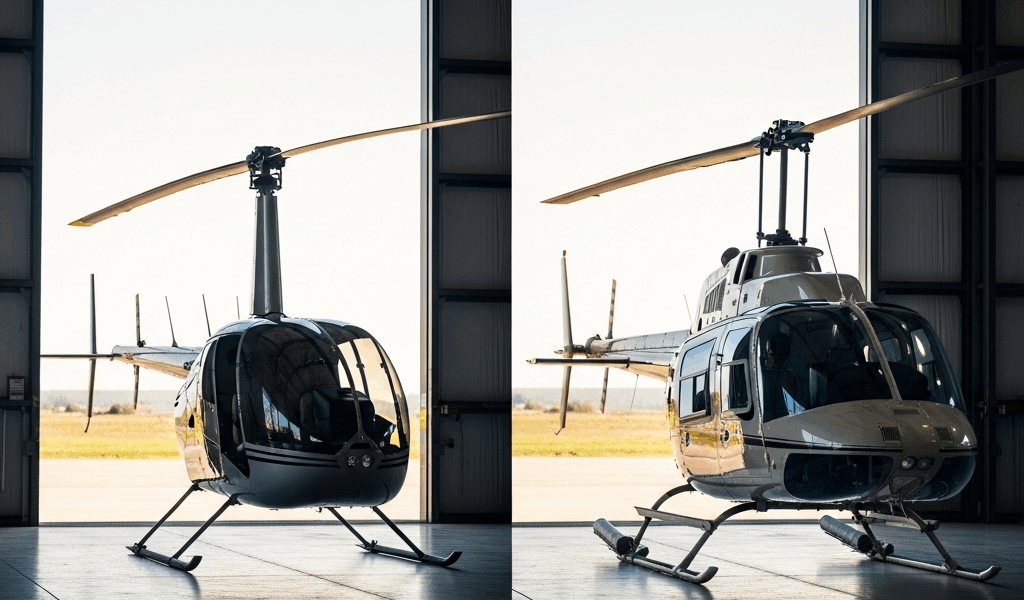
Robinson R44 vs Bell 206 JetRanger operating costs has gotten complicated with all the spec-sheet noise flying around. As someone who spent years around both aircraft — at small operators, through private owners who fly both types regularly, at FBOs where these machines sit side by side — I learned everything there is to know about what these things actually cost. Today, I will share it all with you.
These two helicopters cross-shop more than you’d think. A low-time used Bell 206B can land in the same price neighborhood as a new Robinson R44 Raven II. That creates a genuine decision point. The buyer sitting on that fence is usually one of three people: a private owner doing 100–150 hours a year for personal travel, a small tour operator trying to build something sustainable, or a flight school owner eyeing the dual-use case. Each of those profiles gets a different answer from the numbers below. So, without further ado, let’s dive in.
Purchase Price and Financing Reality
A new Robinson R44 Raven II sits around $385,000–$410,000 from the factory as of 2024. Used Raven IIs with 1,000–1,500 hours move in the $180,000–$260,000 range — depending on avionics, paint, and how well the logbooks tell the story.
Used Bell 206B JetRangers are more complicated. A decent mid-time 206B — say 3,000–4,500 total hours — might list at $280,000–$380,000. Bell 206L LongRangers push higher, often $400,000–$550,000 for similar time. On paper, a $290,000 turbine sounds like a steal when a new piston sits at $395,000.
Don’t make my mistake. I spent weeks treating those sticker prices as the real comparison number. They aren’t. Lenders know the difference between piston and turbine — they price it in. Turbine helicopters often require larger down payments. Twenty to thirty percent is common. Interest rates from aviation lenders like AOPA Finance or US Aircraft Finance tend to run slightly higher on older turbine platforms — residual value is harder to predict on a 1970s-era airframe. The R44 has a more predictable depreciation curve. Lenders like that.
A low-time 206 looks attractive on paper until you ask one question: when was the last hot section inspection, and who paid for it?
Hourly Operating Costs Side by Side
Probably should have opened with this section, honestly. This is what you actually came for.
Fuel
The R44 Raven II runs a Lycoming O-540 six-cylinder piston on 100LL AvGas. Real-world cruise burn sits around 13–15 gallons per hour. At a national average of roughly $6.50/gallon for 100LL, you’re looking at $85–$98 per hour in fuel.
The Bell 206B runs an Allison 250-C20B turbine. Jet-A consumption in cruise runs about 23–27 gallons per hour. Jet-A averages $5.80–$6.20/gallon at most FBOs right now. That puts 206 fuel cost at $133–$167 per hour. Turbines win on fuel cost per gallon. They lose badly on consumption volume. That gap matters more than most people realize before they actually start filling tanks.
Engine Overhaul Reserve
This is the number that changes everything. The Lycoming O-540 in the R44 Raven II carries a 2,200-hour TBO. Factory overhaul runs approximately $30,000–$38,000. Set aside $14–$17 per flight hour as your reserve.
The Allison 250-C20B is a different story entirely. Hot section inspection hits every 1,750 hours — roughly $25,000–$40,000 at shops like Turbine Engine Center or StandardAero. Full overhaul at 3,500 hours can run $90,000–$130,000. Conservatively, you need to reserve $38–$52 per flight hour for engine work on the 206. That is not a soft number. Find a 206 operator, mention the last overhaul invoice, and watch their face.
Rotor and Dynamic Components
R44 main rotor blades, tail rotor, dynamic components — reserving around $12–$18 per hour covers most operators when averaged across a typical ownership cycle.
The Bell 206 carries a more complex rotor system with life-limited components that have real replacement costs attached. Realistic reserve: $22–$30 per hour for dynamic components. That’s what the numbers say. Operators who ignore it find out the hard way.
Oil Consumption and Incidentals
The R44 burns about a quart of Phillips X/C 20W-50 every 8–10 hours. Negligible. The Allison 250 uses MIL-PRF-23699 spec turbine oil at roughly a quart every 10–12 hours. Also negligible in the broader cost picture. These numbers essentially cancel each other out.
The Totals
- R44 Raven II variable cost per hour: approximately $115–$140
- Bell 206B JetRanger variable cost per hour: approximately $200–$260
Surprised by the gap? Most people who haven’t actually sat down and done the overhaul math are. That’s what makes this comparison so endearing to us helicopter people — the turbine always sounds cooler until the spreadsheet shows up.
Fixed Annual Costs Nobody Talks About
Burned by ignoring fixed costs on a previous analysis I ran for a small operator in 2021, I now put these first on any spreadsheet. Every time.
Insurance
For a private owner — 500+ total hours, current instrument rating — R44 hull and liability insurance on a $250,000 aircraft runs roughly $8,000–$12,000 annually. Pilots with fewer than 200 hours in type pay more. Sometimes significantly more. Some underwriters quote $15,000+ without blinking.
A Bell 206B insured at $320,000 hull value, same pilot profile, runs $14,000–$22,000 per year. I’m apparently a “moderate risk” profile and Avemco works for me while Global Aerospace never quite quoted the same number twice — but both confirm turbine premiums run meaningfully higher. Lower hours in type adds another $5,000–$8,000 to that premium. Easily.
Hangar and Tiedown
Hangar costs vary wildly by region. In the midwest, a T-hangar big enough for an R44 might run $400–$650/month. In the northeast or California, budget $800–$1,400/month for comparable space. The 206 is physically larger — more floor space required — and that sometimes pushes you into a larger hangar category. Add $100–$200/month in certain markets. Small number. Adds up over twelve months.
Annual Inspection
R44 annuals at a Robinson Service Center typically run $2,500–$4,500 depending on what squawks surface. Bell 206 annuals are longer, more involved — budget $5,000–$9,000, and that assumes no surprises in the tail rotor gearbox or fuel control unit. There are usually surprises.
Avionics Subscriptions and Other Fixed Costs
Garmin Pilot or ForeFlight subscriptions run $100–$200/year regardless of airframe. Flying with a GTN 650Xi or similar panel adds another $600–$1,200/year in database subscriptions. These costs are identical between platforms — neither one wins here.
Total fixed annual costs, conservatively: R44 at roughly $22,000–$32,000/year, Bell 206 at $34,000–$52,000/year — before a single hour of flight time.
So Which One Should You Actually Buy
But what is the real deciding variable here? In essence, it’s annual hours flown. But it’s much more than that.
Under 150 hours annually — which describes most private owners — the R44 Raven II wins on economics in a way that isn’t close. Lower fixed costs, lower variable costs, easier financing, and a parts ecosystem Robinson has deliberately kept accessible. The performance gap between a piston R44 and a turbine 206 is real at altitude or in hot-and-high conditions. It does not justify an extra $25,000–$40,000 per year in total operating cost for someone flying the mountains of Colorado on weekends.
Over 200 hours annually in a revenue-generating context — tours, charter, utility work — the 206 starts making a different kind of sense. Payload, turbine reliability reputation with commercial clients, density altitude performance where the R44 runs out of margin — all of that matters operationally. The economics still favor the R44 on pure cost-per-hour math, but a 206 with seats actually being filled can justify the premium. That’s what makes the JetRanger endearing to us commercial operators — when the mission fits, it fits completely.
Frustrated by the allure of a cheap turbine, many buyers end up owning a very expensive helicopter they fly 80 hours a year — purchased optimistically using a $290,000 price tag as the primary justification. The most honest thing I can tell you sounds like something you’d hear leaning against a hangar door at sunset: buy the R44 unless you have a specific mission the R44 cannot fly, because the 206 will cost you twice as much to own — and half as many people admit that until after the first annual.



Stay in the loop
Get the latest aero weenie updates delivered to your inbox.