Meet the Contenders
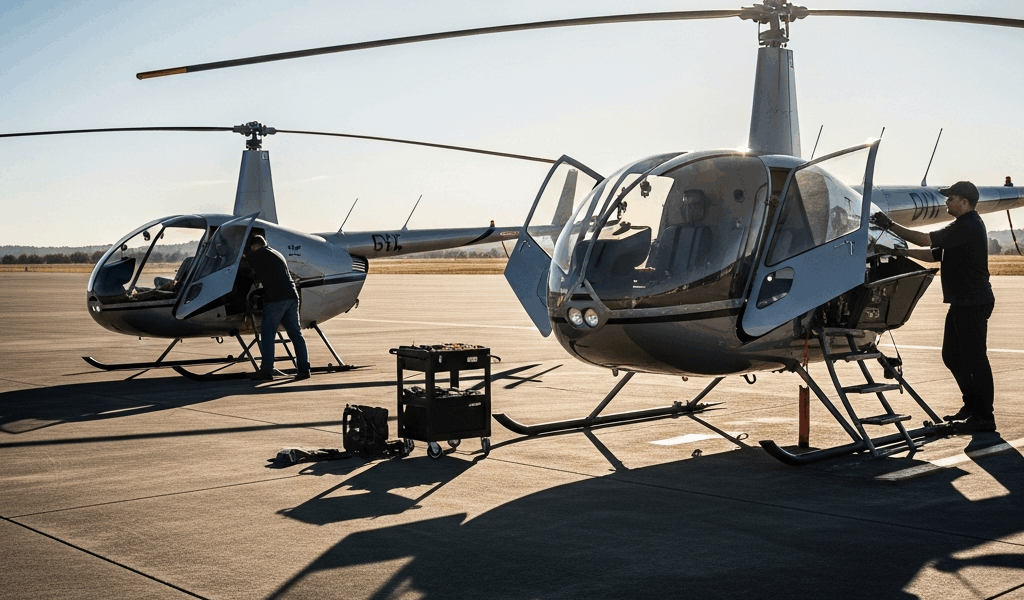
Picking between the Robinson R44 and the Guimbal Cabri G2 has gotten complicated with all the spec-sheet noise flying around. As someone who has logged genuine ramp time with both machines — not just read the brochures in a waiting room — I learned everything there is to know about where these two actually differ. Today, I will share it all with you.
The R44 showed up in 1993. It runs a Lycoming IO-540 six-cylinder piston engine, hauls four people, and has basically become the default helicopter for private ownership and training across the U.S. It is, for better or worse, the Honda Civic of rotorcraft. Everyone has flown one. Everyone has a hot take. Parts are everywhere. The Cabri G2 is a different creature entirely — Hélicoptères Guimbal out of France introduced it in 2012, it seats two, runs a Lycoming O-360 four-cylinder, and wraps everything in a carbon fiber and fiberglass composite airframe with a fenestron enclosed tail rotor. Flight schools have started quietly swapping their aging R22s for Cabri G2s, and a few are eyeing it as an R44 replacement too. That’s the tension here. Proven American workhorse versus a scrappy European newcomer slowly winning converts one CFI at a time. That’s what makes this comparison endearing to us rotorhead types. So, without further ado, let’s dive in.
Performance and Handling Back to Back
Honestly, on paper these two are frustratingly close. The R44 Raven II cruises somewhere between 110 and 116 knots, service ceiling sits around 14,000 feet, range lands near 300 nautical miles on standard fuel. The Cabri G2 cruises at roughly 100 to 108 knots, service ceiling comes in near 16,000 feet depending on conditions, range around 280 to 300 nautical miles. Neither helicopter embarrasses the other in straight-line numbers. Hover performance is similarly matched at any altitude a student is likely to see. Neither one runs away with the spec sheet — which means the real story lives in how they actually feel underfoot and what surrounds them operationally.
But what is a fenestron tail rotor? In essence, it’s an enclosed shrouded fan built into the tail boom instead of an exposed blade assembly. But it’s much more than that. The design is meaningfully quieter during ground operations and substantially less exposed during low-hover maneuvering and confined area work. For training environments — where students flare early, drift sideways, and generally try their best to injure machinery — that tail rotor protection carries real safety weight. The Cabri also brings a more modern cockpit layout and lighter control forces overall. Some instructors love it. Some old-school pilots find the feel disconcertingly soft. I’m apparently a chronic over-controller, and the Cabri’s feather-light inputs never really worked for me at first — took a solid twenty minutes before I stopped chasing the aircraft around the sky. Don’t make my mistake. Brief yourself on the control sensitivity before you ever pull pitch.
What It Actually Costs to Own and Operate
Probably should have opened with this section, honestly. This is what most people actually need to know, and it’s what they spend the least time researching before writing a check.
New prices first. A new Robinson R44 Raven II runs approximately $358,000 to $380,000 depending on configuration. A new Guimbal Cabri G2 comes in around $280,000 to $310,000 — sounds like a bargain until you dig into what happens after delivery. The used market tells a different story entirely. A clean 2015 to 2018 R44 with reasonable hours moves in the $180,000 to $240,000 range without much drama. Finding a used Cabri in the United States is genuinely difficult, and when you do locate one, you’re negotiating with a seller who knows the supply is thin. That’s not a great position for a buyer.
TBO costs matter enormously here. The R44 Raven II’s IO-540 carries a 2,200-hour TBO — factory overhaul runs around $30,000 to $35,000. Airframe overhaul comes due at 2,200 hours as well. Robinson’s parts ecosystem is enormous by comparison to almost anything else in piston rotorcraft. Overhauled components, PMA parts, mechanics who’ve done this a hundred times — all abundant, all accessible. The Cabri’s O-360 engine is a common, affordable unit. That part is genuinely fine. The composite airframe is where the maintenance conversation gets complicated fast. Composite repair requires specific training and materials that most small U.S. shops simply don’t stock. Ding the tail boom on a tug, and you may be waiting on parts from Europe or shipping to a specialty facility three states away. That cost doesn’t appear anywhere in the sales brochure.
- R44 Raven II fuel burn — approximately 15 to 17 gallons per hour at cruise
- Cabri G2 fuel burn — approximately 8 to 10 gallons per hour at cruise
- At $6.00 per gallon avgas, that works out to roughly $96–$102 per hour for the R44 versus $48–$60 per hour for the Cabri
- Insurance for a new R44 with a 200-hour private pilot typically lands between $8,000 and $12,000 annually
- Cabri insurance runs broadly similar but varies more — insurers are still getting comfortable with the type
The Cabri’s fuel economy is its single strongest financial argument, especially for flight schools running high-cycle training operations. At 1,000 hours annually, fuel savings alone approach $40,000. That’s real money — not rounding error. It still needs to be weighed against parts sourcing friction and a thinner resale pool when the time eventually comes to move the aircraft along.
Training School vs Private Owner — Who Should Buy Which
Flight Schools
The Cabri G2 wins the training school argument — and it’s not particularly close. Frustrated by the persistent problem of tail rotor strikes during student ground operations, engineers designed the fenestron specifically to address the most common training accident category, using an enclosed shroud and composite integration that exposed designs simply can’t match. The composite airframe, while more specialized to repair, tolerates minor contact better than the R44’s aluminum structure. Lighter controls build better habits in students earlier. The fuel economy at high training cycles generates real annual savings that compound fast. Schools that have made the switch report higher student satisfaction scores and lower insurance incident rates. The one legitimate counterargument — that incoming students often already hold R22 or R44 time — is real but shrinking as the Cabri spreads through the training ecosystem.
Private Owners
Private owners should buy the R44. Full stop. Used market depth means you can find the right airframe at the right price, negotiate from an informed position, and exit without bleeding value into a shallow buyer pool. Mechanics who know the R44 intimately exist in virtually every regional aviation hub in the country. Parts are cheap. Parts are available. Parts are frequently on the shelf. The four-seat cabin means you can bring family without a weight-and-balance crisis eating your preflight. The R44 is not the most modern or fuel-efficient helicopter in this comparison — I’m not pretending otherwise. But for a private owner who wants to fly weekends, build time, and eventually sell without stress, it is the correct answer.
The Verdict — Stop Overthinking It
Tormented by a choice between two perfectly good helicopters, most buyers end up doing absolutely nothing for six months. Don’t be that person. Here is the direct answer.
Buy the Robinson R44 if you are a private individual who wants proven reliability, a massive parts network, strong resale liquidity, and the ability to carry more than one passenger without running advanced math first. Buy the Guimbal Cabri G2 if you operate a flight school, run high training cycles, and can absorb a more specialized maintenance supply chain in exchange for better safety margins, dramatically lower fuel burn, and a genuinely modern training platform.
Both helicopters are good. Neither will embarrass you on the ramp. The R44 wins on practicality for private ownership; the Cabri wins on the training line. Pick the one that matches your actual use case — not the one that sounds coolest at the fuel pump. I’m apparently the kind of person who needed to hear that fifteen years ago and didn’t. Don’t make my mistake.


Stay in the loop
Get the latest aero weenie updates delivered to your inbox.