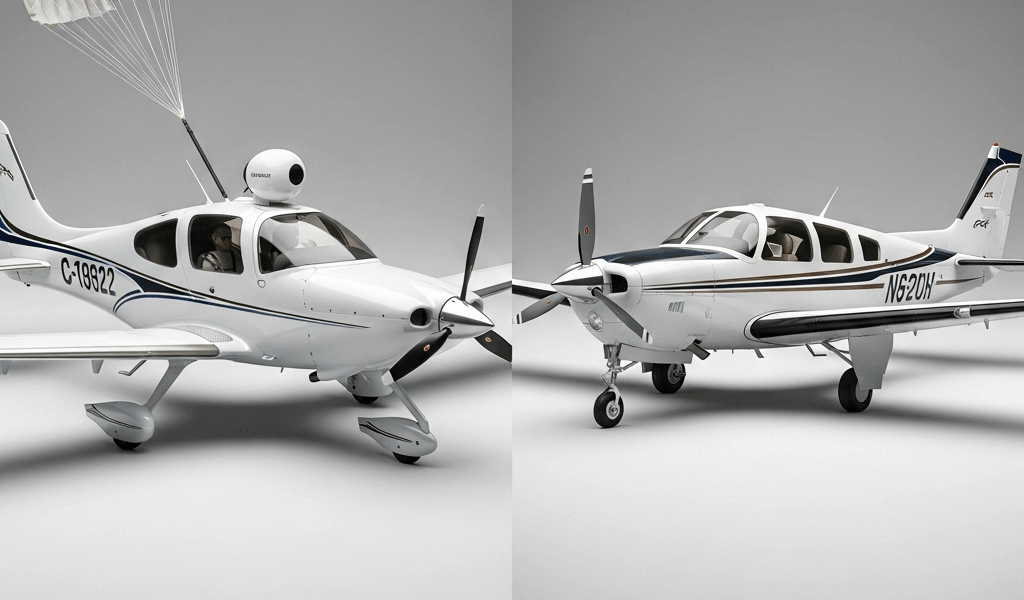
Cirrus SR22 vs Bonanza G36 — Which Four-Seat Single Should You Buy?
The Cirrus SR22 vs Bonanza G36 debate has been running hot on every aviation forum since roughly 2004, and I have sat on both sides of it. I logged about 340 hours in a 2007 SR22 GTS that a flying club I belonged to operated out of Scottsdale, and then spent two years as a co-owner of a 2015 Bonanza G36 based at Centennial Airport in Colorado. I am not going to pretend I have no opinion. But I am also not going to pretend one airplane wins every category, because that would be dishonest and it would waste your time. These are two genuinely excellent machines built around fundamentally different answers to the same question: what does safety mean to a private pilot?
Here is what I can tell you from actual seat time — the choice between these two airplanes is not really about avionics or cruise speed. It is about philosophy. And your philosophy had better match the airplane you buy, or you will spend a lot of money being quietly miserable at the ramp.
The Philosophical Divide — Parachute vs Retractable Gear
Startled by the accident statistics the first time I really dug into NTSB reports, I came to understand that most single-engine piston fatalities are not engine failures. They are loss-of-control events, disorientation in IMC, and fuel mismanagement. The Cirrus Aircraft Protection System — CAPS — addresses a different failure mode than anyone was designing for in 1947 when the Bonanza first flew. That context matters.
CAPS is a ballistic parachute system that deploys the entire airframe. As of mid-2024, it has been credited with saving more than 210 lives across the Cirrus fleet. That is not a marketing number — those are documented activations with survivors. The SR22 carries a BRS-6 rocket-deployed parachute rated for deployment at speeds up to 133 knots and altitudes as low as 920 feet AGL in level flight. The system adds roughly 57 pounds to the airplane’s empty weight and costs somewhere between $15,000 and $18,000 to repack after a deployment. It also has a mandatory repack interval every ten years regardless of activation. Factor that in.
What CAPS does is give a non-instrument-rated pilot, or a disoriented instrument-rated one, a genuine last resort. Pull the handle and the airplane comes down under a canopy. You will probably survive. You may walk away. That is extraordinary.
The Bonanza G36 answers the safety question differently. It is built on 75-plus years of refinement, operates with retractable gear, and demands a higher level of systems awareness from the pilot. The Continental IO-550-B engine it runs is one of the most proven powerplants in general aviation. Retractable gear adds roughly 15 knots of cruise speed compared to a fixed-gear equivalent — but it also adds a failure mode. Gear-up landings happen. Not often, but they happen. And the Bonanza’s systems generally reward pilots who stay proficient and punish those who get casual.
That is not a knock on the airplane. It is a description of the contract you sign when you buy a complex, high-performance aircraft. The Bonanza community will tell you — correctly — that a well-trained, current Bonanza pilot operating within the aircraft’s limitations has an excellent safety record. The data supports that. What CAPS does is compress the skill curve on the catastrophic end of the distribution. The Bonanza does not offer that compression.
Neither approach is wrong. But they are genuinely different. A pilot who flies 150 hours a year, stays instrument current, and does regular recurrent training is probably not giving up much safety by choosing the Bonanza. A pilot who flies 80 hours a year, lets the instrument ticket lapse, and occasionally stretches fuel reserves should probably be flying the Cirrus.
Acquisition and Operating Costs
Probably should have opened with this section, honestly, because cost eliminates one of these airplanes for a lot of buyers before the philosophy conversation even starts.
A new 2024 Cirrus SR22 in standard trim is priced around $1.025 million. Step up to the SR22T — the turbocharged version — and you are at $1.25 million before options. A new Bonanza G36 lists at approximately $900,000. Both are eye-watering numbers, and both reflect the reality that new certified piston production aircraft are built in quantities that make cars look like mass manufacturing.
The used market is where most buyers actually shop, and here the numbers get more interesting. A 2015 SR22 G5 in good condition with a mid-time engine trades between $380,000 and $450,000. A comparable 2015 Bonanza G36 trades between $480,000 and $550,000 — the Bonanza actually holds its value slightly better on the used market, partly because production numbers are lower. A 2010 SR22 GTS with a fresh overhaul can be found for $275,000 to $310,000 if you are patient and willing to shop VREF and controller.com thoroughly.
Hourly Operating Costs
Based on figures from the Conklin & de Decker aircraft cost tool and my own logbooks, expect these ballpark operating costs for owner-flown missions in the 150-hour-per-year range:
- Cirrus SR22 (normally aspirated) — approximately $641 per hour all-in, including fuel at current avgas prices, engine reserve, maintenance, insurance, hangar, and prop reserve
- Bonanza G36 — approximately $550 per hour on the same basis
The SR22’s Lycoming IO-550-N burns about 15.5 gallons per hour at 75 percent power. The Bonanza’s Continental IO-550-B burns roughly 14.8 gallons per hour at a similar power setting. The fuel difference sounds minor, but at $6.50 per gallon for 100LL, it adds up across 150 annual hours.
Insurance is where the SR22 often surprises people. Contrary to what you might expect given CAPS, hull insurance on an SR22 runs higher than on a comparable Bonanza for most pilot profiles — because the airplane costs more and because insurers price to the hull value, not the safety system. A 500-hour private pilot with an instrument rating insuring a $400,000 SR22 might pay $9,000 to $12,000 annually. A similar pilot insuring a $500,000 Bonanza G36 might pay $11,000 to $14,000, though training requirements are typically stricter and the initial premium reflects that.
Annual inspection costs differ meaningfully. The SR22’s fixed gear and relatively straightforward systems make annuals run between $2,500 and $5,000 at a Cirrus-authorized service center, assuming no squawks. The Bonanza’s retractable gear system, complex fuel system, and the notorious requirement to keep up with Beechcraft service bulletins — particularly around the spar carry-through structure — can push annuals to $4,000 to $8,000. My first Bonanza annual at Centennial was $6,200. I had budgeted $3,500. Lesson learned.
Cabin Comfort and Useful Load
Slide into the back seat of a Bonanza G36 and then slide into the back seat of an SR22. You will notice the difference immediately. The Bonanza’s cabin is 44.5 inches wide at the shoulders. The SR22’s is 49 inches wide. Wait — that seems backward from what most people expect. The SR22 is actually wider. But the Bonanza is configured as a six-place airplane, meaning the rear cabin section is designed around genuine adult occupancy with folding third-row seats, not just theoretical capacity. Rear seat legroom in the G36 is noticeably better than in the SR22, and for a family hauling teenagers or adults who are not yoga instructors, that matters on a three-hour cross-country.
The SR22 is definitively a four-place airplane despite the occasional fifth-seat argument. The Bonanza offers genuine utility for five occupants with modest baggage, or four adults with real luggage.
Useful Load and Payload With Full Fuel
Here is where spreadsheet math becomes ramp math. The SR22 G5 has a published useful load of approximately 1,092 pounds. Fill the 92-gallon tanks to full and you burn 552 pounds of fuel capacity, leaving around 540 pounds for people and bags. Four adults at the FAA standard 190 pounds each equals 760 pounds. You cannot do it with full fuel. You are always trading fuel for passengers.
The Bonanza G36’s useful load is approximately 1,100 pounds, slightly higher. With 74 usable gallons aboard — 444 pounds of fuel — you have 656 pounds left for payload. Four adults at 190 pounds is 760 pounds. Same math problem, slightly different numbers. Neither airplane hauls four full-sized adults and full fuel without a payload compromise. That is honest piston single reality.
The Bonanza wins on baggage. Its aft baggage compartment holds 270 pounds and 23 cubic feet. The SR22’s combined baggage areas total 130 pounds and 13.3 cubic feet. If you are the type who takes real road-trip luggage rather than a duffel bag, the Bonanza’s trunk is meaningfully more useful.
Avionics and Panel Ergonomics
Forced to choose a winner on the panel, I give it to Cirrus without hesitation. The Perspective+ avionics suite built around dual Garmin G1000 NXi displays with synthetic vision, the Cirrus Airframe Parachute System activation handle integrated into the panel design, and the overall cockpit workflow reflect twenty years of Cirrus learning from how actual owner-pilots use their avionics. The sidestick controller is divisive — some pilots love it, some hate it — but the overall human factors design is excellent.
The Bonanza G36 ships with the Garmin G1000 NXi as standard equipment from Beechcraft, and it is a capable panel. It just feels like the avionics were fitted to an airframe that was designed before glass panels existed, because they were. The Bonanza panel is less integrated, less ergonomically intentional. It still works beautifully, but the SR22 cockpit feels purpose-built in a way the G36 does not.
The Verdict — Match the Mission
After all of this, here is what I actually believe about who should buy which airplane.
Family of Four Doing Weekend Trips
Either airplane works. If your typical mission is a Friday evening departure with two adults and two kids under 14, a weekend bag each, and a 300-nautical-mile leg, the SR22 handles it comfortably. If one of those kids has become a large adult child, or you regularly fly with a fifth occupant, the Bonanza’s cabin and extra seat capacity tip the scales. The SR22’s fixed gear makes it lower-maintenance and simpler to fly for pilots who are not flying constantly. For the occasional-but-serious pilot who averages 100 to 120 hours per year with family on board, the SR22’s CAPS system provides a margin that a reasonable parent will value.
Safety-Conscious Owner-Pilot
Buy the SR22. This is not debatable in my view. If CAPS has saved 210 documented lives and you can afford the airplane, the philosophical argument for choosing a parachute-equipped airframe for yourself and your family is compelling. The system is not infallible — it requires sufficient altitude to deploy, and it cannot save you from all scenarios — but it changes the survivability math on the scenarios that actually kill people in piston singles. No retractable gear, simpler systems, and a genuine last resort if everything goes wrong.
Long Cross-Country Missions
The Bonanza G36 earns its keep here. Longer legs, better rear seat comfort for adult passengers, more baggage capacity, and a cabin that feels less like a sports car cockpit on hour three. If your typical mission profile is a 600-nautical-mile leg with two adults, luggage for a week, and a preference for arriving without a backache, the G36’s combination of range and cabin livability is genuinely better. The Continental IO-550-B at cruise is also notably smoother than the Lycoming IO-550-N — that may be partly confirmation bias, but I do not think so entirely.
New to High-Performance Singles
The SR22 wins this category clearly. Fixed gear eliminates the gear-up landing failure mode entirely. Simpler systems reduce the cognitive load during busy phases of flight. Cirrus’s own training ecosystem — the CSIP program and the Cirrus Approach transition training curriculum — is genuinely good and widely available. The Bonanza is not a difficult airplane for a well-trained pilot, but it demands that you actually be well-trained and that you stay current with the airplane’s systems. The SR22 is more forgiving of the occasional lapse in recency.
Bought outright today with my own money and my family’s comfort and safety in mind, knowing what I know after flying both types extensively — I would buy the SR22. Not because the Bonanza is worse. It is not worse. It is a magnificent airplane with a legitimate claim to being the finest piston single ever produced. I would buy the SR22 because I do not fly 200 hours a year anymore, because my kids occasionally ride right seat, and because the parachute represents a type of safety margin that money can buy and that I would rather have than not have. Your calculation may differ. It should differ. That is the point.
Match the mission. Then match the philosophy. The hangar queen you admire is not the right airplane — the airplane that fits how you actually fly is.
For a deeper look at the whole-airframe parachute, useful-load tradeoffs, training and ownership checks, read our complete Cirrus SR22 guide.


Stay in the loop
Get the latest aero weenie updates delivered to your inbox.