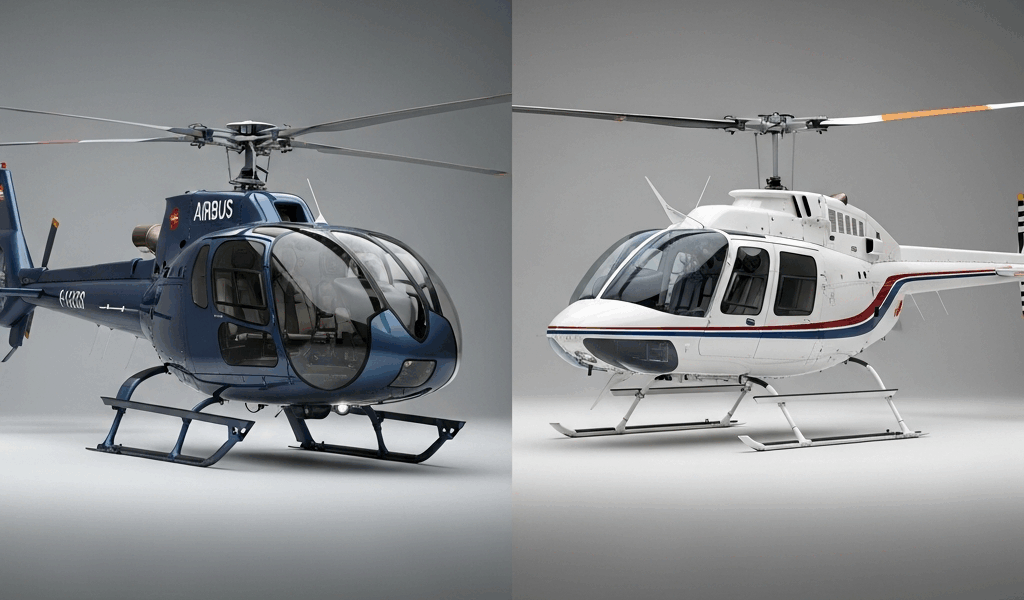
Airbus H125 vs Bell 505 — Which Light Turbine Helicopter Wins?
The Airbus H125 vs Bell 505 debate comes up constantly in light turbine circles, and honestly, the fact that nobody has written a genuinely useful comparison from an operational standpoint is a little baffling. Most of what’s out there reads like a brochure rewrite. Spec tables, sure. Engine ratings, yes. But what it actually feels like to operate one of these machines 250 hours a year, in real terrain, with real fuel bills and real insurance premiums — that’s what’s missing. I’ve flown both platforms across a range of commercial roles, and I’ve spoken to tour operators in the Grand Canyon corridor, flight school directors in Texas, and utility contractors running utility patrol in western Canada. The picture that emerges is more nuanced than any manufacturer’s marketing department wants you to believe.
Neither helicopter is universally better. That’s the honest answer. But for your specific mission profile, one of them is almost certainly the right choice — and picking the wrong one is an expensive mistake. I know, because I watched a training school in Arizona buy an H125 before realizing the Bell 505’s G1000H NXi suite aligned far better with their instrument syllabus. The aircraft got sold eighteen months later at a loss. Let’s make sure that’s not your story.
H125 vs Bell 505 at a Glance
Before getting into the weeds on mission performance, it helps to have the hard numbers in front of you. Here’s how the two aircraft compare on the specs that actually matter to operators.
| Specification | Airbus H125 | Bell 505 Jet Ranger X |
|---|---|---|
| Engine | Safran Arriel 2D (847 shp) | Safran Arrius 2R (504 shp continuous) |
| MTOW | 2,250 kg (4,960 lb) | 1,520 kg (3,351 lb) |
| Useful Load | ~1,020 kg (2,249 lb) | ~680 kg (1,499 lb) |
| Cruise Speed | 245 km/h (132 kt) | 232 km/h (125 kt) |
| Service Ceiling | 7,010 m (23,000 ft) | 5,486 m (18,000 ft) |
| Sling Load Capacity | 1,400 kg (3,086 lb) | 907 kg (2,000 lb) |
| Cabin Volume | 2.61 m³ | 2.69 m³ |
| Standard Avionics | Analog (glass aftermarket) | Garmin G1000H NXi (standard) |
| New Acquisition Cost (approx.) | $2.8M–$3.2M USD | $1.5M–$1.8M USD |
A few things jump out immediately. The H125 costs roughly twice as much to buy new. It carries significantly more payload and can operate at altitudes that the Bell 505 simply cannot reach. The Bell 505, on the other hand, ships from the factory with a glass cockpit suite that pilots genuinely love, at a price point that makes it accessible to owner-operators and flight schools without a fleet-level budget.
Probably should have opened with this section, honestly. The cost gap alone shapes everything downstream — financing, insurance, residual value assumptions, and the break-even analysis for any commercial operation.
Power and Performance — Where the H125 Pulls Ahead
Pushed by a Safran Arriel 2D producing 847 shaft horsepower, the H125 is in a different weight class from the Bell 505 the moment you depart a high-elevation helipad on a hot afternoon. I’ve departed the Kananaskis helipad in Alberta — elevation roughly 4,800 feet, ambient temperature around 30°C — with a full utility load, and the H125 just climbs. There’s no white-knuckle power margin calculation happening in your head. That’s a real thing. Ask any pilot who’s done that in an aircraft with marginal power reserve, and you’ll hear a very different story.
The H125’s Arriel 2D is rated for a 30-minute OEI (one engine inoperative) power of 1,020 shp, which doesn’t apply in a single-engine aircraft but tells you something about headroom. In normal operations, the engine rarely gets asked to work hard. That margin is what makes hot-and-high operations feel routine rather than stressful.
The Hot-and-High Reality
Service ceiling comparisons on paper — 23,000 feet for the H125 versus 18,000 feet for the Bell 505 — sound abstract. In practice, the difference shows up not at cruise altitude but at the departure and landing zone. Mountain tour operations above 8,000 feet density altitude, firefighting support at elevation, or ski resort shuttle work all expose the Bell 505’s power limitations faster than the spec sheet suggests.
That said, the Bell 505 handles standard-condition operations — sea-level tours, pipeline patrol at low altitude, training circuits — with complete competence. The Arrius 2R is a reliable, proven engine with a healthy TBO and parts availability that Bell has done a solid job supporting. This isn’t a knock on the 505. It’s an honest acknowledgment that the aircraft was designed for a different performance envelope.
Sling Load Operations
The H125’s 1,400 kg sling load capacity is a genuine operational differentiator. Utility contractors doing construction support, powerline installation, or remote resupply in mountainous terrain pick the H125 for a reason. The Bell 505’s 907 kg limit is more than adequate for light utility and firefighting bucket operations, but it removes the aircraft from consideration for serious construction lift work.
One utility operator I spoke to in British Columbia put it simply: “The 505 is a great aircraft, but I can’t build transmission towers with it. The H125 earns its cost back inside three seasons of tower work.” That’s the calculation. Revenue-per-flight-hour matters, and sling capacity is a direct multiplier on that number.
Speed and Range
The cruise speed delta — 132 knots for the H125 versus 125 knots for the Bell 505 — is real but modest. For tour operations running 30–40 minute loops, it’s essentially irrelevant. For ferry work or long-distance utility positioning, those seven knots accumulate. Neither aircraft is particularly long-range without ferry tanks, but the H125’s larger fuel capacity gives it a meaningful endurance edge in roles where repositioning fuel costs are significant.
Avionics and Cockpit — The Bell 505 Glass Advantage
Walk up to a new Bell 505 and open the cockpit door, and you’re looking at a Garmin G1000H NXi integrated avionics suite. Two 10.4-inch primary flight displays. Synthetic vision. WAAS GPS. Traffic advisory. Terrain awareness. It’s a genuinely modern, well-integrated system that Garmin and Bell co-developed specifically for the 505 platform. It’s not bolted on. It talks to the aircraft’s systems natively.
Walk up to a new H125 from the factory — unless you’ve specifically ordered the Helionix option or paid for an aftermarket glass installation — and you’re looking at conventional analog instrumentation. The Helionix system exists and is excellent, but it’s an upgrade package, not standard equipment. A full Helionix fit in an H125 adds somewhere in the neighborhood of $200,000–$350,000 to the acquisition cost depending on configuration. That’s a real number that changes the budget conversation significantly.
What Pilots Actually Think of the G1000H NXi
Having flown the G1000H NXi suite in the 505, I can tell you the integration is genuinely good. The synthetic vision terrain display is particularly useful in canyon and mountain tour work where situational awareness margins matter. The system’s familiarity is also a practical training benefit — pilots transitioning from fixed-wing glass cockpits or training aircraft equipped with Garmin avionics already know the logic and menu structure.
Flight schools especially value this. If your students are building toward instrument ratings and commercial certificates, training them in a G1000H NXi environment isn’t just convenient — it’s pedagogically coherent. The Arizona school I mentioned earlier learned this lesson the hard way after purchasing the H125.
The H125 Helionix System
Airbus’s Helionix suite is a different animal — more deeply integrated with the aircraft’s health monitoring and VEMD (Vehicle and Engine Multifunction Display) than the Garmin system, and it carries four-axis autopilot capability in its higher-tier configurations. For serious IFR operations, offshore work, or EMS missions, Helionix is arguably the more sophisticated option. But it’s not standard, and it’s not cheap, and for most light turbine buyers in the tour or training segment, it’s overkill.
The honest pilot verdict: if cockpit technology matters to your mission or your training syllabus, the Bell 505 delivers a better out-of-the-box experience at a significantly lower price. If you’re buying an H125 for utility or high-altitude work where the avionics package is secondary to raw performance, the standard fit is adequate.
Operating Costs — What Owners Actually Spend Per Hour
This is the section where most comparisons go vague. “Operating costs vary by region and operator.” Thanks, helpful. Let me give you actual numbers based on conversations with operators running these aircraft commercially in North America, cross-referenced with published maintenance data.
Fuel Burn
The H125 burns approximately 200–220 liters per hour (53–58 US gallons per hour) at cruise power. The Bell 505 burns approximately 135–155 liters per hour (36–41 US gallons per hour) at comparable conditions. At $2.50 USD per liter for Jet-A (a reasonable mid-2024 reference price across many US and Canadian regional FBOs), that translates to:
- H125 fuel cost — approximately $500–$550 per flight hour
- Bell 505 fuel cost — approximately $338–$388 per flight hour
Over a 250-hour operating year, that fuel differential runs between $28,000 and $53,000 USD. That’s a significant number. It’s not the whole cost picture, but it’s the number that shows up on the credit card every week and gets noticed.
Maintenance Intervals and Parts
The H125 operates on a condition-monitored and on-condition maintenance philosophy, with the Arriel 2D having a TBO (time between overhaul) of 3,000 hours. Major gearbox and rotor head components have their own interval schedules. Maintenance reserve estimates for H125 operators typically run $350–$500 per flight hour depending on operation type and whether the aircraft is on a Safran HELPASS or equivalent power-by-the-hour program.
The Bell 505 with the Arrius 2R runs a similar on-condition philosophy. Bell’s Maintenance Cost Guarantee program (which Bell has offered in various forms) provides some cost predictability. Operator-reported maintenance reserves for the 505 run approximately $250–$380 per flight hour, again depending on operation type and whether you’re on a flat-rate program.
The gap is real but not enormous. Both aircraft benefit meaningfully from power-by-the-hour programs that normalize the unpredictable cost spikes that come with unscheduled maintenance. For a 200–300 hour per year operator, being on a program matters more than which aircraft you chose — budget variability is the enemy of cash flow planning.
Insurance
Insurance premiums vary enormously by pilot experience, operational category, and insurer appetite, but ballpark figures for commercial operations in the US as of 2023–2024: H125 hull and liability coverage for a commercial operator with experienced pilots runs approximately $45,000–$75,000 annually. Bell 505 coverage for comparable operations runs $22,000–$40,000 annually. The lower hull value of the 505 drives most of that delta.
All-In Hourly Cost Estimate
For a 250-hour-per-year commercial operator, blended total operating cost (fuel, maintenance reserve, insurance amortized, routine consumables) runs approximately:
- H125 — $1,100–$1,400 per flight hour
- Bell 505 — $750–$950 per flight hour
Those numbers don’t include debt service on acquisition financing, pilot wages, or hangar rent — costs that apply equally to both aircraft. They represent the aircraft-specific cost of keeping the machine in the air.
The H125’s higher hourly cost can absolutely be justified when the revenue premium from utility work or high-performance tour operations is factored in. A full sling load operation billing at $2,500–$3,500 per flight hour makes $1,300 in operating costs look very different than a $600-per-hour scenic tour operation does.
Which One Should You Buy
Fine. Here are the verdicts, by use case. No hedging.
Tour Operator
If you’re running tours at sea level or low elevation — Grand Canyon South Rim, coastal tours, urban sightseeing — the Bell 505 is the financially rational choice. Lower acquisition cost, lower operating cost, glass cockpit that impresses passengers, and a cabin volume (2.69 m³) that’s marginally larger than the H125’s for the passenger experience. The 505 seats five including the pilot, which matches the H125’s tour configuration.
If you’re operating above 7,000 feet density altitude regularly — Grand Canyon North Rim, Alaskan glacier tours, Rocky Mountain corridor operations — the H125 is the only sensible answer. Pilots operating marginal-power aircraft in those corridors are one hot afternoon away from a very bad day. The H125’s power margin at altitude isn’t a luxury; it’s a safety asset with measurable actuarial value.
Flight Training School
Bell 505. Full stop. The G1000H NXi suite’s alignment with modern training syllabi, the lower acquisition cost that reduces per-aircraft capital exposure, and the lower hourly operating cost that makes training more affordable for students — these three factors together make the 505 the dominant choice for training operations. Several established flight academies in the US and Australia have already built turbine transition syllabi around the 505 platform for exactly these reasons.
The H125’s performance capabilities are largely irrelevant to training operations conducted at normal elevations and in VFR conditions. You’re paying for performance you’re not using.
Utility Operator
H125, without much debate. The sling load capacity, hot-and-high performance, and proven utility configuration options — cargo hooks, cargo baskets, wire strike protection systems, hoist installations — make the H125 the established platform for serious utility work. The global support network for H125 utility configurations is mature in a way the Bell 505 simply isn’t yet, partly because the 505
Buyers considering a smaller first turbine should also compare the Robinson R66 and Bell 505 by mission, support and total ownership.



Stay in the loop
Get the latest aero weenie updates delivered to your inbox.