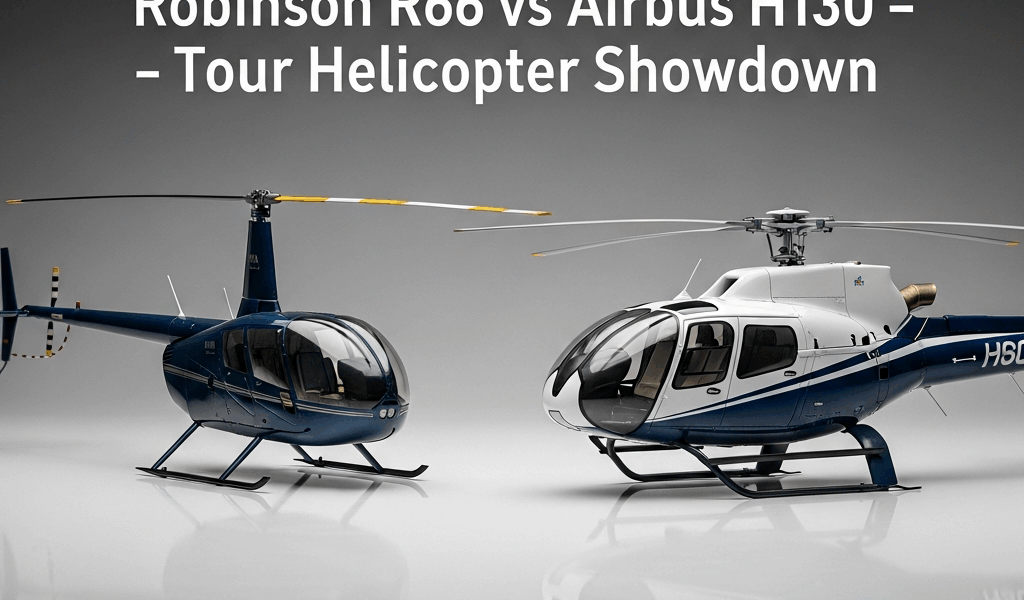
Robinson R66 vs Airbus H130 — The Numbers That Matter
The Robinson R66 vs Airbus H130 debate comes up in almost every serious tour operator conversation I’ve had over the past decade, and yet almost nobody has written a straight comparison that accounts for what operators actually care about — not just rotor diameter and empty weight, but the real question: which one makes you more money while keeping your customers happy enough to leave five-star reviews. I’ve spent time in both aircraft, talked to fleet managers from Kauai to the Grand Canyon to the Swiss Alps, and made at least one expensive mistake personally when advising a client to go a direction that looked good on paper and didn’t hold up operationally. More on that later.
First, the raw numbers — because you can’t have the argument without them.
| Specification | Robinson R66 Turbine | Airbus H130 (EC130 T2) |
|---|---|---|
| Engine | Rolls-Royce RR300 (300 shp) | Turbomeca Arriel 2D (952 shp) |
| Passenger Seats | 4 | 6–7 |
| Cruise Speed | 110 knots | 133 knots |
| Range | 350 nm | 340 nm |
| Max Gross Weight | 2,700 lb (1,225 kg) | 5,291 lb (2,400 kg) |
| Fuel Burn (approx.) | 23 gph | 42–47 gph |
| Noise Certification | Standard ICAO Chapter 8 | 7 dB below ICAO Chapter 8 |
| New Purchase Price (approx.) | $1.1–$1.2 million USD | $3.5–$4.2 million USD |
| Tail Rotor Design | Conventional | Fenestron (shrouded) |
| Useful Load | ~1,100 lb | ~1,764 lb |
The seat count differential is where this comparison starts getting interesting — and where a lot of operators get the math wrong before they’ve even flown either aircraft. Four passengers versus six or seven is not a 50% increase in revenue potential. Depending on your tour price point and load factor, it can be the difference between a viable business model and one that requires everything to go right every single day.
The H130 also uses the Fenestron tail rotor system — that enclosed, shrouded tail fan design that Airbus has been refining since the late 1960s on various platforms. It’s not just cosmetically different. It genuinely changes the acoustic character of the aircraft in a way that matters enormously in specific operating environments. More on that in the next section.
Probably should have opened with this section, honestly. Every operator conversation I’ve ever had eventually circles back to these numbers, usually after someone has already half-committed to a decision based on what a salesperson told them at Heli-Expo.
Passenger Experience — The H130 Advantage
Dragged into a side-by-side demo flight in Scottsdale a few years back, I remember sitting in the H130’s rear bench seat and noticing immediately that the window beside me was enormous — floor-to-ceiling wraparound glass that genuinely made the cabin feel more like a gondola than an aircraft. That’s not an accident. The H130 was explicitly designed with the tourism market in mind, and the Airbus engineers optimized the cabin geometry around that Fenestron tail rotor, which allowed them to eliminate the large tail rotor clearance concerns that shape conventional helicopter cabin layouts.
The windows on the H130 are genuinely class-leading. The forward-facing seats get an unobstructed view over the instrument panel area, and the rear passengers get those sweeping panoramic side windows. For a Grand Canyon flight or a Hawaii coastline tour, this is a genuine operational differentiator that shows up in your TripAdvisor ratings. I’ve seen operators track this metric specifically. It matters.
The Noise Advantage — What 7 dB Actually Means
The H130 is certified 7 dB below ICAO Annex 16 Chapter 8 noise requirements. That sounds like a technical footnote. It isn’t. Decibels are logarithmic — a 7 dB reduction represents roughly a 50% reduction in perceived acoustic energy. The Fenestron design reduces the sharp, impulsive blade-passing noise that makes conventional tail rotors distinctive and, frankly, unpleasant on long scenic flights.
For passengers, this means they can have an actual conversation during the flight without resorting to the shouted, leaning-in-close communication style that ruins the romance of the experience. For operators in noise-sensitive locations — think Lauterbrunnen in Switzerland, or the communities around Kauai’s Na Pali Coast, or the neighborhoods adjacent to New York’s downtown heliport — this noise certification has direct operational and regulatory implications.
Several National Park Service concession agreements now contain noise-threshold language. The H130’s certification profile gives operators meaningful flexibility in those negotiations. The R66, for all its virtues, is a conventional helicopter with conventional noise characteristics. It’s quieter than a piston Robinson R44, certainly, but it’s not in the same conversation as the H130 on acoustics.
Cabin Layout and Weight Limits
The H130’s useful load of approximately 1,764 pounds means you can actually fill those six or seven seats with real-world passengers without running weight and balance calculations that require a moment of quiet optimism. If you’ve operated a four-seat turbine in a tourist market, you know exactly what I’m talking about — the pre-flight ritual of weighing passengers, reshuffling seating arrangements, and occasionally having a very uncomfortable conversation with someone who provided a creative estimate of their body weight when booking.
The R66 at approximately 1,100 pounds useful load and four seats can hit its limits with two large adults up front and two in the back, especially at density altitude. Phoenix in August. Aspen year-round. Anywhere in Hawaii above 4,000 feet. The H130 handles these scenarios with margin to spare.
Operating Economics — Where the R66 Wins
Here’s where my earlier mistake becomes relevant. I once advised a small startup tour operator in Utah — running Bryce Canyon and Zion routes — to acquire an H130 as their first aircraft based on the passenger experience argument. The aircraft was magnificent. The operation lasted fourteen months before they restructured. The economics just didn’t pencil out at their volume and price point.
The R66 is the lowest-cost-per-flight-hour turbine helicopter commercially available. Full stop. That’s not a Robinson marketing claim — it’s a number that holds up across multiple independent operator surveys and maintenance cost analyses I’ve reviewed.
Fuel — The Number That Compounds Daily
The R66 burns approximately 23 gallons per hour at cruise. The H130 burns 42 to 47 gallons per hour depending on conditions, loading, and power settings. At current Jet-A prices averaging around $6.50 per gallon at general aviation facilities — and significantly higher at remote or island locations — that fuel differential works out to roughly $125–$156 per flight hour.
Run those numbers against a realistic operational schedule. Say 800 flight hours per year, which is achievable for a busy tour operation. The R66 saves you somewhere between $100,000 and $125,000 per year in fuel alone compared to the H130. That’s not nothing. That’s a pilot salary. That’s your maintenance reserve fund. That’s the down payment on your second aircraft.
Maintenance — The Rolls-Royce RR300 Factor
The R66 uses the Rolls-Royce RR300 engine, a purpose-developed variant of the RR250 series that has been flying in helicopters since the 1960s and has an extraordinarily mature support infrastructure. Overhaul costs, parts availability, and mechanic familiarity with the platform are all working in the R66’s favor. The engine TBO (time between overhaul) is set at 2,200 hours, and the overhaul cost runs approximately $60,000–$80,000 through authorized service centers — expensive, but predictable.
The H130’s Turbomeca Arriel 2D is an excellent, reliable engine. But it’s more powerful, more complex, burns more fuel, and costs substantially more to overhaul. The overall variable maintenance cost per flight hour on the H130 runs roughly $180–$230 depending on your operator-to-manufacturer program enrollment. The R66 runs $80–$110 per flight hour in comparable analyses.
Acquisition Cost — The Capital That Shapes Everything
A new Robinson R66 Turbine lists in the $1.1 to $1.2 million range. A new Airbus H130 T2 lists between $3.5 and $4.2 million depending on configuration, avionics package, and interior spec. That’s a $2.3 to $3 million capital differential. On a ten-year financing basis at commercial aviation lending rates around 7.5%, the annual debt service difference between the two aircraft is approximately $275,000–$340,000 per year.
You need to generate a lot of additional revenue from those extra two or three seats to close that gap. At a typical scenic tour price point of $200–$300 per passenger, you’d need to fly 900–1,700 additional passengers per year just to cover the financing differential before accounting for the higher operating costs. For a high-volume operation — think Blue Hawaiian Helicopters or Maverick Aviation volume levels — those numbers are achievable. For a regional operator flying 1,500 total passengers per year, they aren’t.
Which Tour Operators Should Buy Which
The answer isn’t ambiguous once you’ve done the math honestly. These are two fundamentally different tools with different target customers and different business models.
Buy the H130 If —
- You operate in a noise-sensitive environment where community relations or regulatory compliance demand the quietest certified helicopter available
- Your price point is $400 per person or higher and your brand identity is built on premium experience
- You operate in a high-demand, high-volume corridor where the additional two to three seats per flight directly translates to meaningfully more revenue per departure slot
- You have a National Park Service concession or similar agreement where noise certification language creates competitive advantage
- You operate regularly at high density altitude where the H130’s greater power margin becomes an operational safety and reliability factor
- Your marketing differentiates on passenger comfort, window views, and the conversation-friendly cabin environment
The operators who’ve built sustainable H130 fleets in the tourism market — companies running Grand Canyon West flights, Hawaii volcano tours, European Alps transfers — share a common characteristic. They charge enough per seat that the economics work, and they’ve identified a customer segment that will pay for the experience differential. That customer exists. It’s a real market. But it’s not every market.
Buy the R66 If —
- You’re launching a new operation and capital preservation in the early years is existential
- Your tours are priced at $150–$300 per person and volume throughput matters more than per-seat premium
- You operate in a non-noise-restricted environment where the H130’s acoustic advantages don’t translate into regulatory or competitive benefits
- You run a mixed-use operation — tours plus charter, aerial photography, utility work — and need the lowest possible cost per flight hour to remain competitive across all revenue streams
- You’re building toward a larger fleet and want to start generating profit while you scale, rather than betting the entire operation on a single high-value asset
The R66 is genuinely underrated in the tour helicopter conversation. Operators who run it well — tight cost control, good maintenance programs, efficient scheduling — report some of the strongest margins in the sector. The aircraft is not glamorous. Passengers don’t post Instagram videos of the R66’s panoramic windows. But at $23 per hour in fuel and 4 seats generating revenue, the numbers work in a way that forgives a lot of imperfect days.
The Fleet Combination Worth Considering
Several of the most financially stable mid-size tour operators I’ve encountered run a mixed fleet — one or two H130s positioned as the premium product at a higher price point, supported by one or two R66s handling the volume business and back-filling when the H130 is down for scheduled maintenance. This approach gives you the marketing credibility of the Airbus product while maintaining the operational cushion of the Robinson economics. It’s not a strategy for a startup. But if you’re at a stage where you’re buying your third or fourth aircraft, the combination deserves serious analysis.
The Robinson R66 vs Airbus H130 question doesn’t have a universal answer. It has a correct answer for your specific operation, your specific market, your specific price point, and your specific capital position. The operators who get into trouble are the ones who buy the aircraft they admire rather than the aircraft their business model requires. Don’t be that operator.


Stay in the loop
Get the latest aero weenie updates delivered to your inbox.