Two Trainers That Could Not Be More Different
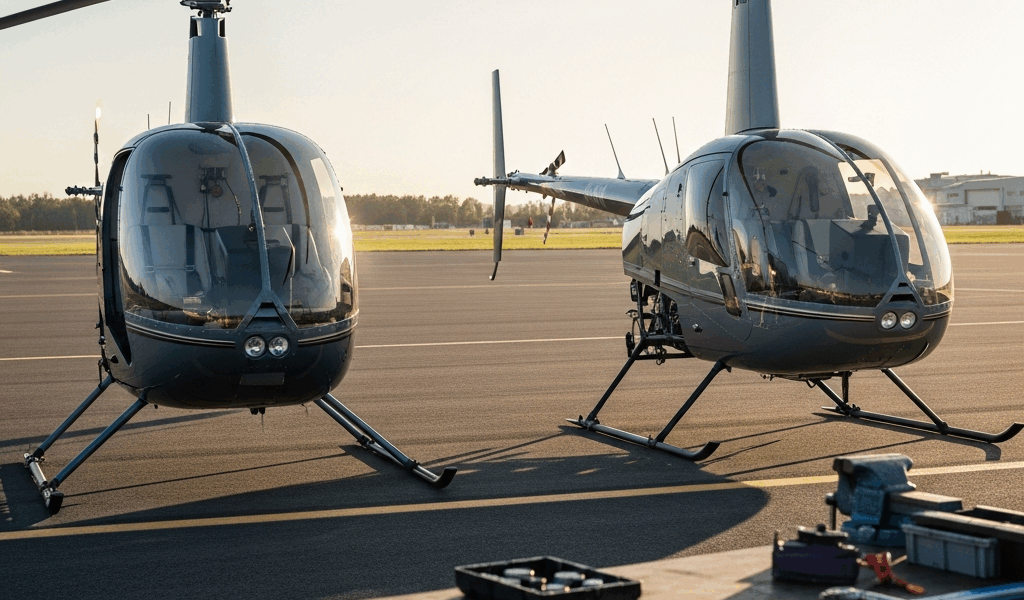
The Guimbal Cabri G2 vs Robinson R22 debate has gotten complicated with all the tribal loyalty and brand cheerleading flying around. Ask ten CFIs which one wins and you will get eleven opinions, two arguments, and at least one person quietly texting their insurance broker. As someone who logged roughly 40 hours in an R22 Beta II before climbing into a G2 for the first time, I learned everything there is to know about what separates these machines — and what that transition actually feels like from the left seat. Today, I will share it all with you.
The R22 is a legend. Full stop. It trained more helicopter pilots than any other aircraft in history, and dismissing it because something newer exists is revisionism that ages badly. That said — the moment I settled into the G2 after the R22, something felt immediately different. Some of it was good. Some of it was humbling. There was definitely one moment where I reached for a collective configured nothing like I expected. So without further ado, let’s dive in.
We are judging both aircraft across four areas: real-world specs and performance, safety records and training environment, operating costs for schools, and which machine actually fits your situation — whether you are a student or an operator shopping for three ships.
Specs and Performance, Back to Back
Starting with the raw numbers. The Robinson R22 Beta II carries a max gross weight of 1,370 lbs, a useful load hovering around 490–510 lbs depending on configuration, and cruises at roughly 96 knots. Power comes from a Lycoming O-360-J2A producing 145 hp — derated in practice. Range sits around 200 nautical miles with reserves. The rotor system is a semi-rigid two-blade teetering design. That detail matters enormously for everything that comes later.
The Guimbal Cabri G2 brings a max gross of 1,653 lbs and a useful load closer to 573 lbs. Cruise speed is similar — right around 100 knots — and it runs the same Lycoming O-360-J2A family, same 145 hp rating. Range stretches to roughly 380 miles on standard tanks. But what is the biggest mechanical difference? In essence, it is the rotor system. The G2 uses a fully articulated three-blade design with individual blade flapping, lead-lag, and feathering. But it is much more than that — because bolted to the tail is a fenestron.
The fenestron — that enclosed tail rotor shroud — is not aesthetic packaging. During hover training over uneven ground, during pedal turns near fence lines, near any obstacle a nervous student misjudges on a Tuesday morning lesson, that housing matters. New students have genuinely terrible spatial awareness. The fenestron does not make tail rotor strikes impossible. It changes the geometry of where they can occur. That is a meaningful distinction.
Safety Record and Training Environment
Probably should have opened with this section, honestly. For most flight school operators, safety data is the deciding factor before any spreadsheet ever gets opened.
The R22 carries an NTSB history that deserves honest treatment — not dismissal, not panic. The aircraft was involved in a disproportionate number of fatal accidents during the 1980s and 1990s. Many involved low-rotor-RPM events, specifically mast bumping in the semi-rigid teetering rotor during low-G flight. Robinson responded. Mandatory safety notices went out. The Low-G pushover warning became a fixture of R22 training. Accident rates improved substantially after that. This is not a death trap. But the underlying design physics that enabled those accidents? Those have not changed.
Frustrated by the pattern of those specific accident types, Bruno Guimbal built the G2 with those failure modes explicitly in mind. The fully articulated rotor eliminates mast bumping vulnerability by design. The aircraft also ships standard with a full-authority digital engine control system and warning architecture the R22 simply does not carry. Insurance underwriters now price this gap openly — several major aviation insurers apply meaningfully lower hull and liability premiums to G2 fleets versus R22 fleets running equivalent student utilization hours. That is not marketing. That is actuarial math.
CFIs who have taught autorotations in both aircraft describe the G2 as more forgiving at entry and more predictable through the flare. The R22 demands precision and rewards it — some instructors argue that builds sharper instincts. Both positions have genuine merit. The honest answer is that the G2 gives you more margin to recognize a mistake before it becomes unrecoverable. That margin is worth something different depending on whether you are the student or the operator writing the check.
Cost to Own and Operate
Pushed by fleet economics, most operators doing this math will land somewhere uncomfortable. The G2 wins on safety architecture and loses — at least partially — on parts supply chain.
Wet Hobbs rates at schools currently running R22s typically run $220–$260 per hour, depending on market and fuel costs. G2 wet rates at schools I have spoken with tend to land at $280–$330 per hour. Annual inspections on the R22 run roughly $2,500–$4,000 at most MRO shops. G2 annuals run $4,000–$6,500, partly because Guimbal’s maintenance documentation is thorough and partly because authorized G2 mechanics are not yet sitting on every airport in the country.
Parts availability from Robinson’s Torrance, California facility is genuinely excellent — they answer the phone, they stock components, and lead times on most items are measured in days. Guimbal is a French company. The North American distribution network has improved since Helicopter Adventures and a handful of regional distributors expanded their inventory, but if you ground a G2 on a Friday afternoon for a hydraulic actuator, there is a real possibility that aircraft sits until Tuesday. For a school running three helicopters against a full student schedule, that Tuesday converts directly into lost revenue. Budget for it explicitly. Don’t make my mistake of assuming parts logistics will just work themselves out.
Rough all-in hourly operating cost — fuel, maintenance reserves, insurance, parts — runs approximately $180–$210 for the R22 and $230–$270 for the G2. The G2 costs more to operate. It costs less to insure at scale. I’m apparently the kind of person who builds those two numbers into a five-year model rather than a quarterly snapshot, and that framing works for me while the short-term view never quite tells the full story.
So Which One Should You Train In?
If you are a student with no real choice — your local school flies R22s and that is that — train hard, respect the aircraft’s quirks, and do not treat the low-G restriction as a technicality buried in a checklist. The R22 will make you precise. That precision transfers to every machine you fly afterward. That is not nothing.
If you are an operator buying three ships for a new training program right now, buy G2s. The insurance delta, the reduced accident exposure, and the more forgiving training envelope will protect your students and your business across a five-year horizon in ways the higher purchase price and parts lead times simply do not offset. Run the numbers yourself — but run them across five years, not five months.
Used R22s are abundant, priced between roughly $85,000 and $140,000 depending on airframe hours and avionics. Robinson still supports them. They will keep producing competent pilots for at least another decade. That is what makes the R22 endearing to us rotorheads even as the industry moves on — it earned every bit of its reputation. The G2 simply represents where training programs are heading, and the schools that have already made the switch are not switching back.
The core tradeoff is genuinely this simple: the R22 teaches you where the edge is, and the G2 gives you more room to find it without dying in the process.


Stay in the loop
Get the latest aero weenie updates delivered to your inbox.