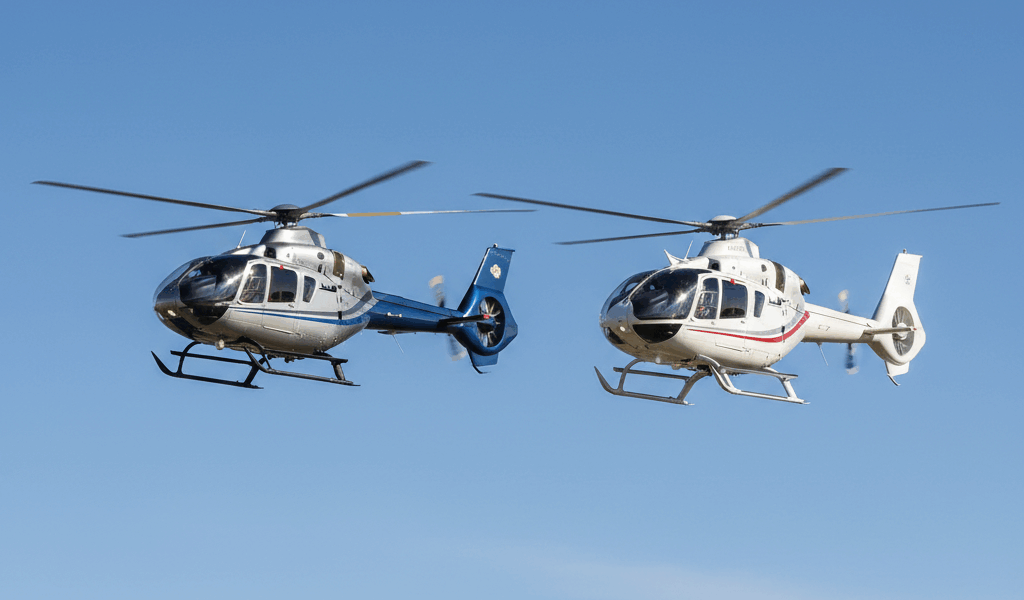
Shopping for a light turbine helicopter has gotten complicated with all the sales pitches flying around. As someone who’s spent time in both the Bell 505 and Robinson R66, I learned everything there is to know about what actually matters when you’re writing the check. Today, I will share it all with you.
## The Quick Answer
The Robinson R66 costs $1 million new and runs about $550-700/hour to operate. The Bell 505 costs $1.4-1.5 million and runs closer to $700-850/hour. That $400,000 price difference buys you better performance, a bigger cabin, and modern glass cockpit avionics. Whether that’s worth it depends entirely on your mission.
I know everyone wants a simple “this one’s better” answer. You won’t get that here because both helicopters excel at different things.
## Price: The $400,000 Question
Let’s start with the elephant in the hangar. A new Robinson R66 lists at right around $1 million. Pre-owned examples average $900,000. The Bell 505 lists at $1.445 million new, with used models averaging $1.5 million (they hold value well, apparently).
That’s a substantial gap. But the purchase price is just the beginning of your expenses.
## Operating Costs: Where It Gets Interesting
The R66 wins on operating costs, no question. Budget $55,000-70,000 annually at 100 flight hours, which works out to $550-700 per hour. Fixed costs run $18,000-24,000 yearly (insurance, hangar, annuals), with variable costs at $37,000-46,000 for 100 hours (fuel, oil, engine reserves).
The Bell 505 runs about 20% higher across the board. You’re looking at roughly $700-850 per hour, depending on how you fly it.
Where things get painful is major maintenance. The R66 requires complete factory teardown every 2,000 hours or 12 years. That service runs approximately $371,000. Yes, you read that right. It’s basically half the purchase price of the helicopter.
Bell hasn’t been around long enough for us to have solid long-term overhaul numbers on the 505. That makes me a bit nervous, honestly. Unknown costs are worse than known expensive ones.
## Performance: Speed vs Efficiency
The Bell 505 is noticeably faster. Cruise at 120-125 knots all day long. The R66 cruises around 110 knots, maybe 115 if you push it. That 10-15 knot difference adds up on longer trips.
Climb rate favors the Bell heavily. Under ideal conditions, the 505 climbs at 1,800-1,950 feet per minute. The R66 manages around 1,000 fpm at max weight. If you’re working in hot, high conditions, that extra climb performance is worth real money.
Range slightly favors the R66 with full tanks – about 260-350 nautical miles depending on conditions, compared to the Bell’s 306 nm. Both are adequate for typical light helicopter missions. Neither is going cross-country without fuel stops.
Service ceiling: Bell 505 reaches 18,610 feet. The R66 tops out around 14,000 feet. Most light helicopter work happens well below either ceiling, so this probably doesn’t matter unless you’re specifically working in high-altitude environments.
## Cabin Space: Inches Matter
Both helicopters seat five people total. But the Bell 505 cabin is legitimately bigger.
**Bell 505 cabin dimensions:**
– Length: 7.2 feet
– Width: 4.8 feet
– Height: 4.41 feet
– Volume: 99 cubic feet
**Robinson R66 cabin dimensions:**
– Length: 6.7 feet
– Width: 4.5 feet
– Height: 4.3 feet
– Volume: 98 cubic feet
Those differences sound tiny on paper. In real life, that extra 3 inches of width makes the Bell noticeably less cramped with four adults aboard. I’m 6’1″ and the R66 feels cozy. The 505 feels like I have elbow room.
The R66 does offer an 18-cubic-foot baggage compartment that holds 300 pounds. That’s legitimately useful for tour operations or personal travel.
## Payload Capacity
The Bell 505 carries a maximum payload of 680 kg (about 1,500 pounds). The Robinson R66 useful load is around 900 pounds, though this varies with options and fuel load.
Wait, that doesn’t match what you read earlier about the Bell having better payload. Here’s the thing: the numbers get complicated depending on whether you’re talking full fuel or tanks-full payload or maximum useful load. In practical terms, both helicopters carry four adults plus bags without issue. If you’re doing something weight-critical, run the actual numbers for your specific mission.
## Avionics: Old School vs Modern Glass
This is where the Bell 505 makes a strong case for that extra $400,000.
The 505 comes standard with the Garmin G1000H NXi – a full glass cockpit with synthetic vision, terrain awareness, traffic alerting, and all the modern goodies. It’s the same system you’ll find in high-end fixed-wing aircraft. Flying IFR? The 505 is equipped for it out of the box.
The Robinson R66 ships with more traditional steam gauges and basic avionics. You can upgrade to glass panels, but that’s extra money on top of the purchase price.
If you learned to fly in the 1990s or earlier, the R66 panel will feel familiar and comfortable. If you’re a younger pilot who trained on glass, the Bell makes more sense.
## Powerplants: Proven vs Powerful
The R66 uses the Rolls-Royce RR300, delivering 270 shaft horsepower. It’s proven, reliable, and burns Jet-A at about 23 gallons per hour.
The Bell 505 runs the Safran (formerly Turbomeca) Arrius 2R, rated at 505 horsepower. Yes, 505 HP in the model 505. Someone in marketing had fun with that.
More power means better performance, obviously. It also means burning more fuel. Both engines have solid reputations for reliability.
## Which One Should You Buy?
I hate giving non-answers, but it genuinely depends on your mission profile.
**Buy the Robinson R66 if:**
– You’re budget-conscious (relatively speaking – we’re still talking million-dollar helicopters)
– Your missions are mostly local, under 100 nm
– You prefer traditional instruments or you’re upgrading from an R44
– Lower operating costs matter more than maximum performance
– You’re okay with factory overhauls every 2,000 hours
**Buy the Bell 505 if:**
– You want the latest technology and full glass cockpit
– Performance matters – you operate in hot/high conditions or need that climb rate
– The larger cabin is worth the premium for your passengers
– You’re running a professional operation where the modern panel and autopilot features provide real value
– You can absorb the higher purchase price and operating costs
## The Real-World Usage
I see a lot of R66s doing utility work, training, light patrol, and personal flying. The operating economics make sense for smaller operators. Tour companies like them because the per-seat-mile costs work out favorably.
The Bell 505 shows up more often in professional operations where the modern avionics and better performance justify the premium. Corporate shuttles, high-end tours, EMS support roles (though you’d probably want something bigger for primary EMS), and operators who need IFR capability.
## Market Considerations
There are over 1,174 Robinson R66s flying worldwide. That’s a well-established fleet with known maintenance patterns, readily available parts, and lots of mechanics who know the aircraft.
The Bell 505 is newer to the market. Fewer flying examples means potentially longer wait times for specialized parts or service. On the flip side, you’re getting newer technology and modern systems.
Resale values? The R66 has a track record – expect reasonable depreciation typical of helicopters. The 505 seems to be holding value well so far, but we don’t have decades of data yet.
## The Decision Nobody Talks About
Here’s what I wish someone had told me when I was helicopter shopping: the purchase price difference matters less than you think over the life of the aircraft.
If you fly 100 hours annually, that $400,000 price gap represents 4-5 years of operating cost differences. If you’re flying 200 hours yearly, it’s 2-3 years. And if the Bell 505’s better performance lets you complete jobs faster or take contracts the R66 can’t handle, the math shifts entirely.
Figure out your actual mission requirements first. Then pick the helicopter that fits those requirements. Don’t buy based on specs or what looks cooler on the ramp.
## The Bottom Line
The Robinson R66 is the smart choice for cost-conscious operators who don’t need cutting-edge avionics or maximum performance. It’s proven, economical, and gets the job done.
The Bell 505 is the right call if you want modern systems, better performance, and are willing to pay for those advantages. The bigger cabin and glass cockpit aren’t just luxury features – they’re genuine operational benefits for many missions.
Both are excellent helicopters. The “better” one is whichever better fits your specific use case and budget. Boring answer, probably, but it’s the truth.
**Sources:**
– [AvBuyer: Robinson R66 vs Bell 505 Comparison](https://www.avbuyer.com/articles/helicopter-comparisons/robinson-r66-vs-bell-505-single-engine-turbine-helicopter-comparison-114166)
– [AIR.ONE: Bell 505 vs R66 Specifications](https://air.one/compare/bell-505-jetranger-x,robinson-helicopters-r66)
– [Wikipedia: Bell 505 Jet Ranger X](https://en.wikipedia.org/wiki/Bell_505_Jet_Ranger_X)
– [Aircraft Cost Calculator: Robinson R66 Operating Costs](https://www.aircraftcostcalculator.com/AircraftOperatingCosts/532/Robinson+R66+Turbine)
– [GlobalAir: Robinson R66 Specifications](https://www.globalair.com/aircraft-for-sale/specifications?specid=1203)



Stay in the loop
Get the latest aero weenie updates delivered to your inbox.